First record of the San Blas skate Dipturus garricki (Bigelow and Schroeder, 1958) in the Guatemalan Caribbean Sea
Authors: Julio Sánchez-Jiménez, Maria de Belen Chacón-Paz, Elisa M. Areano-Barillas, Juan Carlos Pérez-Jiménez, David A. Ebert.
Regional Studies in Marine Science 102 (2026), 105409.
DOI: 10.1016/j.rsma.2026.105409
Available online: 6 September 2026. Received: 8 May 2026. Revised: 24 July 2026. Accepted: 29 August 2026.
Affiliations
Julio Sánchez-Jiménez, Elisa M. Areano-Barillas and Juan Carlos Pérez-Jiménez: Fundación Mundo Azul, Km 21.5 carretera a Villa Canales, Guatemala.
Juan Carlos Pérez-Jiménez: El Colegio de la Frontera Sur, Av. Rancho Polígono 2-A, Ciudad Industrial, Lerma, Campeche CP. 24500, Mexico.
David A. Ebert: Pacific Shark Research Center, Moss Landing Marine Laboratories, San Jose State University, Moss Landing, CA, USA; South African Institute for Aquatic Biodiversity, Grahamstown, South Africa; Department of Ichthyology, California Academy of Sciences, San Francisco, CA, USA.
Corresponding author: Juan Carlos Pérez-Jiménez (jcperez@ecosur.mx).
Abstract
A San Blas skate (Dipturus garricki) was incidentally captured at a depth of ~260 m in the Guatemalan Caribbean Sea, ca. 11 km northeast of El Quetzalito. The immature female with a total length of 742 mm and disc width of 610 mm had morphological characteristics consistent with Dipturus garricki. This is the first record of this little-known skate in the western Caribbean region. This new record is significant due to the scarcity of records of this species along its distribution in the Western Atlantic (N = 19).
Keywords: skate; Rajidae; by-catch; deep-water; Cayman Trench; Guatemala.
Introduction
The San Blas skate, Dipturus garricki (Bigelow and Schroeder, 1958), is a medium-sized, deep-water demersal species, reaching up to 107 cm in total length (Ebert and Dando, 2024). It has a widespread but patchy distribution along the upper continental slopes at depths of 275–598 m in the Western Central and Southwest Atlantic, occurring in the Gulf of Mexico from Florida to Mexico and from Nicaragua to northern Brazil (Last et al., 2016; Crysler et al., 2020; Ebert and Dando, 2024). While no specific information is available on its interactions with fisheries, there is potential for it to be taken as bycatch in deep-water fisheries operating in the northern Gulf of Mexico and off northern South America. However, deep-sea fishing remains undeveloped across much of its range, and a significant portion of its geographic and depth distribution is not currently subject to fishing activities, therefore this species is assessed as Least Concern by the IUCN Red List of Threatened species (Crysler et al., 2020).
Despite the low fishing pressure on this species and other skates, which have received little research attention, concerns persist due to their life history traits, which may make them vulnerable to overexploitation (Ebert and Sulikowski, 2007). Information on the regional distribution, fisheries interactions, ecology, and biology of this species remains scarce. In the western Atlantic, the San Blas skate was described from the northern Gulf of Mexico by Bigelow and Schroeder (1958) based on two specimens collected in 1955 off northwestern Florida (Jones et al., 2020). Since that time only 19 records of this species have been documented with the most recent being 2012 from off northwestern Florida (Mckenzie, 2016). This study provides the first report of Dipturus garricki from the western Caribbean region and the first specimen collected in Guatemala.
Capture and specimen identification
A demersal skate (Order: Rajiformes) was caught by an artisanal fishing vessel (7.62 m long and outboard motor) from El Quetzalito, Guatemala on January 12, 2025 (Fig. 1). The skate was caught in the water column at ~260 m depth with a longline (100 circle hooks #18) in a fishing area called “El hoyo”. The area is located 11 km northeast of El Quetzalito near the margin of the Cayman Trench, with a 1000 m isobath. The Cayman Trench has the deepest zones of the entire Caribbean (with regions deeper than 6000 m), extending from the Gulf of Honduras to southeastern Cuba (Donnelly, 1994).
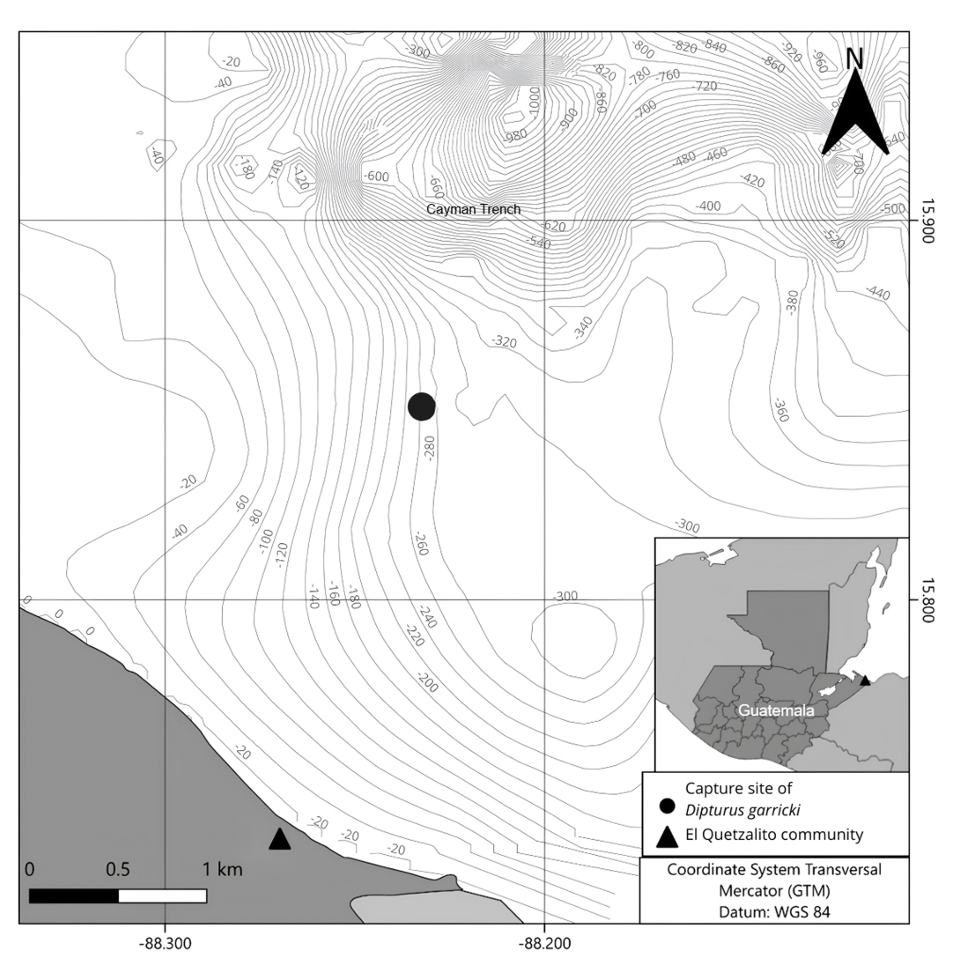
Figure 1. Approximate location of the capture site of Dipturus garricki (black circle) near the margin of the Cayman Trench in the Guatemalan Caribbean, and the location of the El Quetzalito fishing community (black triangle), where the specimen was landed. Bathymetric contours (m) are shown to illustrate the deep-water environment. The inset indicates the location of the study area within Guatemala.
The specimen was taxonomically identified following Last et al. (2016), and 26 morphometric measurements were taken (Table 1) for its characterization using keys, descriptions, and illustrations provided by Castillo-Geniz et al. (2007). The specimen was deposited at the Centro de Estudios del Mar y Acuicultura (CEMA) collection of the Universidad de San Carlos de Guatemala (USAC) under reference number 235.
Specimen characteristics
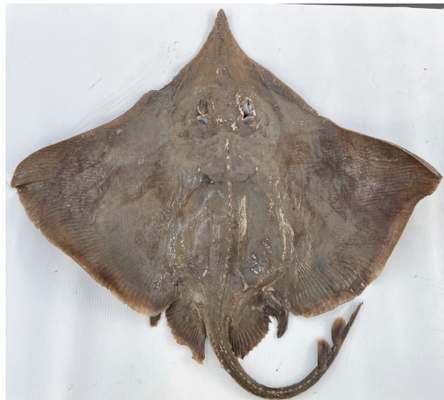
Visual observation of the specimen revealed key diagnostic characteristics consistent with the San Blas skate D. garricki (Bigelow and Schroeder, 1958), a species belonging to the family Rajidae. The caught individual had three rows of thorns on the tail, a median row of thorns on the dorsal disc from nuchal region to tail, two shoulder thorns on each side of the median row of thorns, and was uniformly brown dorsally and brown ventrally. The specimen was an immature female 792 mm TL and 620 mm DW weighing 2.27 kg (Fig. 2). The skate had six unripe oocytes 35 mm in diameter, well-developed oviducal glands (48 and 43 mm in diameter), and an undeveloped uteri 20 mm in width. The data suggest the specimen was a sub-adult.
Editorial note on the source: the abstract and Table 1 report 742 mm total length and 610 mm disc width; the descriptive paragraph reports 792 mm and 620 mm, respectively. The original Figure 2 caption also reports 742 mm. Values are retained as reported in each section; this discrepancy has not been resolved.
Figure 2a. Dorsal view of the immature female Dipturus garricki. The original figure caption reports 742 mm TL.
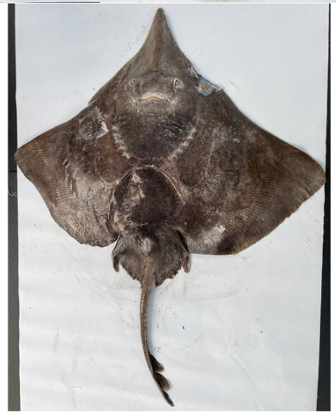
Figure 2b. Ventral view of the same Dipturus garricki specimen.
Table 1. Morphometric measurements
Morphometric measurements of Dipturus garricki from the Caribbean Sea of Guatemala. Measurements were taken following Castillo-Geniz et al. (2007). Values are reproduced as shown in the original table.
| Measurement | Measurement (mm) | % TL |
|---|---|---|
| Total length (TL) | 742 | — |
| Disc width (DW) | 610 | 82.21 |
| Disc length (DL) | 475 | 64.02 |
| Snout to maximum width (SMW) | 295 | 39.76 |
| Anterior pectoral length (APECL) | 430 | 57.95 |
| Posterior pectoral length (PPL) | 280 | 37.73 |
| Preorbital length (PORBL) | 165 | 22.24 |
| Interorbital distance (IOD) | 70 | 9.43 |
| Orbital diameter (OD) | 20 | 2.69 |
| Spiracle length (SL) | 22 | 2.96 |
| Interspiracular distance (ISD) | 55 | 7.41 |
| Prenasal length (PNL) | 145 | 19.54 |
| Preoral length (PORAL) | 171 | 23.04 |
| Internarial length (INL) | 80 | 10.78 |
| Mouth width (MW) | 70 | 9.43 |
| Distance between first gill openings (D1GO) | 135 | 18.19 |
| Distance between fifth gill openings (D5GO) | 80 | 10.78 |
| Distance - snout to cloaca (DSC) | 447 | 60.24 |
| Anterior pelvic lobe length (APELL) | 89 | 11.99 |
| Posterior internal pelvic lobe length (PIPL) | 48 | 6.47 |
| Maximum distance between pelvic fins (DPF) | 193 | 26.01 |
| Distance cloaca to 1st dorsal fin (C1D) | 194 | 26.14 |
| Distance cloaca to 2nd dorsal fin (C2D) | 230 | 30.99 |
| 1st dorsal fin base (1DF) | 31 | 4.18 |
| 2nd dorsal fin base (2DF) | 32 | 4.31 |
| Distance cloaca to caudal tip (DCC) | 302 | 40.70 |
Distribution and significance of the record
Records of this species are scarce. Between 1951 and 2012, only 19 specimens were documented in ichthyological collections, primarily from the northern Gulf of Mexico, with just two records from the Caribbean Sea (Nicaragua and Colombia) (Supplementary Table S1). Before this study, biological data were available for only four specimens: two males measuring 975 mm and 1019 mm TL, and two individuals of undetermined sex measuring 590 mm and 750 mm TL. The two males represent the holotype and paratype described by Bigelow and Schroeder (1958) (Supplementary Table S2). In addition to the presence of D. garricki in Guatemala, the USA, Colombia, and Nicaragua, Ehemann et al. (2019) reported it in Venezuela, and Del Moral-Flores et al. (2016) documented its presence in Mexico.
The significance of the record of D. garricki in the Guatemalan Caribbean lies in the limited number of documented occurrences, the species’ patchy distribution, and the lack of biological data available. Improving our understanding of the diversity and distribution of Rajidae in the Caribbean Sea is particularly important, as the region supports relatively low richness for this family, comprising only 13 species across six genera, compared to the 161 species and 18 genera reported worldwide (Last et al., 2016; Ebert, 2022; Fricke and Fong, 2026).
The limited reports of D. garricki in the Caribbean Sea suggest that encounter rates in fisheries remain low. However, expanding coastal fisheries into deeper waters poses an emerging threat to vulnerable deep-water elasmobranch assemblages, both as targeted catch and bycatch (Baremore et al., 2021; Talwar et al., 2022). Therefore, addressing species-specific data gaps is essential to accurately assess the species’ vulnerability to overexploitation and inform regional management and conservation strategies (Siskey et al., 2018).
Ethics approval
All research activities were conducted under permit Bno.1048, issued by Consejo Nacional de Areas Protegidas (CONAP).
Abbreviations
TL, total length; km, kilometer; m, meter; cm, centimeter; mm, millimeter; kg, kilogram.
CRediT authorship contribution statement
Julio Sánchez-Jiménez: Writing – review & editing, Methodology, Investigation, Data curation. Belen Chacón Paz: Writing – review & editing, Methodology, Investigation, Data curation. Elisa M. Areano-Barillas: Writing – review & editing, Supervision, Funding acquisition. Juan Carlos Pérez-Jiménez: Writing – original draft, Investigation, Formal analysis, Conceptualization. David A. Ebert: Writing – review & editing, Validation, Supervision, Investigation.
Consent for publication
Not applicable.
Authors’ contributions
JS, BC: fieldwork logistics and supervision; JS: fishery monitoring, recording of morphometric data; EA: funding acquisition, supervision; JCPJ: conceptualization, writing the original draft; DAE: writing-reviewing and editing. All the authors reviewed, edited, and approved the manuscript before submission.
Funding
Rufford Foundation and The Summit Foundation provided funding for the elasmobranch monitoring project.
Declaration of Competing Interest
The authors declare that they have no known competing financial interests or personal relationships that could have appeared to influence the work reported in this paper.
Acknowledgments
Fundación Mundo Azul gratefully acknowledges the fishers from El Quetzalito, Leonardo Zaldívar, Ever Ayala, Josué Ayala, and Eliberto Pineda, for their support in monitoring elasmobranch landings, as well as the Consejo Nacional de Áreas Protegidas (CONAP) for granting the permits required to conduct this research. We thank Kathryn Flowers for her assistance in the morphological identification of the specimen and contributions reviewing and editing the paper. Grants from the Rufford Foundation and The Summit Foundation funded this project.
Appendix A. Supporting information
Supplementary data associated with this article can be found in the online version at doi:10.1016/j.rsma.2026.105409.
Data availability
Data will be made available on request.
References
Baremore, I.E., Graham, R.T., Matthew, J.W., 2021. Fishing down the reef slope: characteristics of the nearshore deepwater fisheries of MesoAmerica. Ocean. Coast. Manag. 211, 105773.
Bigelow, H.B., Schroeder, W.C., 1958. Four new rajids from the Gulf of Mexico. Bull. Mus. Comp. Zool. 119 (2), 201–233.
Castillo-Geniz, J.L., Sosa-Nishizaki, O., Pérez-Jiménez, J.C., 2007. Morphological variation and sexual dimorphism in the California skate, Raja inornata Jordan and Gilbert, 1881 from the Gulf of California, Mexico. Zootaxa 1545, 1–16. https://doi.org/10.11646/zootaxa.1545.1.1
Crysler, Z., Lasso-Alcalá, O., Mejía-Falla, P.A., Navia, A.F., Rincon, G., Kyne, P.M., Herman, K., 2020. Dipturus garricki. The IUCN Red List of Threatened Species 2020: e.T161565A124507607. https://dx.doi.org/10.2305/IUCN.UK.2020-3.RLTS.T161565A124507607.en. Accessed on 24 April 2026.
Del Moral-Flores, L.F., Morrone, J.J., Alcocer, J., Pérez-Ponce de León, G., 2016. Diversidad y Afinidades Biogeográficas de Los Tiburones, Rayas y Quimeras (Chondrichthyes: Elasmobranchii, Holocephali) de México. Revista de Biología Tropical 64, 1469–1486. http://www.redalyc.org/articulo.oa?id=44947539009
Donnelly, T.W., 1994. The Caribbean sea floor. In: Donovan, K., Jackson, T.A. (Eds.), Caribbean Geology: An Introduction. Univ. of the West Indies Publ. Assoc, Kingston, pp. 41–64.
Ebert, D.A., 2022. Caliraja gen. nov., a new skate genus (Rajiformes: Rajidae) from the eastern North Pacific. Revista de Biología Marina y Oceanografía 57, 271–275.
Ebert, D.A., Dando, M., 2024. Field Guide to Sharks, Rays, & Chimaeras of the East Coast of North America. Princeton University Press, p. 430.
Ebert, D.A., Sulikowski, J.A., 2007. Preface: biology of skates. Environ. Biol. Fish. 80, 107–110. https://doi.org/10.1007/s10641-007-9244-3
Ehemann, N.R., González-González, L.D.V., Tagliafico, A., Weigmann, S., 2019. Updated taxonomic list and conservation status of chondrichthyans from the exclusive economic zone of Venezuela, with first generic and specific records. J. Fish Biol. 95, 753–771. https://doi.org/10.1111/jfb.14061
Fricke, R., Fong, J.D., 2026. Species by family/subfamily. http://researcharchive.calacademy.org/research/ichthyology/catalog/SpeciesByFamily.asp. Electronic version accessed 23 April 2026.
Jones, C.M., Driggers, W.B.I., Hannan, K.M., Hoffmayer, E.R., Jones, L.M., Raredon, S.J., 2020. An annotated checklist of the chondrichthyan fishes inhabiting the northern Gulf of Mexico Part 1: Batoidea. Zootaxa 4803 (2), 281–315. https://doi.org/10.11646/zootaxa.4803.2.3
Last, P.R., White, W.T., de Carvalho, M.R., Séret, B., Stehmann, M.F.W., Naylor, G.J.P., 2016. Rays of the World. CSIRO Publishing. Comstock Publishing Associates, Ithaca, New York, Clayton, Victoria, Australia, p. 790.
Mckenzie, R., 2016. FSUCML Zoological Collections. Florida State University Coastal and Marine Laboratory. Occurrence dataset https://doi.org/10.15468/zr2798 accessed via GBIF.org on 2026-03-22. https://www.gbif.org/occurrence/1257407049
Siskey, M.R., Shipley, O.N., Frisk, M.G., 2018. Skating on thin ice: identifying the need for species-specific data and defined migration ecology of Rajidae spp. Fish Fish. 20 (2), 286–302.
Talwar, B.S., Anderson, B., Avalos-Castillo, C.G., et al., 2022. Extinction risk, reconstructed catches and management of chondrichthyan fishes in the Western Central Atlantic Ocean. Fish Fish. 23 (5), 1150–1179.
Original publication
Sánchez-Jiménez, J., Chacón-Paz, M. de B., Areano-Barillas, E. M., Pérez-Jiménez, J. C., & Ebert, D. A. (2026). First record of the San Blas skate Dipturus garricki (Bigelow and Schroeder, 1958) in the Guatemalan Caribbean Sea. Regional Studies in Marine Science, 102, 105409.
https://doi.org/10.1016/j.rsma.2026.105409
© 2026 The Author(s). Published by Elsevier B.V. The original article is open access under the CC BY-NC-ND 4.0 license.