Nursery areas for a critically endangered hammerhead shark in the Guatemalan Pacific
Nursery areas for a critically endangered hammerhead shark in the Guatemalan Pacific
Julio Sánchez-Jiménez1 | María de los Rosales-Melgar1 | Elisa Areano1 | Ana C. Hernández1 | Omar Santana-Morales1 | Juan C. Pérez-Jiménez1,2
1 Fundación Mundo Azul, Guatemala, Guatemala
2 El Colegio de la Frontera Sur, Campeche, Mexico
Correspondence: Juan C. Pérez-Jiménez, El Colegio de la Frontera Sur, CP. 24500, Lerma, Campeche, México. Email: jcperez@ecosur.mx
Funding information: Rufford Foundation; PADI Foundation; Waitt Foundation; Shark Conservation Fund; Luis von Ahn Foundation
Abstract
The scalloped hammerhead (Sphyrna lewini) is the shark most frequently landed in Guatemalan artisanal fisheries. From 2017 to 2023, fishery-dependent monitoring recorded 10,000 individuals across three fishing communities. Neonates represented the largest proportion (n = 5860), followed by young of the year (YOY, n = 3929) and significantly fewer juveniles (n = 183) and adults (n = 28). Seasonal patterns were evident, with neonates (84%) and YOY (67.5%) peaking between May and August. The data suggest that neonates and YOY are prevalent seasonally and annually in the three coastal areas.
Keywords
artisanal fisheries, fishery management, Guatemala, neonate, nursery habitat, Sphyrna lewini, YOY
The scalloped hammerhead, Sphyrna lewini (Griffith & Smith 1834), was recently reassessed as Critically Endangered by the IUCN (Rigby et al., 2019) and listed in CITES Appendix II (CITES, 2019). This species is the most frequently caught shark in Guatemalan Pacific waters, raising significant concerns as neonates and early juveniles have historically been captured in coastal areas (Avalos-Castillo & Santana-Morales, 2021; Ruíz Alvarado & Mijangos López, 1999; Ixquiac Cabrera et al., 2009). Avalos-Castillo and Santana-Morales (2021) observed the persistent presence of early life-history stages from 2017 to 2020, suggesting that these coastal regions may fulfil the criteria Heupel et al. (2007) established for identifying shark nursery areas.
Unfortunately, these areas are also important fishing grounds. For instance, artisanal fishing activities in the Guatemalan Pacific occur year-round without restrictions or seasonal closures (Avalos-Castillo & Santana-Morales, 2021), creating challenges for shark conservation. Recognising this issue, the National Plan of Action for Sharks, Rays, and Chimaeras (NPOA-Guatemala; MAGA, 2021) identified the delineation of shark nurseries as a priority research objective to promote their protection. This study aimed to analyse the temporal and spatial occurrences of neonates and young of the year (YOY) scalloped hammerheads along the Guatemalan Pacific coast using fishery-dependent data to identify areas potentially serving as nurseries.
Landing records of scalloped hammerheads were collected from three fishing communities along the Guatemalan Pacific coast. Monitoring surveys were conducted from May 2017 to February 2020 by trained biologists from Fundación Mundo Azul (Blue World Foundation), although monitoring in Buena Vista began in 2019. From March 2020 to June 2023, data collection was conducted by biologists and primarily through a Citizen Science programme, with the participation of trained community monitors. In this study, no experiments with animals were performed. Scalloped hammerheads were collected as part of fishery-dependent surveys, therefore all examinations were made on deceased animals captured during commercial fishing operations.
Over 1476 days of monitoring, fishery-dependent data were collected from the landings of 52 artisanal boats across the three fishing communities. These boats, made of fibreglass and measuring 7.5–9 m long, were equipped with outboard motors. The fisheries targeted teleost fish and rays using bottom and midwater monofilament gillnets (mesh sizes 4–6 cm) or bottom longlines with J or Eagle Claw half circle hooks (3–6 cm in size).
Scalloped hammerheads were measured to the nearest centimetre using total length (LT), defined as the horizontal distance from the tip of the snout to the tip of the caudal fin in its natural position (Compagno, 1984). Sex was determined macroscopically according to the presence or absence of claspers on the pelvic fins. Sharks were categorised into four life stages: (1) neonates (Ne), identified by the presence of an unhealed or healing umbilical scar (Castro, 1993); (2) young of the year (YOY), characterised by a healed umbilical scar and classified as individuals within their first year of life based on the von Bertalanffy growth curve by Piercy et al. (2007); (3) juvenile (J) sharks older than a year but not yet sexually mature; and (4) adults (A) in males when claspers were fully calcified (Clark & Schmidt, 1965), and females considered mature if pregnant or, if not pregnant, measuring over 245 cm TL (Castro, 2011).
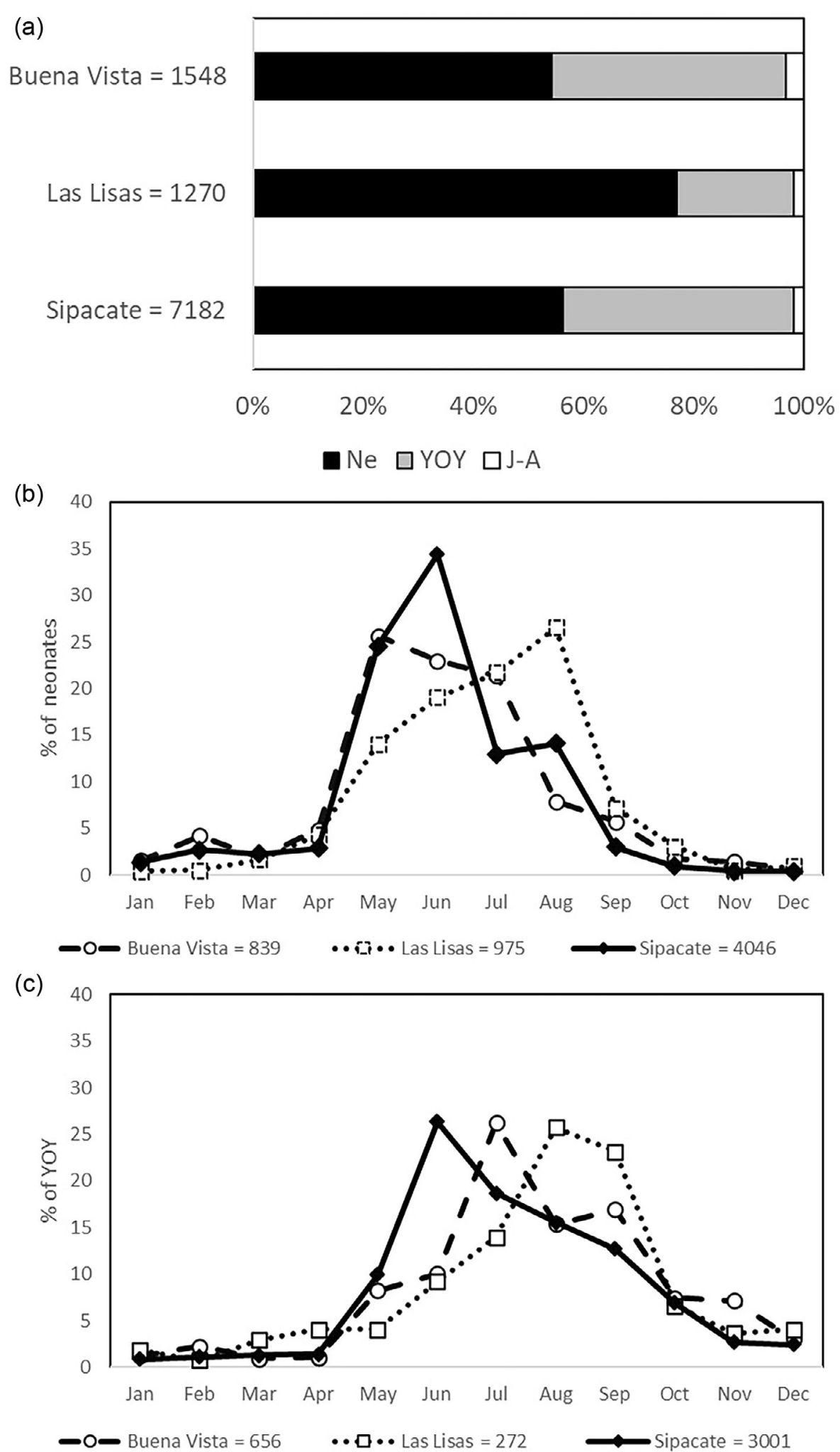
FIGURE 1 Proportions of early life history stages of scalloped hammerhead (Sphyrna lewini) recorded during the landing monitoring programme from 2017 to 2023 in the fishing communities of Buena Vista, Las Lisas and Sipacate on the Pacific coast of Guatemala. (a) Overall percentage distribution of neonates (Ne), young of the year (YOY), and combined juveniles and adults (J-A) across fishing communities. (b) Monthly percentage distribution of neonates across fishing communities. (c) Monthly percentage distribution of young of the year (YOY) across fishing communities. The total number of recorded specimens is shown next to each community’s name.
TABLE 1 Annual records of neonates and young of the year scalloped hammerheads (Sphyrna lewini) from the landing monitoring programme in the fishing communities of Buena Vista, Las Lisas and Sipacate on the Pacific coast of Guatemala.
| 2017 | 2018 | 2019 | 2020 | 2021 | 2022 | 2023 | Total | |
|---|---|---|---|---|---|---|---|---|
| Neonates | ||||||||
| Buena Vista | 93 | 13 | 94 | 347 | 292 | 839 | ||
| Las Lisas | 122 | 46 | 103 | 339 | 207 | 67 | 91 | 975 |
| Sipacate | 36 | 71 | 332 | 1887 | 449 | 659 | 612 | 4046 |
| Total | 158 | 117 | 528 | 2239 | 750 | 1073 | 995 | 5860 |
| Young of the year | ||||||||
| Buena Vista | 50 | 40 | 437 | 129 | 656 | |||
| Las Lisas | 22 | 18 | 7 | 82 | 52 | 69 | 22 | 272 |
| Sipacate | 44 | 43 | 159 | 1718 | 265 | 448 | 324 | 3001 |
| Total | 66 | 61 | 216 | 1800 | 357 | 954 | 475 | 3920 |
A total of 10,000 scalloped hammerheads were recorded across the three fishing communities. Neonates were the most frequently observed life stage (n = 5860), followed by YOY (n = 3929), with juveniles (n = 183) and adults (n = 28) representing a small fraction of the total. Neonates and YOY collectively accounted for over 96% of all records across the communities (Figure 1a). The size range and mean in cm LT (mean ± standard deviation) for each stage were as follows: neonates ranged from 33.0 to 54.4 (50.2 ± 2.8), YOY ranged from 54.1 to 87.0 (62.9 ± 7.9), juveniles ranged from 87.3 to 144.0 (94.6 ± 7.9) and adults ranged from 179.0 to 284.0 (247.7 ± 27.5).
Neonates and YOY were recorded in all years across the three fishing communities, except for 2017 and 2018 in Buena Vista, where monitoring efforts were absent. The majority of neonate and YOY records were obtained between 2020 and 2023, with 5057 neonates (86.3%) and 3586 YOY (91.3%) (Table 1). This significant increase is attributed to the intensified monitoring efforts implemented through the Citizen Science programme.
The highest percentage of monthly neonate records was observed between May and August (Figure 1b), while YOY records peaked between June and September (Figure 1c). In April–June, neonates represented 84.1% and YOY 67.5% of their total annual records. Specifically, during this period neonate records accounted for over 77% of the total neonate records in all three communities: Buena Vista (77.8%), Las Lisas (81.4%) and Sipacate (85.9%). Similarly, in the same period, YOY records comprised more than 52% of the total YOY records for each community: Buena Vista (59.9%), Las Lisas (52.9%) and Sipacate (70.5%). In July–September, YOY records were distributed as follows: 34.6% in Buena Vista, 37.5% in Las Lisas and 24.8% in Sipacate. The data indicate that neonates and YOY are consistently present both seasonally and annually across the three coastal areas, aligning with the criteria established by Heupel et al. (2007).
The present study used fishery-dependent data collected through a Citizen Science programme to analyse the temporal patterns of the early-stage scalloped hammerhead sharks. While Heupel et al. (2007) emphasised the importance of using fishery-independent data to effectively identify nursery habitats, such data with sufficient temporal and spatial coverage are often lacking (Froeschke et al., 2010), particularly in regions like the Guatemalan Pacific. One of the advantages of utilising a Citizen Science programme is the broad coverage of fishing effort, enabling the analysis of seasonal and annual catch records across multiple fishing communities. Also, the findings confirm that, as shown by Oñate-González et al. (2017) and Cuevas-Gómez et al. (2020), fishery-dependent monitoring can effectively provide data to identify nursery areas in coastal regions where fishery-independent data are limited or unavailable.
The findings indicated a tendency for higher numbers of neonates and YOY to be recorded in Sipacate. Located on the central coast of Guatemala, Sipacate is approximately 43 km from Buena Vista and 97 km from Las Lisas. While the general characteristics of the three studied coastal areas are similar, with shallow, turbid waters and slightly uneven mud and sand bottoms (Brenes et al., 1993; Ixquiac Cabrera et al., 2009), Sipacate stands out for its broader shallow habitat. The 20- and 50-m isobaths are farther from the shore at Sipacate compared to Buena Vista and Las Lisas. This greater habitat amplitude is significant, as nursery areas typically occur at depths of 10–50 m, with a preference for 20 m depths (Ixquiac Cabrera et al., 2009). Additionally, the coastal area between Buena Vista and Las Lisas is narrower and features a deep canyon that drops to over 500 m.
Guatemala published the National Plan of Action for Sharks, Rays and Chimaeras (NPOA-Guatemala) in 2008, recently updated in 2021 (MAGA, 2021). Among its priority research topics, the NPOA emphasizes identifying nursery areas as a critical step for implementing effective protection measures. Defining these areas is essential, particularly for supporting the establishment of fish replenishment zones (FRZ), such as in the coastal region of Las Lisas (Mojica et al., 2021). This study underscores the need for each community to establish its own FRZ to protect the early life stages of the scalloped hammerhead. Protecting these nurseries is crucial, as Elizondo-Sancho et al. (2022) demonstrated limited gene flow between nursery areas in Guatemala, Costa Rica and Panama, with the species exhibiting reproductive philopatry, resulting in genetically independent units.
Author contributions
Julio Sánchez-Jiménez, Ana C. Hernández and Omar Santana-Morales: Conceptualisation, methodology, data collection, writing – review and editing, visualisation. María de los Rosales-Melgar and Elisa Areano: Funding acquisition, project administration, supervision, writing – review and editing. Juan C. Pérez-Jiménez: Conceptualisation, formal analysis, investigation, writing – original draft, writing – review and editing, visualisation.
Acknowledgements
We thank the fishers of the artisanal fleet from Buena Vista, Las Lisas and Sipacate. Special thanks to Fidel Hernández, Yessica Hernández, Edwin Segovia, Manuel Zelada, Hugo Martínez and Franklin Léon for their participation in the Citizen Science programme.
Funding information
Funding was provided by the Rufford Foundation, the PADI Foundation, the Waitt Foundation, the Shark Conservation Fund and the Luis von Ahn Foundation.
ORCID
Julio Sánchez-Jiménez https://orcid.org/0000-0002-7258-1700
References
- Avalos-Castillo, C. G., & Santana-Morales, O. (2021). Characterization of the artisanal elasmobranch fisheries off the Pacific coast of Guatemala. Fishery Bulletin, 119, 3–9. https://doi.org/10.7755/FB.119.1.2
- Brenes, C. L., León, S., Gutiérrez, A., & Arroyo, G. (1993). Algunos aspectos oceanográficos de la Plataforma Pacífica de Centro América. Revista Geofísica, 38, 141–158.
- Castro, J. I. (1993). The shark nursery of Bulls Bay, South Carolina, with a review of the shark nurseries of the southeastern coast of the United States. Environmental Biology of Fishes, 38, 37–48. https://doi.org/10.1007/BF00842902
- Castro, J. I. (2011). The sharks of North America. Oxford University Press.
- CITES. (2019). Appendices I, II and III valid from 26 November 2019. https://cites.org/eng/app/appendices.php [Accessed 4 April 2020]
- Clark, E., & von Schmidt, K. (1965). Sharks of the central gulf coast of Florida. Bulletin of Marine Science, 15, 13–83.
- Compagno, L. J. V. (1984). Sharks of the world. An annotated and illustrated catalogue of shark species known to date. Part 2. FAO Fisheries Synopsis, 125, 251–655.
- Cuevas-Gómez, A. G., Pérez-Jiménez, J. C., Méndez-Loeza, I., Carrera-Fernández, M., & Castillo-Geniz, J. L. (2020). Identification of a nursery area for the critically endangered hammerhead shark (Sphyrna lewini) amid intense fisheries in the southern Gulf of Mexico. Journal of Fish Biology, 97(4), 1087–1096. https://doi.org/10.1111/jfb.14471
- Elizondo-Sancho, M., Rodríguez-Arriatti, Y., Albertazzi, F. J., Bonilla-Salazar, A., Arauz-Naranjo, D., Arauz, R., Areano, E., Avalos-Castillo, C. G., Brenes, O., Chávez, E. J., Dominici-Arosemena, A., Espinoza, M., Heidemeyer, M., Tavares, R., & Hernández, S. (2022). Population structure and genetic connectivity of the scalloped hammerhead shark (Sphyrna lewini) across nursery grounds from the Eastern Tropical Pacific: Implications for management and conservation. PLoS One, 17(12), e0264879. https://doi.org/10.1371/journal.pone.0264879
- Froeschke, J. T., Stunz, G. W., Sterba-Boatwright, B., & Wildhaber, M. L. (2010). An empirical test of the “shark nursery area concept” in Texas bays using a long-term fisheries-independent data set. Aquatic Biology, 11, 65–76. https://doi.org/10.3354/ab00290
- Heupel, M. R., Carlson, J. K., & Simpfendorfer, C. A. (2007). Review. Shark nursery areas: Concepts, definition, characterization and assumptions. Marine Ecology Progress Series, 337, 287–297. https://doi.org/10.3354/MEPS337287
- Ixquiac Cabrera, M. J., Franco Arenales, I., Tejeda Velásquez, C. A., Sánchez Rodas, M. R., & Sikahall Prado, J. A. (2009). Áreas de crianza del Pacífico de Guatemala: Herramienta para el manejo y aprovechamiento sostenido del recurso tiburón. Proyecto Fodecyt 13-2006, 48 p. Cent. Estud. Mar Acuic., Univ. San Carlos Guatemala, Guatemala City, Guatemala. http://biblioteca.usac.edu.gt/tesis/24/24_0271.pdf
- MAGA. (2021). Plan de acción nacional para la ordenación y conservación de tiburones, rayas y quimeras de Guatemala. Acuerdo Ministerial no. 280-2021, 2 p. Minist. Agric. Ganad. Aliment., Guatemala City, Guatemala. https://www.maga.gob.gt/download/plan-de-accion-tiburones-guatemala.pdf
- Mojica, A., Giró, A., Areano, E., Avalos, C., Acevedo, M. F., & Sánchez, J. (2021). Propuesta de actualización para la Zona de Recuperación de Pesca del Área de Conservación Las Lisas. ICIAAD - PPD, Pixan’Ja, Fundación Mundo Azul, Iniciativa Arrecifes Saludables, p. 96.
- Oñate-González, E. C., Sosa-Nishizaki, O., Herzka, S. Z., Lowe, C. G., Lyons, K., Santana-Morales, O., Sepúlveda, C., Guerrero-Ávila, C., García-Rodríguez, E., & O’Sullivan, J. B. (2017). Importance of Bahia Sebastian Vizcaino as a nursery area for white sharks (Carcharodon carcharias) in the Northeastern Pacific: A fishery dependent analysis. Fisheries Research, 188, 125–137. https://doi.org/10.1016/j.fishres.2016.12.014
- Piercy, A. N., Carlson, J. K., Sulikowski, J. A., & Burgess, G. H. (2007). Age and growth of the scalloped hammerhead shark, Sphyrna lewini, in the north-west Atlantic Ocean and Gulf of Mexico. Marine and Freshwater Research, 58, 34–40. https://doi.org/10.1071/MF05195
- Rigby, C. L., Dulvy, N. K., Barreto, R., Carlson, J., Fernando, D., Fordham, S., Francis, M. P., Herman, K., Jabado, R. W., Liu, K. M., Marshall, A., Pacoureau, N., Romanov, E., Sherley, R. B., & Winker, H. (2019). Sphyrna lewini. The IUCN Red List of Threatened Species 2019: e.T39385A2918526. https://www.iucnredlist.org/species/39385/2918526 [accessed: 10 April 2020]
- Ruíz Alvarado, C. L., & Mijangos López, N. (1999). Estudio sobre la pesquería del tiburón en Guatemala. In R. Shotton (Ed.), Case studies of the management of elasmobranch fisheries (pp. 174–198). FAO Fisheries Technical Paper 378, part 1. FAO.
How to cite this article
Sánchez-Jiménez, J., de los Rosales-Melgar, M., Areano, E., Hernández, A. C., Santana-Morales, O., & Pérez-Jiménez, J. C. (2025). Nursery areas for a critically endangered hammerhead shark in the Guatemalan Pacific. Journal of Fish Biology, 1–4. https://doi.org/10.1111/jfb.70023