New records and morphometry of the Atlantic sixgill shark Hexanchus vitulus in the Caribbean coast of Guatemala
Abstract
The present study constitutes the first records and morphometry of Hexanchus vitulus on the Caribbean coast of Guatemala. A total of 10 Atlantic sixgill sharks were captured by artisanal fishers during 2015–2019, showing a sex ratio of 2.3:1 (males:females) and a total length ranging from 61–165 cm. Morphometric measurements are provided for future comparisons in other coastal regions. Recorded sharks corresponded mostly to sexually mature individuals, which differs from that reported for different areas of the Caribbean.
Keywords: Hexanchiformes; measurements; distribution; segregation; deep-sea species; Central America.
Introduction
The Atlantic sixgill shark Hexanchus vitulus Springer & Waller, 1969 is one of the three species of the genus Hexanchus, together with the bluntnose sixgill shark H. griseus (Bonnaterre, 1788) and the bigeye sixgill shark H. nakamurai Teng, 1962. In previous decades, H. nakamurai and H. vitulus were recognised as the same species; however, recent genetic studies have suggested divergence between both taxa.
In the Caribbean Sea, knowledge of H. vitulus and other deep-sea sharks is scarce because they are infrequently captured by local artisanal fishers. Although there are occasional records in Belize, Colombia, Venezuela and the Dutch Caribbean, there was no information about its presence in Guatemalan waters or its morphometry in any Caribbean locality. This study reports the first records and morphometric data for H. vitulus in Guatemala, to support future comparisons with specimens caught in other regions.
Methods
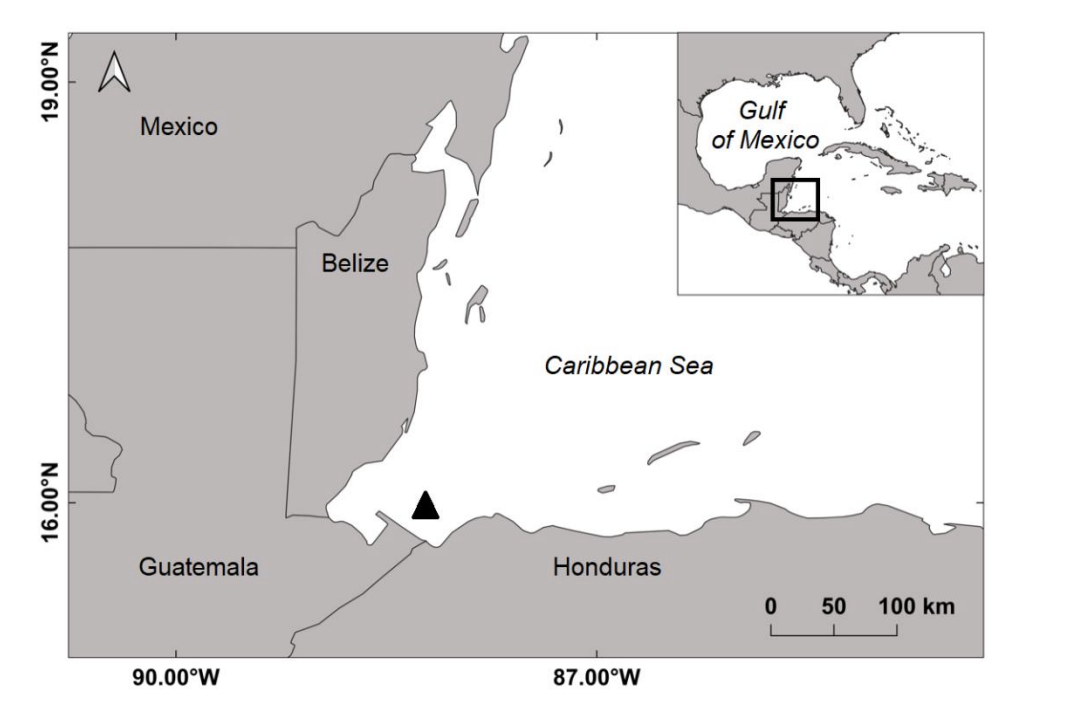
A total of 10 sixgill sharks were captured 80 km offshore from the port of El Quetzalito (15°44′25″N; 88°16′27″W) by artisanal Guatemalan fishers. The date of capture, fishing gear, bait, sex, total length (TL), precaudal length (PL) and fork length (FL) were recorded for every shark. Taxonomic identification followed the descriptions published by Compagno et al. (2005) and Daly-Engel et al. (2019).
Figure 1. Location site (▲) where the specimens of Hexanchus vitulus were captured in the Guatemalan Caribbean during 2015–2019.
Results and discussion
All specimens were identified as H. vitulus based on the presence of six gills, a slender body with brown dorsal and white ventral coloration, a narrow head and mouth, anterior serrations on the lower teeth, and large eyes. These characteristics are also described for H. nakamurai, as H. vitulus is considered a cryptic species with no evident external differences.
Specimens ranged from 61–165 cm TL, with a mean of 142 ± 29 cm TL. All captured sharks were mature individuals except for one juvenile female caught in 2015. The sex ratio was 2.3:1 (males:females) and 90% of the sharks were mature. A total of 82 measurements were obtained from the last individual, a mature male caught in June 2019.
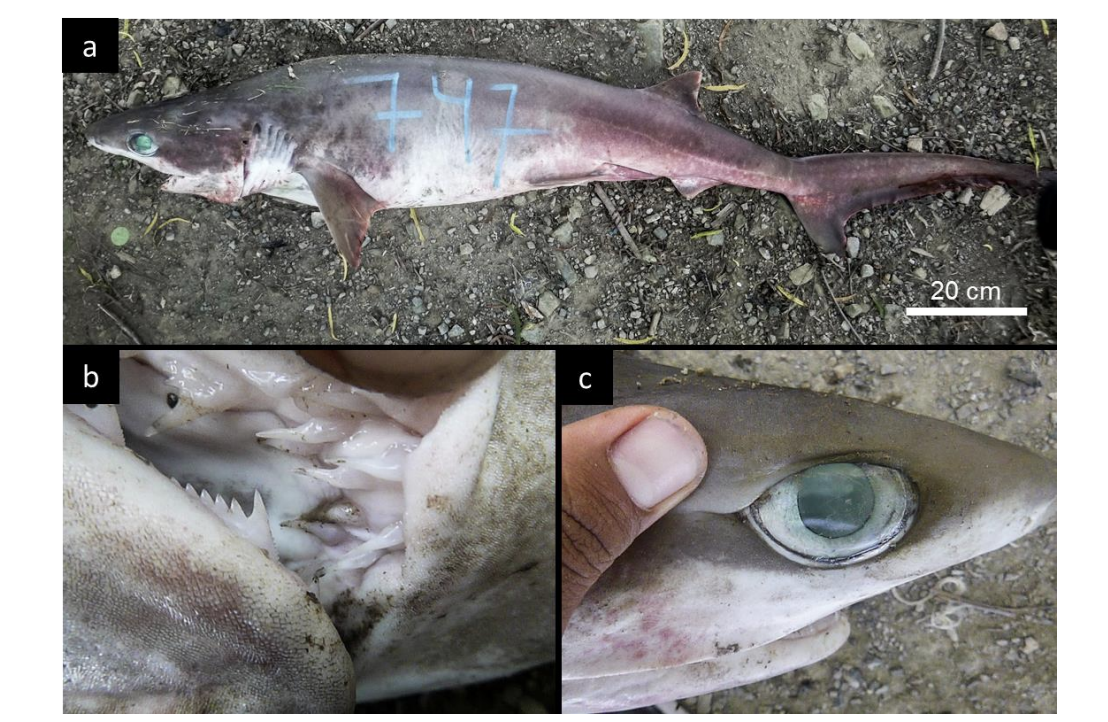
Figure 2. One of the 10 Atlantic sixgill sharks Hexanchus vitulus captured in the Guatemalan Caribbean during 2015–2019: a) full body showing one dorsal fin and six-gill slits, b) upper and lower comb-shaped teeth, c) large eyes.
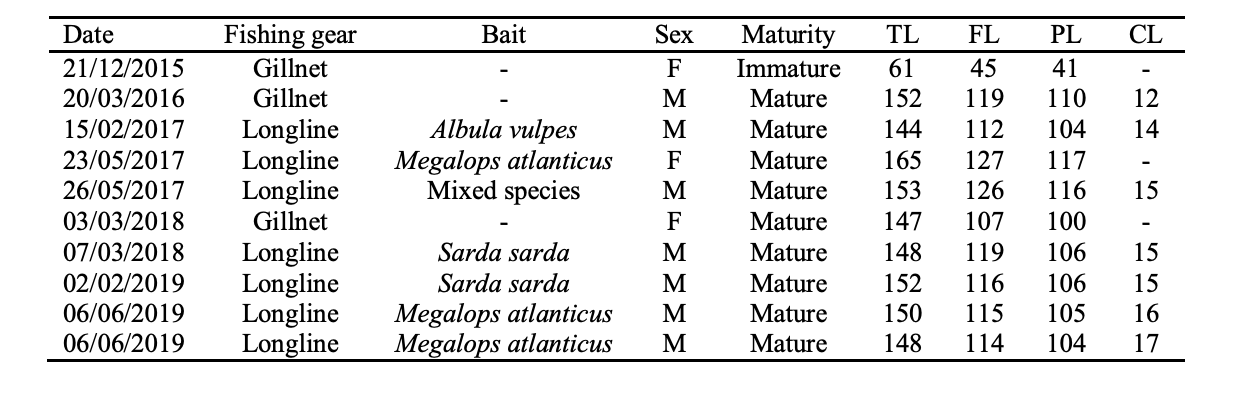
Table 1. Records of Hexanchus vitulus on the Caribbean coast of Guatemala during 2015–2019. TL: total length; FL: fork length; PL: precaudal length; CL: clasper length. All measurements are in centimetres.
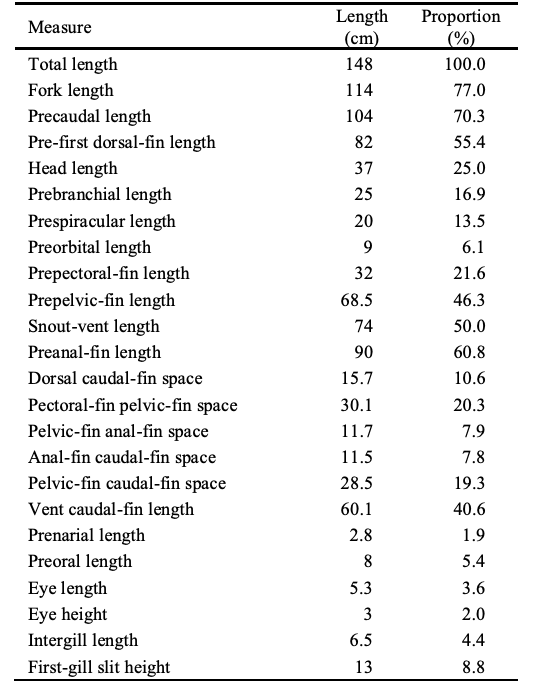
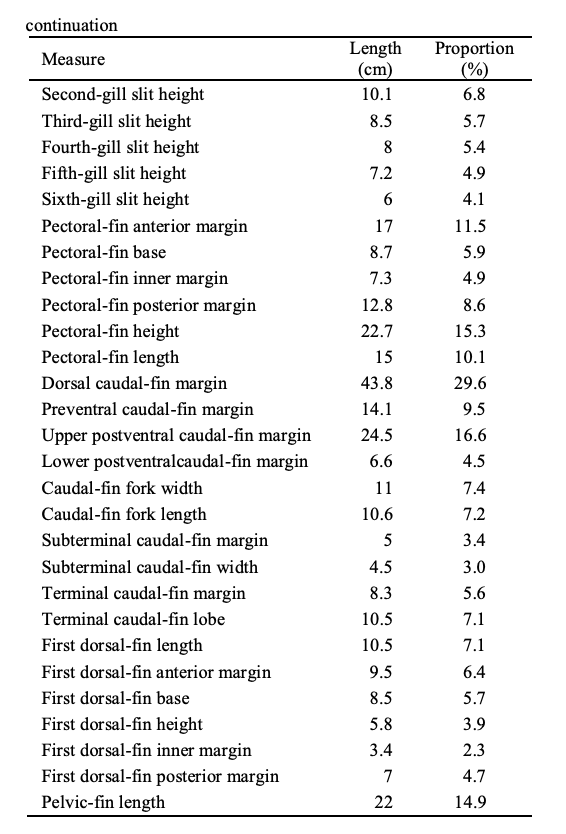
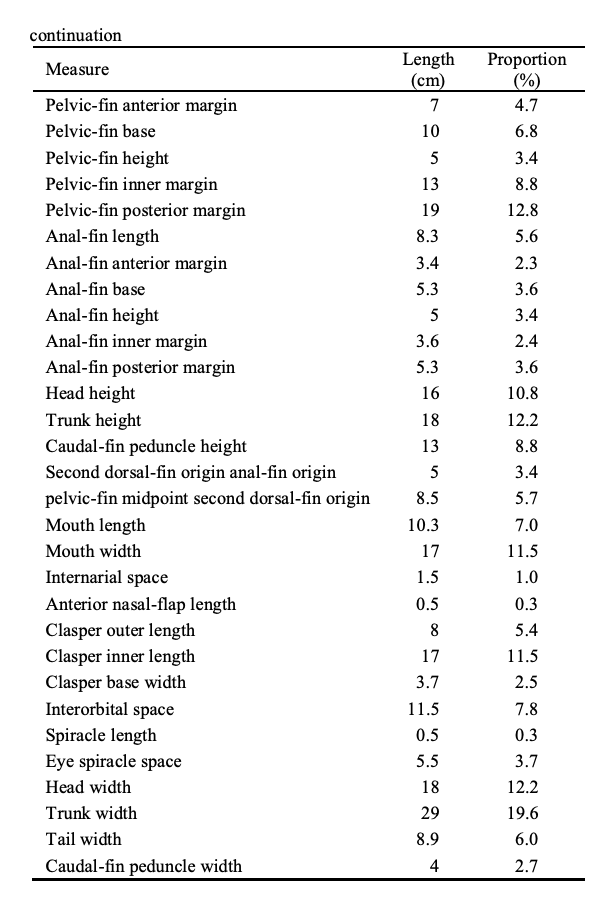
Table 2. Morphometry (length in cm and proportion in %) of a mature male Hexanchus vitulus caught on 6 June 2019 on the Caribbean coast of Guatemala.
The presence of H. vitulus in the Caribbean was recently discussed from specimens captured in Belize. There, immature sharks were obtained mostly during August, September and October at depths of 242–333 m and temperatures of 13–17°C. In this study sharks were caught with similar fishing techniques and at a similar depth (270–350 m), but mature individuals were common during March, May and July. These preliminary observations could suggest that mature individuals are segregated from immature sharks in northern areas such as Belize, possibly in relation to nursery areas or differences in feeding sites.
The occurrence of mature and immature individuals in several areas of the Caribbean could also be related to changes in feeding habits according to maturity, as suggested for the related H. griseus. The preference of H. vitulus for benthic fishes and crustaceans could include hunting or scavenging cephalopods, marine mammals or other elasmobranchs. Future work using stomach contents and stable isotopes could assess a potential ontogenetic dietary shift.
Future research on Caribbean elasmobranch biodiversity should include non-lethal techniques such as baited remote underwater video and environmental DNA analysis at different localities, depths and months. These methods could help clarify the effects of environmental conditions on elasmobranch ecology. Artisanal fishers and deep-sea fisheries may increase in the area as bottom-sea resources become economically exploited.
Acknowledgments
We thank the fishers from El Quetzalito, Josue Ayala, and Francisco Polanco-Vásquez for all the support provided. EEBG thanks the Consejo Nacional de Ciencia y Tecnología for the scholarships provided, and D. Bernot-Simon for the English review. This work was conducted under permit I-DRNO-002-2016 from the Consejo Nacional de Áreas Protegidas de Guatemala.
References
- Becerril-García, E.E., Aguilar-Cruz, C.A., Jiménez-Pérez, A.A. & Galván-Magaña, F. 2017. New record and morphometry of the bluntnose sixgill shark Hexanchus griseus (Chondrichthyes: Hexanchidae) in Baja California Sur, Mexico. Latin American Journal of Aquatic Research, 45(4): 833–836.
- Compagno, L., Dando, M. & Fowler, S. 2005. Sharks of the world. Princeton University Press, New Jersey.
- Daly-Engel, T.S., Baremore, I.E., Grubbs, R.D., Gulak, S.J., Graham, R.T. & Enzenauer, M.P. 2019. Resurrection of the sixgill shark Hexanchus vitulus Springer & Waller, 1969. Marine Biodiversity, 49(2): 759–768.
- Ebert, D.A., White, W.T. & Ho, H.C. 2013. Redescription of Hexanchus nakamurai Teng 1962. Zootaxa, 3752(1): 20–34.
- Hacohen-Domené, A., Polanco-Vásquez, F. & Graham, R.T. 2016. First report of the white saddled catshark in Guatemala’s Caribbean Sea. Marine Biodiversity Records, 9(1): 101.
- Hacohen-Domené, A., Polanco-Vásquez, F. & Graham, R.T. 2017. First record of Heptranchias perlo in Guatemala’s Caribbean Sea. Marine Biodiversity Records, 10(1): 12.
- Mejía-Falla, P.A. & Navia, A.F. 2019. Checklist of marine elasmobranchs of Colombia. Universitas Scientiarum, 24(1): 241–276.
- Van Beek, I.J.M., Debrot, A.O. & De Graaf, M. 2012. Elasmobranchs in the Dutch Caribbean: current population status, fisheries and conservation. IMARES, Wageningen University Research.