New record and range extension of the roughskin spurdog Cirrhigaleus asper in the Caribbean Sea
New record and range extension of the roughskin spurdog Cirrhigaleus asper in the Caribbean Sea
Francisco Polanco-Vásquez¹,², Ana Hacohen-Domené¹,³*, Edgar E. Becerril-García⁴, Sebastián Hernández⁵,⁶
¹ Fundación Mundo Azul, Guatemala, Blvd. Rafael Landivar 10-05, Paseo Cayala Zona 16, Ciudad de Guatemala, Guatemala.
² Wildlife Conservation Society, Avenida 15 de Marzo, Casa #3, Flores Petén, Guatemala
³ Departamento de Biología, Facultad de Ciencias y Humanidades, Universidad del Valle de Guatemala, 18 Av. 11-95 Zona 15, Vista Hermosa III, Ciudad de Guatemala, Guatemala
4 Instituto Politécnico Nacional, Centro Interdisciplinario de Ciencias Marinas, 23096, La Paz, México
5 Laboratorio de Biología Molecular (BIOMOL), Centro de Programas Internacionales y Estudios de Sostenibilidad, Universidad Veritas, San José, Costa Rica
6 Sala de Colecciones Biológicas, Facultad de Ciencias del Mar, Larrondo 1281, Universidad Católica del Norte, Coquimbo, Chile
*Corresponding author: anahacohen@gmail.com
Abstract
This study constitutes the first record and a range extension of the roughskin spurdog (Cirrhigaleus asper) in the Caribbean Sea. A total of three mature female specimens were captured by artisanal fishermen between March and May of 2016 in the coastal community of El Quetzalito, Izabal, Guatemala. The total length of the sharks ranged from 1,110-1,280 mm, which is the largest total length so far reported for this species.
Keywords
Deep-sea species, elasmobranch, Squalidae, Guatemala
Introduction
The family Squalidae (dogfish sharks) includes two genera: Cirrhigaleus (Tanaka, 1912) with three species; and Squalus (Linnaeus, 1758) with 26 species (Ebert et al. 2015). This family is distributed worldwide in temperate and tropical seas, with a preference for deep environments (>50 m) where they feed on benthic fishes and invertebrates (Compagno 2002, Compagno et al. 2005, Ebert et al. 2015). In the Atlantic, eleven species are reported (Compagno 2002, Ebert et al. 2015, Pfleger et al. 2018, Veríssimo et al. 2016, Viana et al. 2016, Finucci et al. 2020a).
The roughskin spurdog Cirrhigaleus asper Merrett, 1973 was first described by Merrett (1973) in the equatorial western Indian Ocean based on a 901 mm total length (LT) mature male holotype. This species has been reported in the South Atlantic Ocean, West and Central Indian Ocean and in the Central Pacific Ocean (Hawaiian Islands). In the Western Atlantic, C. asper has been reported from North Carolina to Florida, in the Gulf of Mexico and the South West of Brazil with no records in the Caribbean Sea (Compagno 2002, Castro 2011, Ebert et al. 2015, Rincon et al. 2017, Del Moral-Flores et al. 2018).
According to Ebert et al. (2015) and Finucci et al. (2020b), C. asper inhabits continental shelves and insular slopes of warm temperate to tropical seas, ranging from 0-1,370 m. However, it can also be observed in river mouths and outer bays (Compagno 1984, Ebert et al. 2015).
The biological information of C. asper is deficient. The age of maturity for this yolk sac viviparous species is unknown, as well as longevity and gestation (Finucci et al. 2020b). However, size at maturity occurs between 89-118 cm for females, and 85-90 cm for males, with a size of 25-28 cm at birth, and a fecundity of 18-22 pups (Ebert et al. 2013, Finucci et al. 2020b). In terms of conservation status, C. asper is listed as “Data Deficient” due to the scarce information available to assess extinction risks based on their distribution and population trends by the International Union for Conservation of Nature (IUCN) (Finucci et al. 2020b).
This report refers to a new record and range extension of C. asper, providing the first scientific evidence of the occurrence of C. asper off the coast of Guatemala, in the Caribbean Sea, based on three female specimens captured as bycatch of artisanal fisheries.
Materials and Methods
Specimens examined and morphometrics
Three specimens of Cirrhigaleus asper were incidentally captured by artisanal fishermen from the coastal community of El Quetzalito, Izabal, Guatemala, at coordinates 15°52.374 N, 88°18.712 W (see Figure 1: Study area and capture location). Two specimens were captured on March 20th, 2016 using a 1,000 m long bottom trammel mesh net with 3.5 inches mesh and one panel. A third specimen was captured on May 18th, 2016 using a 2,000 m long line with 200 hooks (#16). All three specimens were captured at approximately 200 m depth, based on the known length of the fishing gear used.
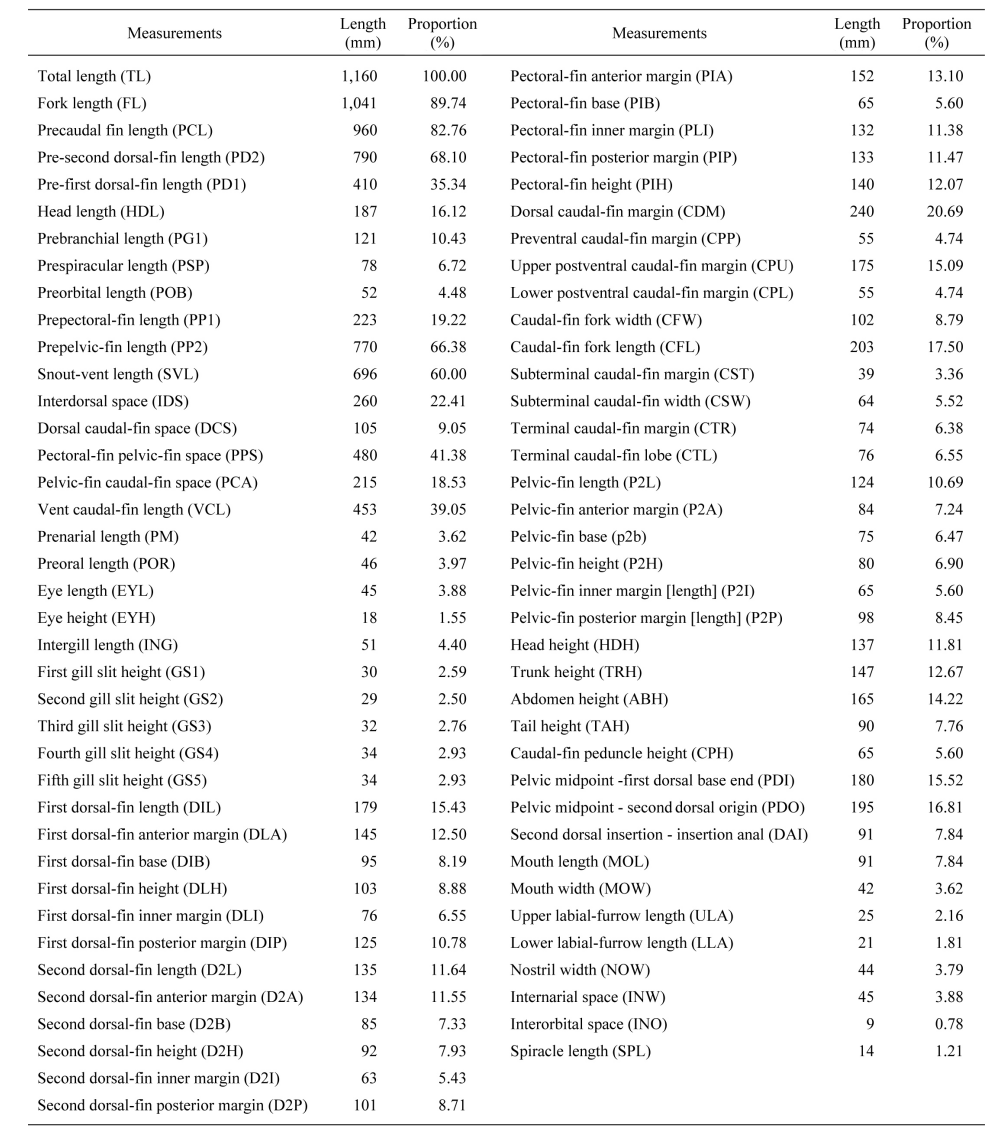
All specimens were examined and identified using identification guides (Compagno 1984, Compagno et al. 2005, Ebert et al. 2015). Regarding morphometry, a total of 76 measurements (following Compagno 2002) were registered for the specimen Id_215 (Table 1; Fig. 2a). Additionally, tissue sample was collected, for genetic identification, only for the specimen Id_235. Unfortunately, deposition of any specimen in a museum/academic collection was not possible due to the fisherman’s decision to use the meat.
Genetic identification
DNA was extracted using the Wizard Genomic DNA Purification Kit (PROMEGA®, Promega Inc., Madison, WI). The cytochrome oxidase subunit one (COI or CO1 ) was amplified by PCR using the following primers FISH F2: 5TCGACTAATCATAAAGATATCGGCAC’ and FISH R2: 5’ACTTCAGGGTGACCGAAGAATCAGAA3’ (Ward et al. 2005). Amplifications were carried out in a PCR of 15 μL of volume with 10X PCR buffer, 25 mM MgCl2 , 10 mM dNTPs, 10 μM of each primer, 5 units of Dream Taq polymerase (Thermo ScientificTM) and 1 μL of DNA. PCR was performed on a SimpliAmp cycler (Applied Biosystem, USA). An initial denaturing step was carried out at 95 °C for 2 min, followed by 30 cycles with 30 s at 94 °C, 30 s at 55 °C, and 1 min at 72 °C, followed by a final extension step of 10 min at 72 °C. The PCR products were sent to the molecular cloning laboratory (MCLAB) in the USA for Sanger sequencing on an ABI 3730 XL Genetic analyzer in both the forward and reverse directions. Forward and reverse sequences were edited and aligned using the GENEIOUS v10.2.3 software to solve ambiguities for the confirmation of nucleotide bases. Sequence divergences were calculated using a Kimura two-parameter (K2P) distance model (Kimura 1980).
Neighbor-joining (NJ) tree of K2P distances were estimated to provide a tree representation of the divergence between the Cirrhigaleus species for the CO1 gene sequence obtained from from Barcode of Life DataSystems (BOLD) (Ratnasingham & Hebert 2007) and GenBank from the NCBI1 . The NJ tree was performed in MEGAX (Kumar et al. 2018) with 1000 replications.
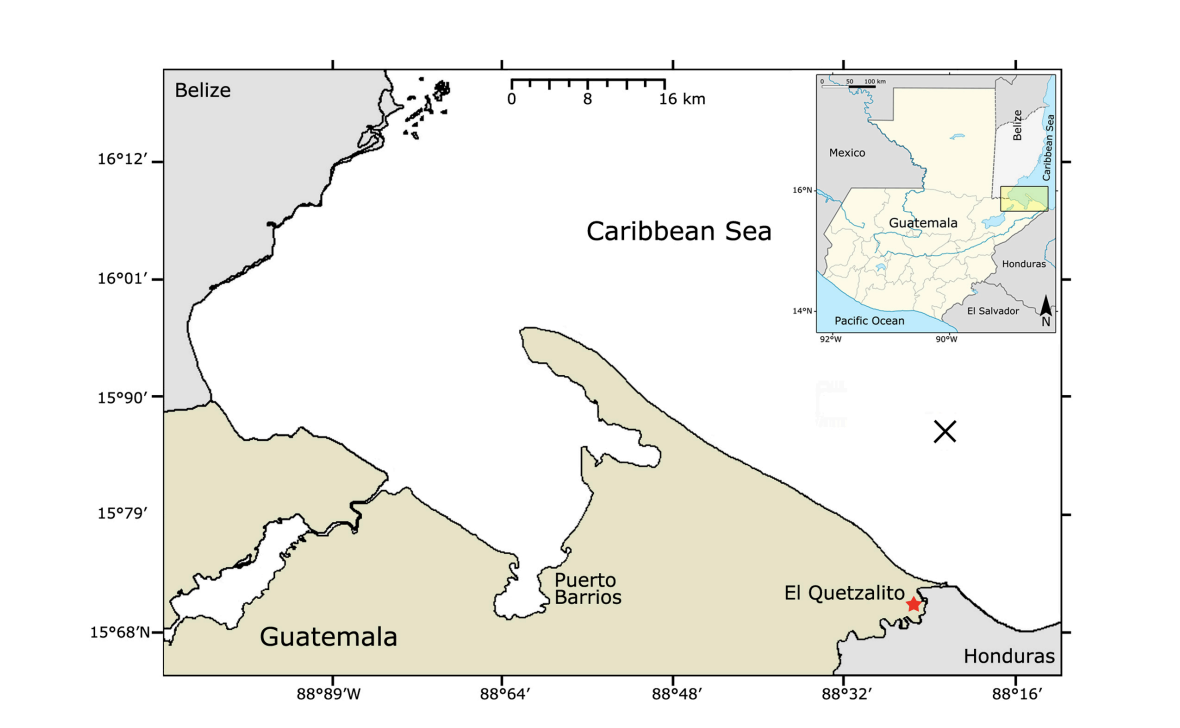
Figure 1. Study area and capture location (x) of Cirrhigaleus asper in the coastal zone of El Quetzalito, Izabal, Guatemala
Table 1. Morphometric measurements (mm) of one female specimen of Cirrhigaleus asper (Id_215) captured by artisanal fishermen between March and May of 2016 in the coastal zone off El Quetzalito, Izabal, Guatemala
Results and Discussion
The species of the genus Cirrhigaleus are distinguished from Squalus species by having a very elongated secondary lobe and by forming nasal barbels that extend to the anterior margin of the mouth while species of the genus Squalus have anterior nasal flaps with a short secondary lobe and, without forming nasal barbels (Compagno et al. 2005).
The species of the genus Cirrhigaleus evidenced a similar length in both dorsal fins while in the Squalus species the second dorsal fin is smaller and lower than the first dorsal fin (Compagno et al. 2005). In Cirrhigaleus species, the second dorsal fin spine it is equal in length to the first dorsal fin spine. In contrast, Squalus species show a second dorsal fin spine larger than the first dorsal fin spine.
In general, the body of the Cirrhigaleus species is robust and markedly humped dorsally, when compared with the genus Squalus, in which the members of this group evidenced a fusiform body arched dorsally throughout all of its length (Viana et al. 2016).
The specimens were identified as Cirrhigaleus asper due to the presence of a stocky body covered with a rough skin, a short-rounded snout and a broad flat head. The body showed a white pigmentation in the belly and a light brown color on the dorsal surface.
The margins of the two dorsal fins were white and the second dorsal fin was about as large as the first, in which a strong and long spine was observed in both dorsal fins. The origin of the first dorsal was behind the pectoral fin rear tips (Compagno et al. 2005; Fig. 2a, b).
Additionally, specimens examined had big nostrils and large-mouth upper labial furrows that were larger than the lower labial furrow length (Fig. 2a). Finally, the specimens presented anterior nasal flaps, with short barbels, a distinguished characteristic that differentiate C. asper from its congeners Cirrhigaleus babifer Tanaka, 1912 and Cirrhigaleus australis White, Last & Stevens, 2007 (Ebert et al. 2015).
Specimens comprised the following morphometric measurements: Id_215: 1,160 mm total length (TL), 1,060 mm precaudal length (PCR), 960 mm fork length (FL) and mature female (Code number= Id_215) (Fig. 2a): Id_216: 1,100 mm TL, 1,030 mm PRC, 970 mm FL and mature female (Code number= Id_216); Id_235: 1,280 mm TL, 1,200 mm PRC, 1,080 mm FL and mature female (Code number= Id_235) (Fig. 2b).
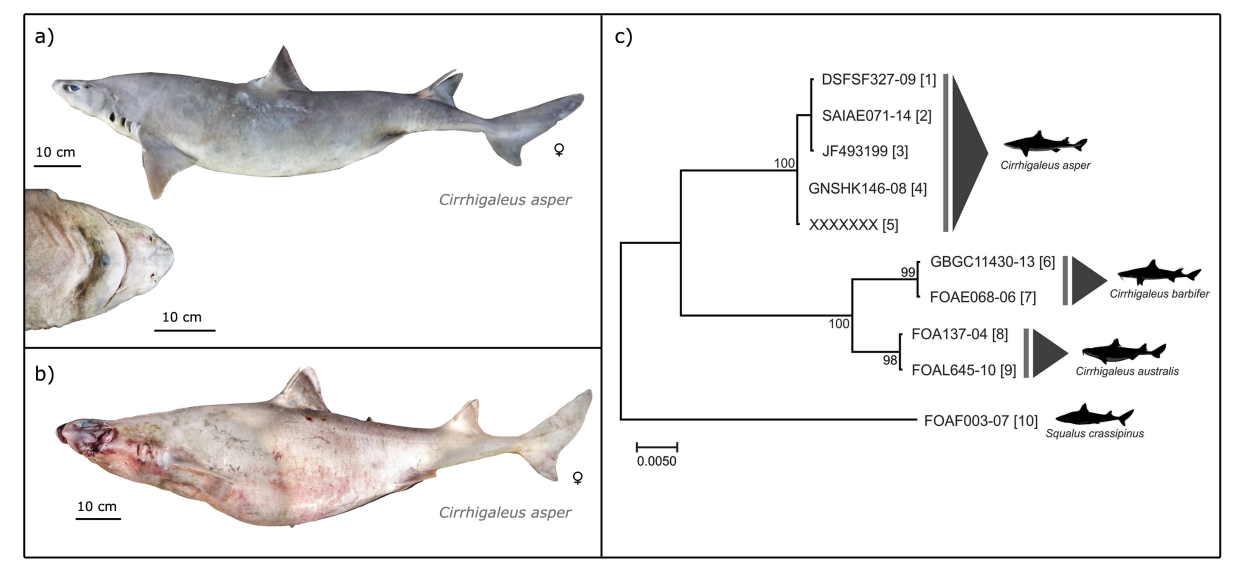
Figure 2. Cirrhigaleus asper specimens: a) Id_215 (1,160 mm TL, mature female); b) Id_235 (1,280 mm TL, mature female); c) Id_235, neighbourjoining phylogenetic tree of C. asper and related species, inferred from gene sequence (COI)
Edited COI sequences were 573 bp long from the specimen identified as Id_235 from Guatemala, in the Caribbean coast (GenBank Accession number MN982926). The sequence is identical to an available voucher specimens of C. asper (DSFSF327-09), and only differing by one bp from the other sequences identified as C. asper obtained from GenBank (JF43139) and from two other voucher specimens of C. asper (SAIAE071-14 and CNSHK146-08).
However, the CO1 sequence of Id_235 differed by 23 substitutions from those of two voucher specimens of C. australis (White et al. 2007) (FOA137-04 and FOAL645-10), and by 24 bp substitutions from one specimen of C. barbider (Kempster et al. 2013) (FOAE068-06). One sequence (KC349854) of Squalus crassispinus Last, Edmunds & Yearsley, 2007 (FOAFOO3-07), it was used as an out-group. The percentages of identity are represented and supported for each branch in the NJ tree (Fig. 2c).
These specimens confirm the first record of the roughskin spurdog C. asper in the Caribbean Sea, off Guatemala. The species has been reported in the Western North Atlantic, the Gulf of Mexico (Campeche), on the southern coast of Brazil and the western coast of Venezuela (Península de Paraguaná) (Castro 1983, Compagno 2002, Fischer et al. 2006, Rincon et al. 2017, Del Moral et al. 2018, Ehemann et al. 2019).
The roughskin spurdog is captured incidentally as a result of trawling, longline fishery, and tilefish fishery in the Southeastern coast of the United States (Compagno 2002). According to Compagno (1984) and Castro (2011), C. asper has no commercial importance to date. However, C. asper is captured incidentally with trammel net and longline in the Caribbean, off Guatemala, and in recent decades the fishers have sold its meat and liver oil to local markets, despite the low quality and price of the meat (Hacohen-Domené et al. 2020).
Regarding body size, the maximum size reported for C. asper is 1,235 mm TL (Fischer et al. 2006). However, frequent sizes for males and females are 710 mm TL and 690 mm TL respectively (Fischer et al. 2006). In this manner, two out of three individuals reported in the present study coincide with the size range reported for this species (specimen Id_215 and Id_216). However, one specimen (Id_235) was longer (1,280 mm TL) than the maximum size reported; which constitutes the largest specimen recorded to date.
Information on the reproduction of this species varies according to the locality. In the southwestern equatorial Atlantic Ocean, Fischer et al. (2006) observed that females of C. asper reached sexual maturity at 1,100 mm TL, while males reached it at 910 mm TL. In contrast, the population from the eastern coast of North America reaches its sexual maturity at 710-850 mm TL for males, and 880-900 mm TL for females (Castro 2011). During this study, female reproductive tracts could not be kept for analysis due to the fisherman’s decision to sell the meat and organs.
However, based on previous studies (Fischer et al. 2006, Castro 2011) and the TL of the three specimens, all specimens reported in this study were likely sexually mature. The relevance of this study resides in the fact that it represents the first record for C. asper in the Caribbean Sea. Finucci et al. (2020b) observed that its range of distribution could be wider, but the information was limited. In this manner, this record constitutes a significant range extension of its distribution to the Caribbean Sea.
More information on the biology and ecology of C. asper is needed for the proper evaluation of the demography in this region. Finally, this study and the record of several deep-sea elasmobranch records in the area (Hacohen-Domené et al. 2016, 2017, 2020; PolancoVásquez et al. 2017, Ehemann et al. 2019) highlights the need for comprehensive deep-sea research surveys to have a better assessment of the region’s deep-water elasmobranchs.
Such records in deep-sea species have important implications for future research and conservation actions for these poorly known sharks and ray species, which could favor present and future management plans regarding local fisheries.
Acknowledgements
We would like to thank the community of El Quetzalito for their constant support to the research program in the area. Also, to Fundación Mundo Azul for the support and funding for the elasmobranch monitoring Project in 2016.
References
- Castro JI. 1983. The sharks of North American waters, 196 pp. Texas A&M University Press, College Station.
- Castro JI. 2011. The sharks of North America, 670 pp. Oxford University Press.
- Compagno LJV. 1984. FAO species catalogue. Vol. 4. Sharks of the world. An annotated and illustrated catalogue of shark species known to date. Part 1. Hexanchiformes to Lamniformes. FAO Fisheries Synopsis 125(4), Part 1: 1-249.
- Compagno LJV. 2002. Sharks of the world. An annotated and illustrated catalogue of shark species known to date. Vol. 2. Bullhead, mackerel and carpet sharks (Heterodontiformes, Lamniformes and Orectolobiformes). FAO Species Catalogue for Fishery Purposes 1(2): 1-269.
- Compagno LJV, M Dando & S Fowler. 2005. Sharks of the world, 368 pp. Princeton University Press, Princeton.
- Del Moral-Flores LF, JJ Morrone, J Alcocer, H Espinosa-Pérez, G Pérez-Ponce & F Uribe. 2018. Listado anotado de los tiburones, rayas y quimeras (Chondrichthyes, Elasmobranchii, Holocephali) de México. Version 1.5. Museu de Ciències Naturals de Barcelona. https://www.gbif.org/occurrence/1257287490
- Ebert DA, S Fowler & LJV Compagno. 2013. Sharks of the world: a fully illustrated guide to the sharks of the world, 528 pp. Wild Nature Press, Plymouth.
- Ebert DA, S Fowler & M Dando. 2015. Sharks of the world, 256 pp. Princeton University Press, Princeton.
- Ehemann NR, LD González-González, A Tagliafico & S Weigmann. 2019. Updated taxonomic list and conservation status of chondrichthyans from the exclusive economic zone of Venezuela, with first generic and specific records. Journal of Fish Biology 95(3): 753-771.
- Finucci B, J Cheok, CF Cotton, DW Kulka, FC Neat, N Pacoureau, CL Rigby, S Tanaka & TI Walker. 2020a. Squalus mitsukurii. The IUCN Red List of Threatened Species 2020: e.T152781967A2957982. https://dx.doi.org/10.2305/IUCN.UK.2020-3.RLTS.T152781967A2957982.en
- Finucci B, J Cheok, CF Cotton, DW Kulka, FC Neat, CL Rigby, S Tanaka & TI Walker. 2020b. Cirrhigaleus asper. The IUCN Red List of Threatened Species 2020: e.T60209A3092852. https://dx.doi.org/10.2305/IUCN.UK.2020-3.RLTS.T60209A3092852.en
- Fischer A, D Veras, F Hazin, M Broadhurst, G Burgess & P Oliveira. 2006. Maturation of Squalus mitsukurii and Cirrhigaleus asper (Squalidae, Squaliformes) in the southwestern equatorial Atlantic Ocean. Journal of Applied Ichthyology 22: 495-501.
- Hacohen-Domené A, F Polanco-Vásquez & RT Graham. 2016. First report of the whitesaddled catshark Scyliorhinus hesperius (Springer 1966) in Guatemala’s Caribbean Sea. Marine Biodiversity Records 9(1): 101. https://doi.org/10.1186/s41200-016-0103-9
- Hacohen-Domené A, F Polanco-Vásquez & RT Graham. 2017. First record of Heptranchias perlo (Bonnaterre 1788) in Guatemala’s Caribbean Sea. Marine Biodiversity Records 10(1): 1-5. https://doi.org/10.1186/s41200-017-0118-x
- Hacohen-Domené A, F Polanco-Vásquez, C Estupiñan-Montaño & RT Graham. 2020. Description and characterization of the artisanal elasmobranch fishery on Guatemala’s Caribbean coast. PLoS ONE 15(1): e0227797. https://doi.org/10.1371/journal.pone.0227797
- Kempster R, D Hunt, B Human, C Egeberg & S Collin. 2013. First record of the mandarin dogfish Cirrhigaleus barbifer (Chondrichthyes: Squalidae) from Western Australia. Marine Biodiversity Records. https://doi.org/10.1017/S175526721300002X
- Kimura M. 1980. A simple method for estimating evolutionary rates of base substitutions through comparative studies of nucleotide sequences. Journal of Molecular Evolution 16: 111-120. https://doi.org/10.1007/BF01731581
- Kumar S, G Stecher, M Li, C Knyaz & K Tamura. 2018. MEGA X: Molecular Evolutionary Genetic Analysis across computing platforms. Molecular Biology and Evolution 35(6): 1547-1549. https://doi.org/10.1093/molbev/msy096
- Merrett NR. 1973. A new shark of the genus Squalus (Squalidae) from the equatorial western Indian Ocean; with a note on Squalus blainvillei. Journal of Zoology 171(1): 93-110. https://doi.org/10.1111/j.1469-7998.1973.tb07518.x
- Pfleger MO, RD Grubbs, CF Cotton & TS Daly-Engel. 2018. Squalus clarkae sp. nov., a new dogfish shark from the Northwest Atlantic and Gulf of Mexico, with comments on the Squalus mitsukurii species complex. Zootaxa 4444(2): 101-119. https://doi.org/10.11646/zootaxa.4444.2.1
- Polanco-Vásquez F, A Hacohen-Domené, T Méndez, A Pacay & RT Graham. 2017. First record of the chimaera Neoharriota carri (Bullis and Carpenter 1966) in the Caribbean of Guatemala. Marine Biodiversity Records 10(1): 1. https://doi.org/10.1186/s41200-016-0104-8
- Ratnasingham S & PD Hebert. 2007. BOLD: The Barcode of Life Data System. Molecular Ecology Notes 7: 355-364. https://doi.org/10.1111/j.1471-8286.2007.01678.x
- Rincon G, R Cordeiro, AR Onodera & R Lessa. 2017. Deepwater sharks, rays, and chimaeras of Brazil. IntechOpen. http://dx.doi.org/10.5772/ubrwxgiowb,69471
- Veríssimo A, D Zaera-Perez, R Leslie, S Iglésias, B Séret, P Grifgoriou, A Sterioti, C Gubili, C Barría, C Duffy, S Hernández, I Batjakas & A Griffiths. 2016. Molecular diversity and distribution of eastern Atlantic and Mediterranean dogfishes Squalus highlight taxonomic issues in the genus. Zoologica Scripta 46(4): 414-428. https://doi.org/10.1111/zsc.12224
- Viana S, M Carvalho & U Gomes. 2016. Taxonomy and morphology of species of the genus Squalus Linnaeus, 1758 from the Southwestern Atlantic Ocean (Chondrichthyes: Squaliformes: Squalidae). Zootaxa 4133(1): 1-89. http://doi.org/10.11646/zootaxa.4133.1.1
- Ward RD, TS Zemlak, BH Innes, PR Last & PD Hebert. 2005. DNA barcoding Australia’s fish species. Philosophical Transactions of the Royal Society B: Biological Sciences 360(1462): 1847-1857.
- White WT, PR Last & JD Stevens. 2007. Cirrhigaleus australis n. sp., a new mandarin dogfish (Squaliformes: Squalidae) from the south-west Pacific. Zootaxa 1560(1): 19-30. http://dx.doi.org/10.11646/zootaxa.1560.1.2