
First record of the scoophead shark (Sphyrna media) and new records of great hammerhead sharks (Sphyrna mokarran) in the Guatemalan Pacific
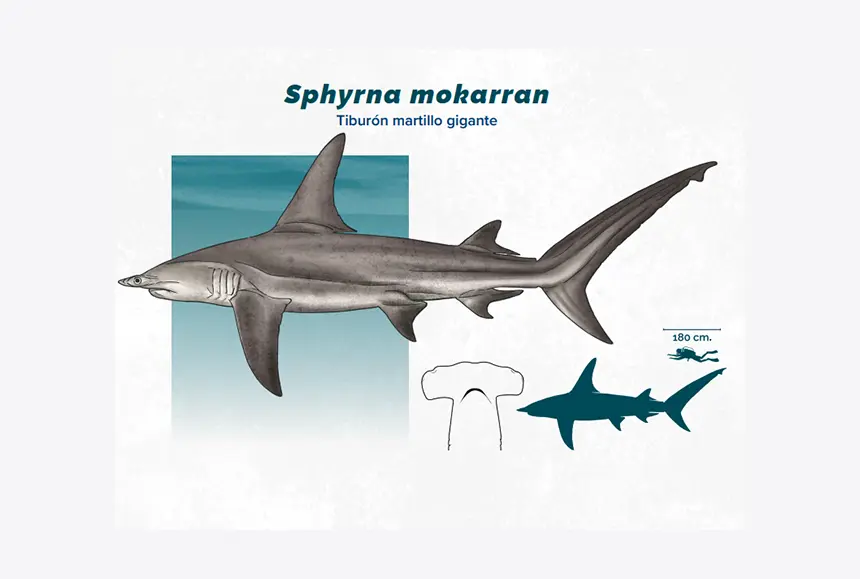
First record of the scoophead shark (Sphyrna media) and new records of great hammerhead sharks (Sphyrna mokarran) in the Guatemalan Pacific
Ana Cristina Hérnandeza, Julio Sánchez-Jiméneza, María de los Angeles Rosales-Melgara, Elisa M. Areano-Barillasa, Juan Carlos Pérez-Jiméneza,b,*
a Fundación Mundo Azul, Km 21.5 carretera a Villa Canales, Guatemala, Guatemala
b El Colegio de la Frontera Sur, Av. Rancho Polígono 2-A, Ciudad Industrial, Lerma, Campeche CP 24500, Mexico
* Corresponding author at: Fundación Mundo Azul, Km 21.5 carretera a Villa Canales, Guatemala, Guatemala. E-mail address: (J.C. Pérez-Jiménez).
Regional Studies in Marine Science 84 (2025) 104122. Accepted 7 March 2025. Available online 8 March 2025.
Abstract
A juvenile scoophead shark (Sphyrna media) and four juvenile great hammerhead sharks (Sphyrna mokarran) captured with longlines (<30 m depth) by small-scale fisheries off the coast of Buena Vista and Sipacate in the Guatemalan Pacific are reported. These species are categorized as Critically Endangered by the IUCN Red List, primarily due to overfishing. All the specimens were juveniles: a male S. media (71 cm TL) and four S. mokarran, including a female (114 cm TL) and three males (79.5, 122, and 149.5 cm TL). Sphyrna mokarran specimens recorded in our study are the smallest ever reported for the Eastern Pacific region. Sphyrna media specimen is the first recorded in the Guatemalan Pacific, increasing the number of hammerhead species to four and the total number of shark species recorded off the Guatemalan Pacific to sixteen.
Keywords
Sphyrnidae; Critically Endangered; uncommon sharks; Tropical Eastern Pacific; artisanal fisheries
1. Introduction
The hammerhead sharks (family Sphyrnidae), so named because of the lateral expansion of the head, comprise sharks occurring in tropical and temperate waters worldwide (Gilbert, 1967); however, the small species, with the exception of Eusphyra blochii, are restricted to waters off the American continent (Ebert et al., 2021). The scalloped hammerhead (Sphyrna lewini Griffith and Smith, 1834) and the smooth hammerhead (Sphyrna zygaena Linnaeus, 1758) are common in the Eastern Pacific (Martínez-Ortíz et al., 2007; Galeana-Villaseñor et al., 2009; Pérez-Jiménez, 2014). The great hammerhead (Sphyrna mokarran Rüppell, 1837) has been recorded in the Central Mexican Pacific (Castillo-Geniz et al., 2016), Panama, and Guatemala (Guzman et al., 2019; Avalos-Castillo and Santana-Morales, 2021), and the bonnethead (Sphyrna tiburo Linnaeus, 1758), the scalloped bonnethead (Sphyrna corona Springer, 1940) and the scoophead shark (Sphyrna media Springer, 1940) have been recorded off Colombia, Panama, and Mexico (Castillo-Geniz, 2001; Torres-Huerta, 2008; Rico-Mejia and Rueda, 2007; Guzman et al., 2019).
Along the Guatemalan Pacific coast, the most frequently caught shark is S. lewini (Ixquiac-Cabrera et al., 2009; Avalos-Castillo and Santana-Morales, 2021). Sphyrna mokarran and S. zygaena have also been reported in landings (Ixquiac-Cabrera et al., 2009). Notably, there is only one previously documented record of S. mokarran (Avalos-Castillo and Santana-Morales, 2021); however, no data on sex and size have been recorded. Our study is aimed to provide the first verified record of S. media and new records of S. mokarran in the waters of the Guatemalan Pacific.
Sphyrna media is a small-sized (<150 cm total length, TL) hammerhead shark distributed in the Eastern Pacific from the Gulf of California, Mexico, to northern Peru and in the Western Atlantic from Panama to southern Brazil. It inhabits waters in continental shelves from inshore to 100 m depth (Compagno, 1984; Castro, 2011). In comparison, S. mokarran is a large (610 cm TL) coastal and semi-oceanic pelagic shark, wide-ranging in tropical and warm temperate waters (Compagno, 1984; Castro, 2011).
Sphyrna media is captured in fisheries using bottom longlines, gillnets, and hook and line (Compagno, 1984; Kyne et al., 2012), which are typically unmanaged and operate throughout its range. The declining numbers of records over the past several decades and range contraction in some areas indicate that this shark has undergone population reduction in both the Pacific and the Atlantic (Pollom et al., 2020). Records are sparse from elsewhere in the Eastern Pacific (Pérez-Jiménez, 2014; Guzman et al., 2019). Therefore, it is inferred that S. media has experienced a population decline of 80 % due to high levels of fishing, leading to its category of Critically Endangered by the IUCN Red List (Pollom et al., 2020).
Sphyrna mokarran is caught globally as a target and bycatch in coastal and pelagic large- and small-scale longline, purse seine, and gillnet fisheries and is often retained for the fins (Castro, 2011; Kyne et al., 2012; Ebert et al., 2021). Sphyrna mokarran has shown significant declines in several regions throughout its range, and its population has declined by 80 % over three generations; consequently, it has been categorized as Critically Endangered by the IUCN Red List (Rigby et al., 2019).
2. Records and discussion
The historical presence of S. media and S. mokarran in the Eastern Pacific is well documented in ichthyological collections in Mexico (mainly in the Gulf of California), Costa Rica, and Panama (Table 1). It is important to highlight the lack of recent records in the Gulf of California, Mexico, despite intense landing monitoring surveys in recent decades (Pérez-Jiménez, 2014). Before our study, the most recent records of S. media were in 2009–2010 off Panama (Vega et al., 2023), and the most recent records of S. mokarran were in 2006–2014 in the Central Mexican Pacific (Castillo-Geniz et al., 2016) (Table 2).
Table 1. Specimens of Sphyrna media (n = 40) and Sphyrna mokarran (n = 30) from the Eastern Pacific preserved in ichthyological collections. NA: not available.
SIO = Scripps Institution of Oceanography; LACM = Natural History Museum of Los Angeles County; USNM = Smithsonian Institution National Museum of Natural History; FMNH = Field Museum of Natural History; IBUNAM = Colección Nacional de Peces, UNAM; CAS = California Academy of Sciences; YPM = Peabody Museum of Natural History; AMNH = American Museum of Natural History; CMN = Canadian Museum of Nature.
In our study, we conducted landing monitoring in the fishery communities on the Central Guatemalan Pacific coast. Sphyrna media specimen was landed in the fishing community of Buena Vista, and the four S. mokarran specimens (including the one reported by Avalos-Castillo and Santana-Morales, 2021) were landed in Sipacate by artisanal boats (fiberglass outboard motored, 7.5–9 m in length), which target teleosts and rays using bottom longlines (J or Eagle Claw half circle hooks of 3–6 cm height) in the continental shelf at less than 30 m depth.
Sphyrna media specimen was taxonomically identified following the descriptions by Compagno (1984), Castro (2011), and Ebert et al. (2021), such as a moderately broad, anteriorly arched, mallet-shaped head, with weak medial and lateral indentations on its anterior edge (Fig. 1). We used molecular methods to confirm visual identification due to the close morphological similarity with S. corona. We collected a muscle sample from S. media for genetic analysis to confirm species identity. Tissue samples were stored in 95 % ethanol, and total DNA extraction was performed using the Qiagen DNeasy Blood and Tissue Kit following the manufacturer’s protocol (Qiagen, Valencia, CA, U.S.A). A 772-base pair (bp) fragment of the mitochondrial COI region was amplified, and three independent replicates were run using the primers FishCoxI F1 (5´TCWACCAACCACAAAGAYATYGGCAC) and FishCoxI R1 (TARACTTCWGGGTGRCCRAAGAATCA), modified from Ward et al. (2005). Polymerase chain reaction (PCR) was performed as follows: 94 ˚C for 2 min., 35 cycles of 30 s at 94 ˚C, 55 ˚C for 45 s, and 72 ˚C for 40 s, followed by a final extension step of 72 ˚C for 10 min. Successfully amplified PCR products were purified using Exo-SAP (Thermo Scientific) and sequenced on an ABI 3500. All sequences were edited, checked manually, and aligned using GeneiousPrime (http://www.geneious.com). A BLAST search was performed in GenBank to compare the sequences against all available specimens, including potential matches with S. corona. Since no S. media sequences were available in GenBank, species identification was validated using genetically confirmed S. media samples from Colombia and Panama.
Sphyrna mokarran specimens were taxonomically identified following the descriptions by Compagno (1984), Castro (2011), and Ebert et al. (2021), such as the anterior margin of the head nearly straight and with a median indentation and first dorsal fin very high and falcate (Fig. 2). We measured the total length (TL) in centimeters of all specimens using a metric tape.
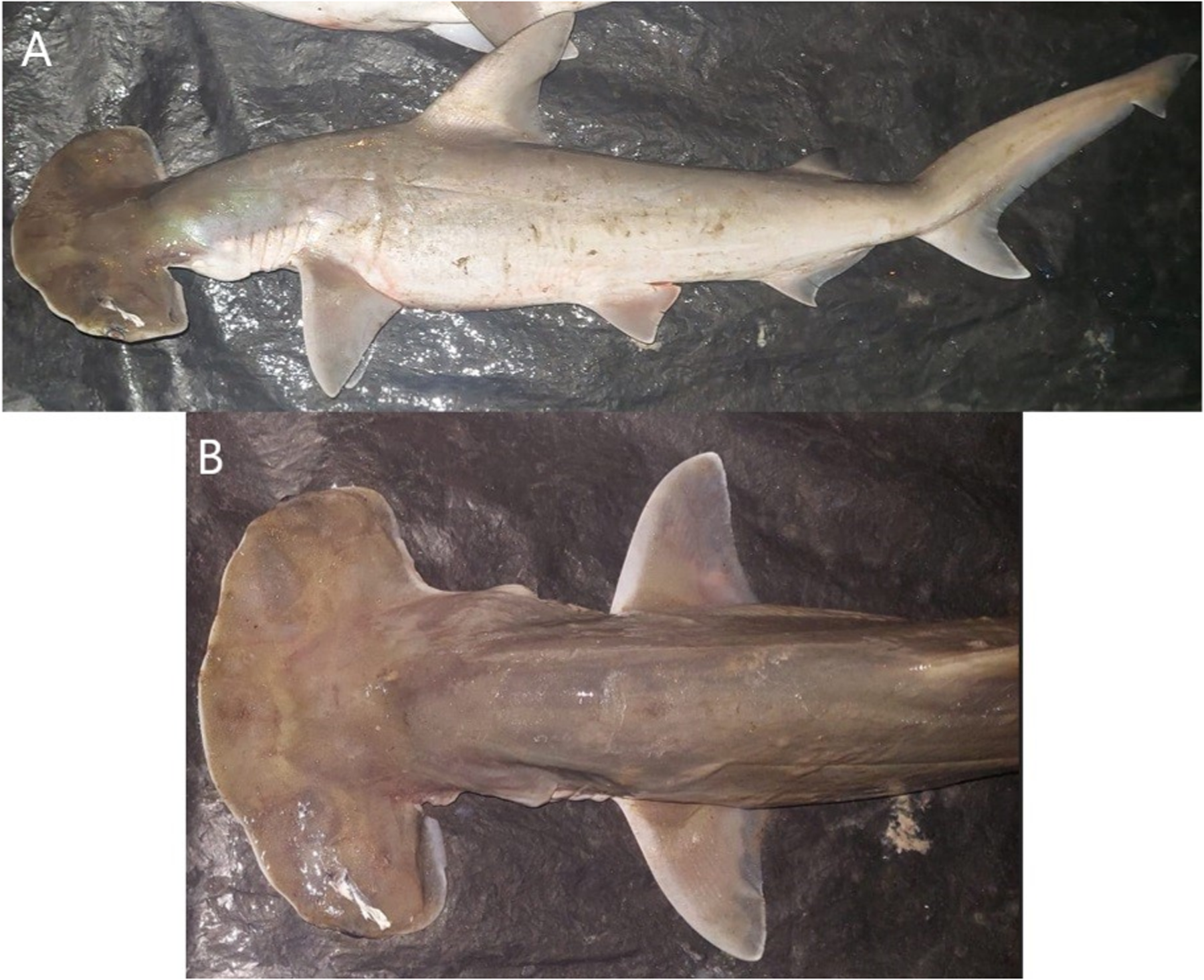
Fig. 1. Scoophead shark Sphyrna media (male of 71 cm TL), A) Lateral view, B) Dorsal view of the head.
The male S. media measured 71 cm (TL) and landed on March 15, 2024 (Fig. 1). The first recorded S. mokarran was a male (122 cm TL) landed on February 12, 2020 (this is the one documented by Avalos-Castillo and Santana-Morales, 2021); the second record was a female (114 cm TL) landed on January 5, 2024 (Fig. 2A, B); the third record was a male (149.5 cm TL) landed on March 5, 2024 (Fig. 2C), and the fourth record was a male (79.5 cm TL) landed on June 5, 2024. The smallest S. mokarran (79.5 cm TL) was either a neonate or young of the year; the other S. mokarran and S. media specimens were juveniles.
The size at maturity for S. media males has been estimated to be anywhere from 83 cm TL (Castro, 2011) to 100 cm TL (Ebert et al., 2021). Sphyrna mokarran males mature at 234–269 cm TL, and the females at 250–300 cm TL (Compagno, 1984). Additionally, the size at birth of S. mokarran is 50–70 cm TL (Compagno, 1984; Ebert et al., 2021).
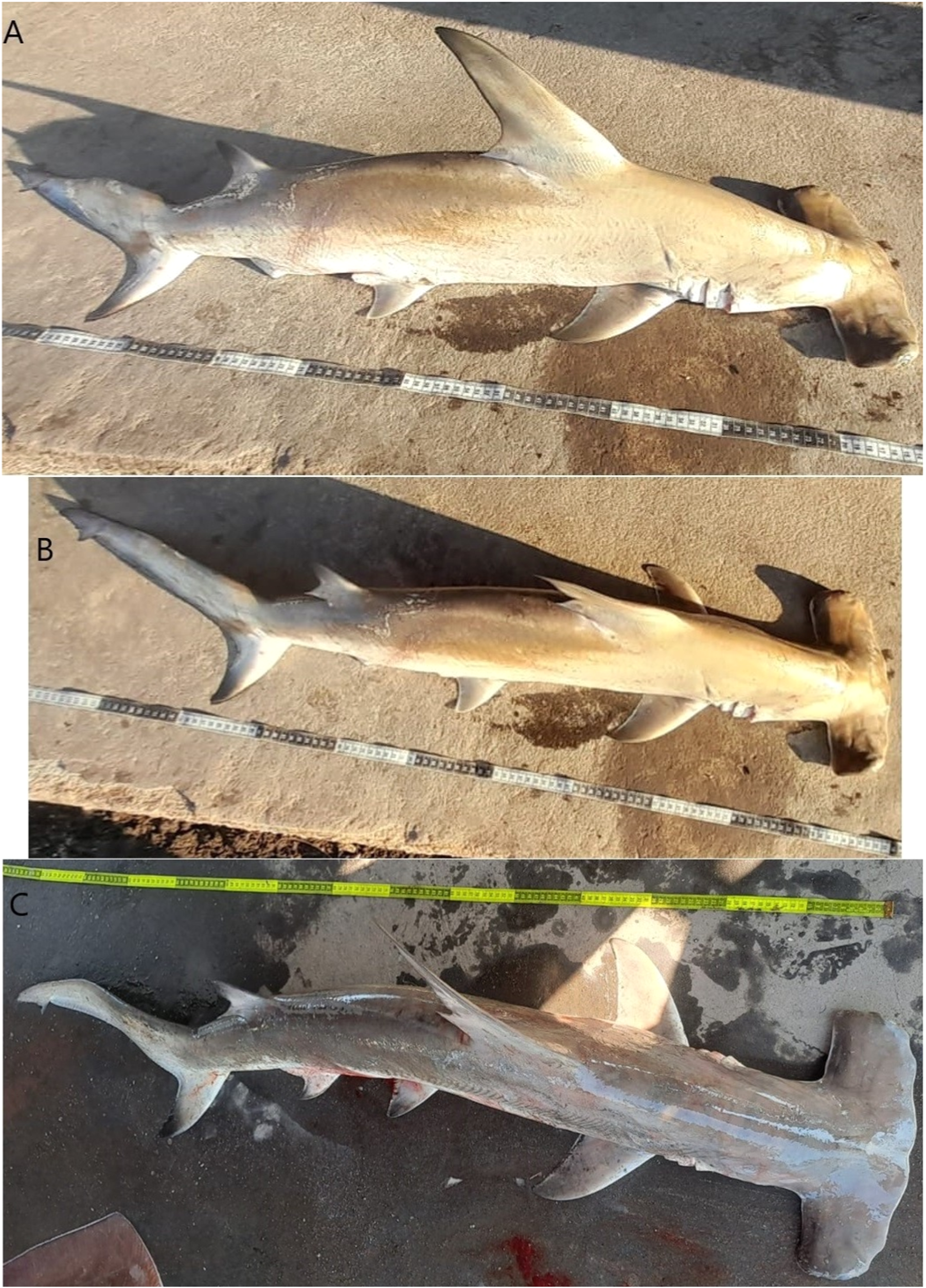
Fig. 2. Great hammerhead shark Sphyrna mokarran, A) Lateral view of a male (114 cm TL), B) Dorsal view of a male (114 cm TL), C) Dorsal view of a male (149.5 cm TL).
With the inclusion of our record of S. media, the number of hammerhead species recorded in the Guatemalan Pacific now is four, including S. lewini, S. zygaena, and S. mokarran (Ixquiac-Cabrera et al., 2009; Avalos-Castillo and Santana-Morales, 2021), and increased to 16 the total number of shark species off Guatemalan Pacific coast. The relevance of the S. media record relies on the recent scarcity of records for this species in the Eastern Pacific (Table 2). Moreover, the sizes of S. mokarran reported in our study are the smallest recorded for the Eastern Pacific region, underscoring the importance of continuous monitoring of landings along the Guatemalan Pacific coast.
Table 2. Biological data of Sphyrna media (n = 26) and Sphyrna mokarran (n = 263) from the Eastern Pacific, recorded in fisheries landings since 1999. NA: not available.
| Country | Year of the records | Number of records | Size (cm, TL) | Sex | Reference |
|---|---|---|---|---|---|
| Sphyrna media | |||||
| Guatemala | 2024 | 1 | 71 | Male | Present study |
| Panama | 2009–2010 | 18 | 29.3–77.5 | Both | Vega et al. (2023) |
| Panama | 2007–2009 | 1 | NA | NA | Guzman et al. (2019) |
| Mexico | 2006–2007 | 1 | 156 | Male | Torres-Huerta (2008) |
| Mexico | 1999–2001 | 2 | NA | NA | Castillo-Geniz (2001) |
| Colombia | 2001 | 3 | NA | NA | Navia and Mejía-Falla (2016) |
| Sphyrna mokarran | |||||
| Guatemala | 2020–2024 | 4 | 79.5–149.5 | 3 males, 1 female | Present study |
| Mexico | 2006–2014 | 253 | 140–342 | Both | Castillo-Geniz et al. (2016) |
| Mexico | 2010 | 1 | 424 | Female | Tovar-Ávila and Gallegos-Camacho (2014) |
| Panama | 2007–2009 | 2 | NA | NA | Guzman et al. (2019) |
| Mexico | 2005–2006 | 3 | NA | NA | Galeana-Villaseñor et al. (2009) |
Ethics approval
All research activities were conducted under permit Bno.1604, issued by Consejo Nacional de Áreas Protegidas (CONAP), and the collect B-01605 and research permits B-00923.
Author statement
We, the authors, declare that the work described in this manuscript has not been published previously. This manuscript is not under consideration for publication elsewhere. All authors have approved the submission of this manuscript and affirm that the publication of this article is authorized by the responsible authorities of the institutions where the research was conducted. Furthermore, we confirm that if this manuscript is accepted for publication, it will not be published elsewhere in the same form, in English, or in any other language, including electronically, without the written consent of the copyright holder.
Funding
Luis von Ahn Foundation, the Shark Conservation Fund, and U.S. Fish and Wildlife Service provided funding for the elasmobranch monitoring project.
Declaration of Competing Interest
The authors declare that they have no known competing financial interests or personal relationships that could have appeared to influence the work reported in this paper.
Acknowledgments
Fundación Mundo Azul thanks Buena Vista and Sipacate fishers for their support while conducting fishery-dependent surveys. Special thanks to our communitarian landing monitors Edwin Segovia, Manuel Zepeda, Franklin León, and Hugo Martínez. Cindy Gonzalez and Demian Chapman conducted the molecular analysis to confirm the scoophead shark identification. Thanks to Consejo Nacional de Áreas Protegidas (CONAP) for authorizing this research.
Data availability
Data will be made available on request.
References
- Avalos-Castillo, C.G., Santana-Morales, O., 2021. Characterization of the artisanal elasmobranch fisheries off the Pacific coast of Guatemala. Fish. Bull. 119 (9), 3. https://doi.org/10.7755/FB.119.1.2
- Castillo-Geniz, J.L., 2001. Elasmobranquios del Golfo de Tehuantepec, litoral Chiapaneco. Informe Final del Proyecto CONABIO S123. Comisión Nacional para el Conocimiento y Uso de la Biodiversidad, México, DF.
- Castillo-Geniz, J.L., Godínez-Padilla, C.J., Ortega-Salgado, I., Ajas-Terriquez, H.A., 2016. Programa de Observadores de Tiburón (POT). In: Castillo-Geniz, J.L., Tovar-Ávila, J. (Eds.), Tiburones Mexicanos de importancia pesquera en la CITES. Instituto Nacional de Pesca, Ciudad de México, pp. 56–67.
- Castro, J.I., 2011. The Sharks of North America. Oxford University Press, New York.
- Compagno, L.J.V., 1984. Sharks of the world. An annotated and illustrated catalogue of shark species known to date. Part 2. FAO Fish. Synop. 125, 251–655.
- Ebert, D.A., Dando, M., Fowler, S., 2021. Sharks of the World. A Complete Guide. Princeton University Press, New Jersey.
- Galeana-Villaseñor, I., Galván-Magaña, F., Santana-Hernández, H., 2009. Pesca con anzuelos en barcos palangreros del Océano Pacífico mexicano: efectos en la captura y peso de tiburones y otras especies. Rev. Biol. Mar. Oceanogr. 44 (1), 163–172.
- Gilbert, C.R., 1967. A revision of the hammerhead sharks (Family Sphyrnidae). Proc. U. S. Natl. Mus. 199, 1–88.
- Guzman, H.M., Cipriani, R., Vega, A.J., Morales-Saldaña, J.M., 2019. Fisheries and conservation assessment of sharks in Pacific Panama. Aquat. Conserv. Mar. Freshw. Ecosyst. 1–16. https://doi.org/10.1002/aqc.3245
- Ixquiac-Cabrera, M.J., Franco-Arenales, I., Tejeda-Velásquez, C.A., Sánchez-Rodas, M.R., Sikahall-Prado, J.A., 2009. Áreas de crianza del Pacífico de Guatemala: Herramienta para el manejo y aprovechamiento sostenido del recurso tiburón. Proyecto Fodecyt 13-2006. Centro de Estudios del Mar y Acuicultura, Universidad de San Carlos de Guatemala, Guatemala City, Guatemala.
- Kyne, P.M., Carlson, J.K., Ebert, D.A., Fordham, S.V., Bizzarro, J.J., Graham, R.T., Kulka, D.W., Tewes, E.E., Harrison, L.R., Dulvy, N.K., 2012. The Conservation Status of North American, Central American, and Caribbean Chondrichthyans. IUCN Species Survival Commission Shark Specialist Group, Vancouver, Canada.
- Martínez-Ortíz, J., Galván-Magaña, F., Carrera-Fernández, M., Mendoza-Intriago, D., Estupiñán-Montaño, C., Cedeño-Figueroa, L., 2007. Abundancia estacional de tiburones desembarcados en Manta-Ecuador. In: Martínez-Ortíz, J., Galván-Magaña, F. (Eds.), Tiburones en el Ecuador: Casos de estudio. EPESPO-PMRC, Manta, Ecuador, pp. 9–27.
- Navia, N.F., Mejía-Falla, P.A., 2016. Fishing effects on elasmobranchs from the Pacific Coast of Colombia. Universitas Scientiarum 31 (1), 9–22. https://doi.org/10.11144/Javeriana.SC21-1.feoe
- Pérez-Jiménez, J.C., 2014. Historical records reveal potential extirpation of four hammerhead sharks (Sphyrna spp.) in Mexican Pacific waters. Rev. Fish. Biol. Fish. 24, 671–683. https://doi.org/10.1007/s11160-014-9353-y
- Pollom, R., Avalos, C., Bizzarro, J., Burgos-Vázquez, M.I., Cevallos, A., Charvet, P., Espinoza, M., Faria, V., Herman, K., Mejía-Falla, P.A., Navia, A.F., Pérez-Jiménez, J.C., Rincon, G., Sosa-Nishizaki, O., 2020. Sphyrna media. The IUCN Red List of Threatened Species 2020: e.T60201A3091753. https://doi.org/10.2305/IUCN.UK.2020-3.RLTS.T60201A3091753.en
- Rico-Mejia, F., Rueda, M., 2007. Evaluación experimental bioeconómica de cambios en la tecnología de captura de camarón con redes de arrastre en aguas someras del Pacífico Colombiano. Bol. Invest. Mar. Cost. 36 (1), 79–109.
- Rigby, C.L., Barreto, R., Carlson, J., Fernando, D., Fordham, S., Francis, M.P., Herman, K., Jabado, R.W., Liu, K.M., Marshall, A., Pacoureau, N., Romanov, E., Sherley, R.B., Winker, H., 2019. Sphyrna mokarran. The IUCN Red List of Threatened Species 2019: e.T39386A2920499. https://doi.org/10.2305/IUCN.UK.2019-3.RLTS.T39386A2920499.en
- Torres-Huerta, A.M., 2008. Elasmobranquios del sistema laguna Chantuto-Panzacola y Carretas-Pereyra de la Reserva de la Biosfera La Encrucijada, Chiapas. Informe final SNIB-CONABIO Proyecto DJ030. Comisión Nacional para el Conocimiento y Uso de la Biodiversidad, México, DF.
- Tovar-Ávila, J., Gallegos-Camacho, R., 2014. Oldest estimated age for Sphyrna mokarran (Carcharhiniformes: Sphyrnidae) in the Mexican Pacific. Hidrobiológica 24 (2), 163–165.
- Vega, A.J., Robles, P.Y.A., Quezada, F., Montes, L., del Cid, A., Quintero, O., 2023. Incidencia de elasmobranquios en la pesca artesanal en los golfos de Chiriquí y Montijo, Pacífico Panameño. Scientia 33 (1), 144–172.
- Ward, R.D., Zemlak, T.S., Innes, B.H., Last, P.R., Hebert, P.D., 2005. DNA barcoding Australia’s fish species. Philos. Trans. R. Soc. B 360 (1462), 1847–1857.