First record of the kitefin shark, Dalatias licha (Bonnaterre, 1788) from the Guatemalan Caribbean Sea
First record of the kitefin shark, Dalatias licha (Bonnaterre, 1788) from the Guatemalan Caribbean Sea
Julio Sánchez-Jiménez1, Josué Ayala-Donado1, María de los Ángeles Rosales Melgar1, Elisa M. Areano-Barillas1, Devanshi Kasana2, Mónica González-Jaramillo3 & Juan Carlos Pérez-Jiménez1,4
1 Fundación Mundo Azul, Guatemala, Guatemala
2 Department of Biological Sciences, Florida International University, North Miami, FL, USA
3 Independent Consultant, San Francisco de Campeche, Campeche, Mexico
4 El Colegio de la Frontera Sur, Ciudad Industrial, Lerma, Campeche, Mexico
Corresponding author: Juan Carlos Pérez-Jiménez (jcperez@ecosur.mx)
Associate Editor: Yassir Torres
Abstract
Deepwater fishing operations occur close to the shore of the Guatemalan Caribbean. In a study to characterize the deepwater species present in the fishing area, the incidental catch of a kitefin shark, Dalatias licha, was recorded at a depth of ~284-334 m, ca. 11 km northeast of El Quetzalito fishing village. The adult female with a total length of 1420 mm had morphological characteristics consistent with D. licha, which was confirmed by molecular methods. First record of D. licha in the western Caribbean region, a species cataloged at risk by the IUCN red list. With this record, the number of shark species known in the Guatemalan Caribbean increases to 25.
Keywords
Chondrichthyes; Dalatiidae; Dalatias licha; by-catch; deep-water; Cayman Trench; Guatemala
The kitefin shark (Dalatias licha) (Bonnaterre, 1788) is a medium-sized (1820 mm maximum total length, TL) deepwater, mesopelagic to benthic species encountered in warm, temperate, and tropical waters of the outer continental and insular shelves and slopes from 37 to 1800 m depth (Compagno 1984). However, it is most commonly recorded at depths between 300 to 1000 m (Castro 2011). The species occurs circumglobally with patchy distributions in the Atlantic and Indo-West Central Pacific oceans (Finucci et al. 2018), reportedly forming distinct regional subpopulations (Compagno & Cook 2005).
D. licha is a target and incidental catch across its range for the flesh, squalene-rich liver oil, fishmeal, and leather (Compagno 2016). However, life history characteristics of D. licha, such as slow growth and relatively large size at maturity of 1000-1200 mm TL (Walls & Guallart 2015, Ebert et al. 2021), render it particularly vulnerable to exploitation and rapid depletion, as evidenced by declines in targeted fisheries in Australia and the northeast Atlantic (Walls & Guallart 2015, Finucci et al. 2018). Due to significant population declines documented in regional subpopulations, the species was globally assessed as Vulnerable by the International Union for the Conservation of Nature Red List with an inferred global population decline of at least 30% (Finucci et al. 2018).
The recorded specimen of D. licha measured 1420 mm TL and weighed 13.6 kg. The shark was caught by an artisanal fishing vessel (7.62 m long and outboard motor) on January 10, 2023, using a longline (100 circle hooks #18, baited with tarpon and mullet) in a fishing area called "El Hoyo" at ~284-334 m depth. The area is located 11 km northeast of El Quetzalito, Guatemala, on the margin of the Cayman Trench.
The taxonomic identification of the specimen was done following Ebert et al. (2021). Eighty-two measurements were taken (Table 1) following Compagno (1984) for its description. The caught individual had dark brown coloration, short nose, thick lips, large spiracles, no anal fin, and triangular lower teeth with serrations (Fig. 1). The specimen was deposited at the Centro de Estudios del Mar y Acuicultura (CEMA) collection of the Universidad de San Carlos de Guatemala (USAC) under reference number 166.
Molecular analysis was conducted to confirm species identification. Tissue samples were collected and preserved in 95% ethanol. Genomic DNA was extracted for the samples using the manufacturer’s tissue protocol for the Qiagen DNAeasy kit (Qiagen, Valencia, California). DNA barcoding to amplify the highly conserved mitochondrial cytochrome oxidase I gene (COI) was used following the protocol outlined by Cardeñosa et al. (2014). Partial COI sequences (~450-600 bp) were amplified using the universal primers FishCoxI F (5′ TCWACCAACCACAAGAYATYGGCAC 3′) and FishCoxI R (5′ TARACTTCWGGGTGRCCRAAGAATCA 3′) modified from Ward et al. (2005). The polymerase chain reaction (PCR) profile was as follows: 94°C for 2 min followed by 35 cycles of 94°C for 30 s, 55°C for 45 s, and 72°C for 40 s, with a final extension of 72°C for 10 min. A no-template negative control was included to monitor for reagent contamination. PCR products were visualized on 2% agarose gel, purified using Exo-SAP, and sequenced on an ABI3730 DNA Analyzer (Thermo Fisher Scientific).
The sequences were cleaned and edited using Geneious 2023.2.1 (http://www.geneious.com). Trimmed sequences were used as query searches for BLAST of National Center for Biotechnology (NCBI) GenBank (https://blast.ncbi.nlm.nih.gov/Blast.cgi) and Barcode of Life Data Systems (http://www.boldsystems.org), assigning species identity with a >99% sequence similarity to D. licha. A fragment of 567 bp of the COI gene was obtained for the sample (E-value = 0.0). The sequence was submitted to GenBank under accession number OQ591896.
The literature has limited information about this species’ regional distribution, fisheries, ecology, and biology from the western Atlantic. In the western Atlantic, the species was first reported in the Gulf of Maine, north Atlantic Ocean (Bigelow & Schroeder 1948), followed by Oregon in the northern Gulf of Mexico (Bigelow et al. 1955). Subsequently, there were photographic records in Bermuda and Grand Cayman (Clark & Kristof 1990), and more recently, this species has been reported from the south Atlantic in Brazil (Soto & Mincarone 2001) and the southern Caribbean Sea in Venezuela (Tagliafico et al. 2007) (Table S1).
Table 1. Morphometric measurements of Dalatias licha from the Caribbean Sea of Guatemala.
| Measurement | Measurements (mm) | % of total length |
|---|---|---|
| Total length | 1420 | |
| Precaudal length | 1140 | 80.28 |
| Pre-second dorsal length | 975 | 68.66 |
| Pre-first dorsal length | 505 | 35.56 |
| Head length | 280 | 19.71 |
| Prebranchial length | 215 | 15.14 |
| Prespiracular length | 120 | 8.45 |
| Preorbital length | 90 | 6.33 |
| Prepectoral length | 280 | 19.71 |
| Prepelvic length | 835 | 58.80 |
| Snout-vent length | 920 | 64.78 |
| Interdorsal space | 340 | 23.94 |
| Dorsal-caudal space | 135 | 9.50 |
| Pectoral-pelvic space | 405 | 28.52 |
| Pelvic-caudal space | 170 | 11.97 |
| Vent-caudal length | 500 | 35.21 |
| Prenarial length | 35 | 2.46 |
| Preoral length | 62 | 4.36 |
| Eye length | 55 | 3.87 |
| Eye height | 25 | 1.76 |
| Intergill length | 70 | 4.92 |
| First-gill slit height | 30 | 2.11 |
| Second-gill slit height | 30 | 2.11 |
| Third-gill slit height | 32 | 2.25 |
| Fourth-gill slit height | 32 | 2.25 |
| Fifth-gill slit height | 37 | 2.60 |
| Pectoral anterior margin | 135 | 9.50 |
| Pectoral radial length | 155 | 10.91 |
| Pectoral base | 80 | 5.63 |
| Pectoral inner margin | 70 | 4.92 |
| Pectoral posterior margin | 90 | 6.33 |
| Pectoral height | 150 | 10.56 |
| Pectoral length | 125 | 8.80 |
| Dorsal caudal margin | 281 | 19.78 |
| Preventral caudal margin | 130 | 9.15 |
| Upper postventral caudal margin | 230 | 16.19 |
| Subterminal caudal margin | 40 | 2.81 |
| Subterminal caudal width | 60 | 4.22 |
| Terminal caudal margin | 62 | 4.36 |
| Terminal caudal lobe | 65 | 4.57 |
| First dorsal length | 140 | 9.85 |
| First dorsal anterior margin | 130 | 9.15 |
| First dorsal base | 68 | 4.78 |
| First dorsal height | 52 | 3.66 |
| First dorsal inner margin | 70 | 4.92 |
| First dorsal posterior margin | 60 | 4.22 |
| Second dorsal length | 150 | 10.56 |
| Second dorsal anterior margin | 125 | 8.80 |
| Second dorsal base | 90 | 6.33 |
| Second dorsal height | 80 | 5.63 |
| Second dorsal inner margin | 70 | 4.92 |
| Second dorsal posterior margin | 78 | 5.49 |
| Pelvic length | 190 | 13.38 |
| Pelvic anterior margin | 140 | 9.85 |
| Pelvic base | 130 | 9.15 |
| Pelvic height | 100 | 7.04 |
| Pelvic inner margin length | 82 | 5.77 |
| Pelvic posterior margin length | 135 | 9.50 |
| Head height | 130 | 9.15 |
| Trunk height | 170 | 11.97 |
| Abdomen height | 195 | 13.73 |
| Tail height | 80 | 5.63 |
| Caudal peduncle height | 45 | 3.16 |
| First dorsal midpoint-pelvic origin | 280 | 19.71 |
| Pelvic midpoint-first dorsal insertion | 350 | 24.64 |
| Pelvic midpoint-second dorsal origin | 20 | 1.40 |
| Mouth length | 60 | 4.22 |
| Mouth width | 105 | 7.39 |
| Upper labial furrow length | 20 | 1.40 |
| Lower labial furrow length | 25 | 1.76 |
| Nostril width | 15 | 1.05 |
| Internarial space | 40 | 2.81 |
| Anterior nasal flap length | 15 | 1.05 |
| Interorbital space | 70 | 4.92 |
| Spiracle length | 20 | 1.40 |
| Eye spiracle space | 25 | 1.76 |
| Head width | 180 | 12.67 |
| Trunk width | 200 | 14.08 |
| Abdomen width | 200 | 14.08 |
| Tail width | 65 | 4.57 |
| Caudal peduncle width | 30 | 2.11 |
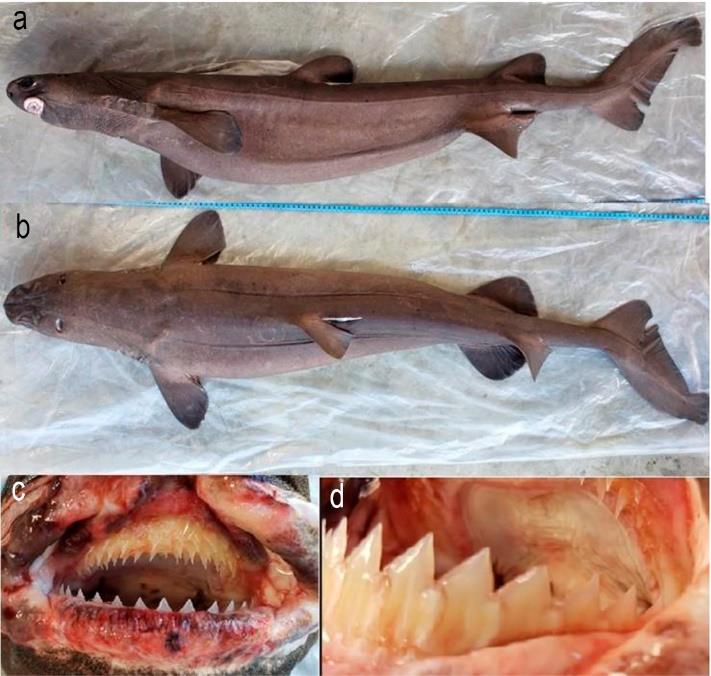
Figure 1. Adult female 1420 mm total length of Dalatias licha. a) lateral view, b) dorsal view, c) upper jaw teeth, d) lower jaw teeth.
Before the present study, the specimen from Venezuela was the only documented record from the Caribbean Sea and the most recent record in the western Atlantic. The specimens recorded from the Caribbean were both mature females of the same size (1420 mm TL) over the length at maturity (1170-1200 mm TL) (Castro 2011, Ebert et al. 2021). Additionally, 14 specimens from the western Atlantic, mainly from the northern Gulf of Mexico and the Gulf of Maine, have been found in ichthyological collections (Table S2).
During the same fishing trip, two other deepwater species were incidentally caught along with D. licha, the dwarf sicklefin chimaera Neoharriotta carri Bullis & Carpenter, 1966 (663-1090 mm TL) and the whitesaddled catshark Scyliorhinus hesperius Springer, 1966 (440-480 mm TL). Both species have been previously reported in the study area (Hacohen-Domené et al. 2016, Polanco-Vásquez et al. 2017) in addition to the sharpnose sevengill shark Heptranchias perlo (Bonnaterre, 1788), which was recently documented from the same fishing village (El Quetzalito) in the Guatemalan Caribbean (Hacohen-Domené et al. 2017).
The presence of the Cayman Trench near the Guatemalan Caribbean coast could explain the record of these deepwater shark species. The Cayman Trench is a narrow, deep linear basin immediately north of the Nicaraguan Rise, notable for being the site of contemporary sea-floor spreading. It extends from the Gulf of Honduras to southeastern Cuba. It has the deepest zones of the entire Caribbean (with regions deeper than 6000 m) and is bounded on the north and south sides by steep walls (Donnelly 1994).
With the record of D. licha, the number of shark species known in the Guatemalan Caribbean increased to 25. The few reports of this species in the Caribbean Sea reflect that current encounter rates in the fishery are low; however, the expansion of coastal fisheries to deeper waters presents an emerging threat to vulnerable deepwater assemblages of elasmobranchs as targeted and incidental catch (Baremore et al. 2021, Talwar et al. 2022).
Acknowledgments
Fundación Mundo Azul thanks El Quetzalito’s fishers for their support while monitoring elasmobranch landings and Consejo Nacional de Áreas Protegidas (CONAP) for permitting this research. We thank Dr. Dave Ebert for his assistance in the morphological identification of the specimen. Grants from the Rufford Foundation and The Summit Foundation funded this project.
Conflict of interest statement: The authors declare no conflict of interest.
Ethics approval: All research activities were conducted under permit Bno.1048, issued by Consejo Nacional de Áreas Protegidas (CONAP).
Data and materials availability: The specimen is available at the Centro de Estudios del Mar y Acuicultura (CEMA) collection of the Universidad de San Carlos de Guatemala (USAC) under reference N°166. Additional photographic material is available on request.
References
- Baremore, I.E., Graham, R.T. & Matthew, J.W. 2021. Fishing down the reef slope: characteristics of the nearshore deepwater fisheries of Mesoamerica. Ocean and Coastal Management, 211: 105773. doi: 10.1016/j.ocecoaman.2021.105773
- Bigelow, H.B., Perez-Farfante, I. & Schroeder, W.C. 1948. Fishes of the western North Atlantic, Part 1: lancelets, cyclostomes, and sharks (Memoir Sears Foundation for Marine Research, N°1). Yale University, New Haven.
- Bigelow, H.B., Schroeder, W.C. & Springer, S. 1955. Three new shark records from the Gulf of Mexico. Museum of Comparative Zoology, 49: 1-12.
- Cardeñosa, D., Hyde, J. & Caballero, S. 2014. Genetic diversity and population structure of the pelagic thresher shark (Alopias pelagicus) in the Pacific Ocean: Evidence for two evolutionarily significant units. PLoS One, 9: e110193. doi: 10.1371/journal.pone.0110193
- Castro, J.I. 2011. The sharks of North America. Oxford University Press, Oxford.
- Clark, E. & Kristof, E. 1990. Deep-sea elasmobranch observed from submersibles off Bermuda, Grand Cayman, and Freeport, Bahamas. In: Pratt, H.L., Gruber, S.H. & Taniuchi, T. (Eds.). Elasmobranchs as living resources: Advances in the biology, ecology, systematics, and the status of the fisheries. NOAA Technical Report NMFS, 90: 269-284.
- Compagno, L.J.V. 1984. Sharks of the world. An annotated and illustrated catalogue of shark species known to date. Part 1. Hexanchiformes to Lamniformes. FAO Fisheries Synopsis, 125. FAO, Rome.
- Compagno, L.J.V. 2016. Sharks. In: Carpenter, K.E. & De Angelis, N. (Eds.). The living marine resources of the Eastern Central Atlantic: bivalves, gastropods, hagfishes, sharks, batoid fishes, and chimaeras. FAO species identification guide for fisheries purposes. FAO, Rome.
- Compagno, L.J.V. & Cook, S.F. 2005. Kitefin shark Dalatias licha. In: Fowler, S.L., Cavanagh, R.D., Camhi, M., Burgess, G.H., Cailliet, G.M., Fordham, S.V., et al. (Eds.). Sharks, rays and chimaeras: the status of chondrichthyan fishes. IUCN/SSC Shark Specialist Group, Gland, Cambridge.
- Donnelly, T.W. 1994. The Caribbean Sea floor. In: Donovan, K. & Jackson, T.A. (Eds.). Caribbean geology: An introduction. University of the West Indies, Kingston, pp. 41-64.
- Ebert, D.A., Dando, M. & Fowler, S. 2021. Sharks of the world. A complete guide. Princeton University Press, New Jersey.
- Finucci, B., Walls, R.H.L., Guallart, J. & Kyne, P.M. 2018. Dalatias licha. The IUCN Red List of Threatened Species, 2018: e.T6229A3111662. doi: 10.2305/IUCN.UK.2018-2.RLTS.T6229A3111662.en
- Hacohen-Domené, A., Polanco-Vásquez, F. & Graham, R.T. 2016. First report of the whitesaddled catshark Scyliorhinus hesperius (Springer, 1966) in Guatemala’s Caribbean Sea. Marine Biodiversity Records, 9: 101. doi: 10.1186/s41200-016-0103-9
- Hacohen-Domené, A., Polanco-Vásquez, F. & Graham, R.T. 2017. First record of Heptranchias perlo (Bonaterre, 1788) in Guatemala’s Caribbean Sea. Marine Biodiversity Records, 10: 12. doi: 10.1186/s41200-017-0118-x
- Polanco-Vásquez, F., Hacohen-Domené, A., Méndez, T., Pacay, A. & Graham, R.T. 2017. First record of the chimaera Neoharriota carri (Bullis & Carpenter, 1966) in the Caribbean of Guatemala. Marine Biodiversity Records, 10: 1. doi: 10.1186/s41200-016-0104-8
- Soto, J. & Mincarone, M. 2001. First record of kitefin shark, Dalatias licha (Bonnaterre, 1788) (Chondrichthyes, Dalatiidae), in the South Atlantic. Mare Magnum, 1: 26.
- Tagliafico, A., Rago, N. & Ron, E. 2007. Primer reporte del tiburón Dalatias licha (Bonnaterre, 1788) (Elasmobranchii: Squaliformes: Dalatiidae) para Venezuela y el Mar Caribe. Boletín del Instituto Oceanográfico de Venezuela, 46: 113-117.
- Talwar, B.S., Anderson, B., Avalos-Castillo, C.G., Blanco-Parra, M., Briones, A., Cardeñosa, D., et al. 2022. Extinction risk, reconstructed catches and management of chondrichthyan fishes in the western central Atlantic Ocean. Fish and Fisheries, 23: 1150-1179. doi: 10.1111/faf.12675
- Walls, R. & Guallart, J. 2015. Dalatias licha (Europe assessment). The IUCN Red List of Threatened Species, 2015: e.T6229A48948357.
- Ward, R.D., Zemlak, T.S., Innes, B.H., Last, P.R. & Hebert, P.D. 2005. DNA barcoding Australia’s fish species. Philosophical Transactions of the Royal Society B: Biological Sciences, 360: 1847-1857. doi: 10.1098/rstb.2005.1716
Supplementary material
Table S1. Records of Dalatias licha in the western Atlantic and the Caribbean Sea. TL: total length.
| Sex (maturity stage) | Capture site | Ichthyological collection | TL (mm) | Depth of capture | Year of capture | Reference |
|---|---|---|---|---|---|---|
| Female (adult) | Georges Bank, Gulf of Maine, USA | Am. Mus. Nat. Hist., No. 14056 | 1470 | 83.5 m | 1937 | Bigelow & Shroeder (1948) |
| Female (juvenile) | Oregon, USA, northern Gulf of Mexico | U.S. Nat. Mus., N°157834 | 845 | 376 m | ? | Bigelow et al. (1955) |
| Male (neonate) | Off State Rio Grande, southern Brazil | Museu Oceanográfico do Vale do Itajaí (MOVI 16034) | 344 | Surface waters, drift net | 2000 | Soto & Mincarone (2001) |
| Female (adult) | Northwest Isla Margarita, Venezuelan Caribbean | CI-ECAM 0135 | 1420 | 240 m | 2006 | Tagliafico et al. (2007) |
| Female (adult) | Guatemalan Caribbean | CEMA 166 | 1420 | 284–334 | 2023 | Present study |
Table S2. Records of Dalatias licha in the western Atlantic from ichthyological collections (http://www.fishnet2.net/search.aspx). GOM: Gulf of Mexico. MCZ: Museum of Comparative Zoology, Harvard; USNM: Smithsonian National Museum of Natural History; CNPE: Colección Nacional de Peces, Biology Institute of the National Autonomous University of Mexico.
| Ichthyological collection | Catalog number | Country | Site of collection | Depth (m) | Year |
|---|---|---|---|---|---|
| MCZ | Ich S-1293 | USA | Gulf of Maine | Mid-1800s | |
| USNM | 157834 | USA | Pensacola, FL (GOM) | 411 | 1955 |
| USNM | 157844 | USA | Alabama (GOM) | 366 | 1955 |
| USNM | RAD100095 | USA | Alabama (GOM) | 366 | 1955 |
| USNM | 187625 (n = 2) | USA | Florida (Atlantic) | 1958 | |
| USNM | 220861 | USA | Louisiana (GOM) | 402 | 1962 |
| USNM | 206066 | USA | Mississippi (GOM) | 393–411 | 1962 |
| USNM | 188501 | USA | Mississippi (GOM) | 366–375 | 1962 |
| CNPE | 14609 | Mexico | Southern GOM | 698 | 2004 |
| MCZ | Ich S-1310 | USA | Gulf of Maine | ||
| MCZ | Ich S-1306 | USA | Gulf of Maine | ||
| MCZ | Ich S-1305 | USA | Gulf of Maine | ||
| USNM | 220739 | USA | Florida (FL) |
Received: August 7, 2023; Accepted: November 27, 2023