First record of the bluntnose sixgill shark Hexanchus griseus (Bonnaterre, 1788) in the Guatemalan Caribbean Sea
First record of the bluntnose sixgill shark Hexanchus griseus (Bonnaterre, 1788) in the Guatemalan Caribbean Sea
Julio Sánchez-Jiménez1, Omar Santana-Morales1, Josué Ayala-Donado1, María de los Rosales-Melgar1, Elisa M. Areano-Barillas1, Mónica González-Jaramillo2 & Juan Carlos Pérez-Jiménez1,3
Corresponding author: Juan Carlos Pérez-Jiménez (jcperez@ecosur.mx)
Abstract
The Guatemalan Caribbean has a deepwater fishing area close to the shore around the Cayman Trench. This study reports the first record of the bluntnose sixgill shark (Hexanchus griseus) from this fishing area. Fishery-independent surveys using longlines at ~430-465 m depth, ~11 km northeast of El Quetzalito fishing village, were conducted in 2022 and 2023. Two bluntnose sixgill sharks were captured during these surveys. The sharks were females with total lengths of 300 and 310 cm, with morphological characteristics consistent with this species. These are the first confirmed records of bluntnose sixgill sharks in the western Caribbean Sea. Expanding coastal fisheries to deeper waters presents an emerging threat to deep-sea chondrichthyans in the region. Therefore, periodic fisheries monitoring is needed to estimate their vulnerability to fishing pressure.
Keywords
Hexanchus griseus; sixgill shark; Hexanchidae biodiversity; deep-water; Cayman Trench; Guatemala conservation
The bluntnose sixgill shark Hexanchus griseus (Bonaterre, 1788) is a large species (at least 482 cm total length, TL) with a patchy distribution worldwide that inhabits continental and insular shelves from the surface to at least 2500 m depth in temperate and tropical waters of the Pacific, Atlantic, and Indian oceans (Compagno 1984, Ebert et al. 2021). Castro (2011) reported that ecology and life history differences exist between the Atlantic and Pacific forms, now explained by Vella & Vella (2017) as the result of population structure. Besides population subdivisions between the Pacific and Atlantic oceans, there are subdivisions within oceans and even on a smaller scale within the Mediterranean Sea (Vella & Vella 2017), highlighting the need for adequate knowledge of its distribution at a finer scale. Despite being recorded in the southwestern Caribbean Sea, in Colombia (Mejía-Falla & Navia 2019) and Venezuela (Ehemann et al. 2019, Tavares 2019), its presence was still unconfirmed in the western Caribbean.
The bluntnose sixgill shark was globally assessed in 2019 as Near Threatened (NT) on the IUCN Red List of Threatened Species because it is estimated to have undergone a population reduction of 20-29% over the past three generations (160 years) (Finucci et al. 2020). Although the species is infrequently caught incidentally in deepwater fisheries across its range, there is a high overlap between its distribution and intensive fishing pressure, and there is a lack of species-specific management across its entire range (Finucci et al. 2020). This situation highlights the need for information about distribution at a finer scale to assess potential fisheries impacts or other threats on its populations.
Two sixgill sharks of the order Hexanchiformes, family Hexanchidae, were caught through fishery-independent surveys using an artisanal fishing vessel (7.62 m long with outboard motor) from El Quetzalito, Guatemala, in September 2022 and April 2023. Sampling was conducted through permit Bno.1048, issued by Consejo Nacional de Áreas Protegidas (CONAP), as a part of a project to generate a baseline of elasmobranch deepwater fisheries.
The sharks were caught at ~430-465 m depth with a longline using ten circle hooks N°18, baited with tarpon Megalops atlanticus Valenciennes, 1847 and black jack Caranx lugubris Poey, 1860, and a chemical light stick near the baited hook to increase shark attraction, in a fishing area called El Hoyo (15°51’6.60”N, 88°14’33.78”W). The area is located ~11 km northeast of El Quetzalito fishing village on the margin of the Cayman Trench. The specimens were released after being sexed, and the total length was measured with a metric tape. Both sharks were identified following Compagno (1984) and Ebert et al. (2021).
The first bluntnose sixgill shark, a 310 cm TL female (Fig. 1), was caught and released on September 12, 2022, and the second, a 300 cm TL female, was caught and released on April 21, 2023. Both females were presumed to be immature since size-at-maturity is >400 cm TL (Castro 2011, Ebert et al. 2021).
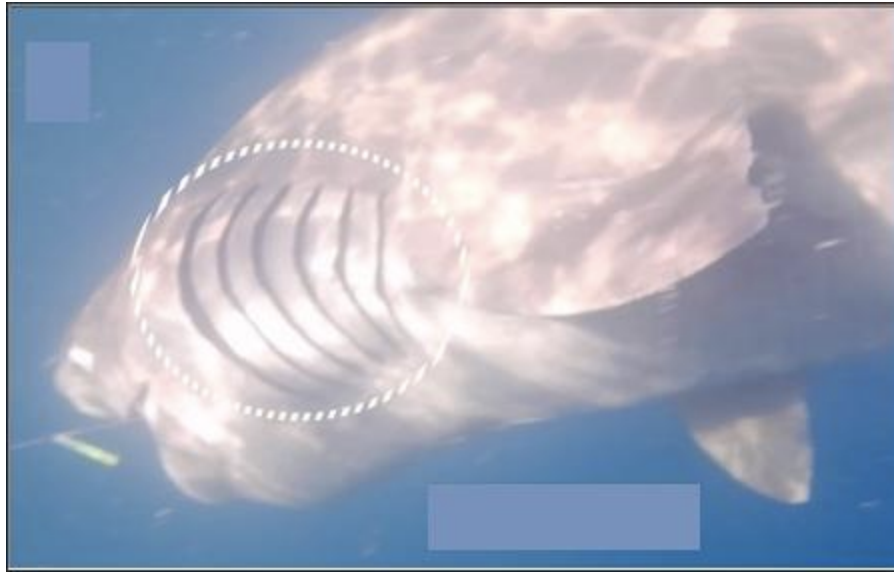
Figure 1. Bluntnose sixgill shark (Hexanchus griseus), a 310 cm TL female caught and released on September 12, 2022, in the fishing area of El Hoyo, Guatemalan Caribbean. The dotted circle highlights the six pairs of gill slits.
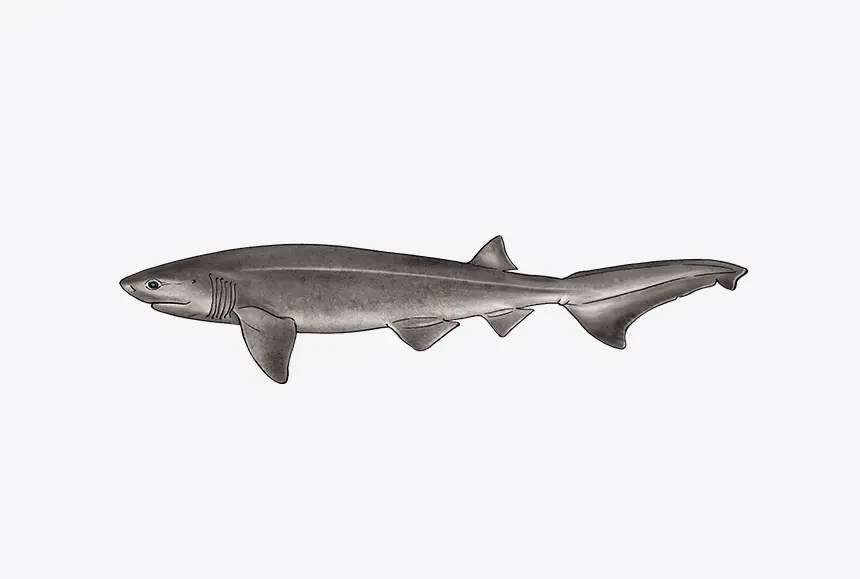
Visual observation of the specimen revealed key diagnostic characteristics consistent with hexanchid sharks. The individuals had six pairs of gill slits, a large mouth, one spineless dorsal fin behind the pelvic fins, a short lower lobe of the caudal fin, and an anal fin. More specifically, both sharks had key characteristics of the bluntnose sixgill shark, including a large, heavy body; broad head; small eyes; and grey or tan to blackish color in the dorsal area. Another sixgill shark present in the study area is the Atlantic bigeye sixgill shark, Hexanchus vitulus (Springer & Waller 1969), which can be distinguished from the bluntnose sixgill shark by its slender, medium-sized body (maximum size of 178 cm TL), a broadly acute mouth; and relatively large eyes (Ebert et al. 2021).
Although Finucci et al. (2020) and Ebert et al. (2021) include other Central American countries (Honduras, Nicaragua, Costa Rica, and Panama) in the species distribution map, occurrence in these countries has yet to be confirmed. Further, only some confirmed records of bluntnose sixgill sharks from the western Atlantic are found in the literature. Bigelow & Schroeder (1948) reported it from the northern coast of Cuba and established that it was rare northwards; for example, there was only one record of a specimen from North Carolina, USA. Bigelow & Schroeder (1948) also established no evidence of occurrence anywhere in the Gulf of Mexico and the Caribbean region. Later, Gilhen & Coad (1991) reported its presence in Nova Scotia, Canada, and Carey & Clark (1995) in Bermuda. Castro (2011) confirmed that the first record in the western North Atlantic was a specimen (310 cm TL) caught in North Carolina (in 1886) and that there was another record (396 cm TL) from the Mississippi River delta, northern Gulf of Mexico (in 1963); additional specimens have been reported from Cape Hatteras, New England, Texas, Florida (Castro 2011), Maryland, Louisiana, Alabama, New Jersey, and Bahamas (Table 1).
Table 1. Records of the bluntnose sixgill shark (Hexanchus griseus) deposited in ichthyological collections from the western Atlantic.
| Ichthyological collection | Catalog number | Country | Site of collection | Depth (m) | Year |
|---|---|---|---|---|---|
| USNM | 37790 | USA | North Carolina | 1886 | |
| ANSP Fish | 102597 | Cuba | Havana | 1934 | |
| USNM | 111180 | USA | Maryland | 1942 | |
| USNM | 112600 | Bahamas | Bimini | 274 | 1948 |
| UF Fish | 102424 | USA | Louisiana | 0 | 1962 |
| USNM | 188048 | USA | Louisiana | 357-366 | 1962 |
| UF Fish | 101285 | USA | Florida | 180 | 1966 |
| TCWC | 3923.01 | USA | Texas | 1984 | |
| UF Fish | 179524 | USA | South Carolina | 1987 | |
| UF Fish | 178570 | Bahamas | Abaco Island | 152 | 1988 |
| UF Fish | 178571 | Bahamas | Abaco Island | 152 | 1988 |
| CMN | 1990-0032.1 | Canada | Nova Scotia | 1989 | |
| UF Fish | 48458 | USA | Alabama | 0 | 1990 |
| UF Fish | 83993 | USA | Alabama | 0 | 1990 |
| UF Fish | 171140 | USA | New Jersey | 2007 | |
| MCZ | 36217 | Cuba | Havana | No data | |
| MCZ | 40424 | Bahamas | Bimini | 304 | No data |
| MCZ | 35630 | Cuba | Havana | No data | |
| NCSM | 28450 | USA | No data |
In the Caribbean Sea, as mentioned above, the species has been reported in Colombia (Mejía-Falla & Navia 2019) and Venezuela (Ehemann et al. 2019, Tavares 2019). The bluntnose sixgill shark has been recorded in the southwest Atlantic (Coscarella et al. 1997, Sabadin et al. 2020, Santander-Neto et al. 2023), particularly in northeast Brazil where Santander-Neto et al. (2023) reports 23 specimens (mainly immature females 180-300 cm TL) caught by commercial fisheries. Thus, before the present study, the reports from Cuba, Colombia, and Venezuela were the only verified records from the Caribbean Sea.
Two other species of the family Hexanchidae have recently been documented for the first time in the small-scale fisheries in the same fishing area where the bluntnose sixgill sharks were caught. Hacohen-Domené et al. (2017) documented two female (28 and 37 cm TL) sharpnose sevengill sharks, Heptranchias perlo, captured in 2016. Avalos-Castillo et al. (2020) reported 10 (61-165 cm TL) Atlantic bigeye sixgill sharks, H. vitulus, caught between 2015-2019. In the Caribbean Sea, the sharpnose sevengill shark and the Atlantic bigeye sixgill shark have also been recorded in Colombia (Mejía-Falla & Navia 2019), Jamaica (McLaughlin & Morrissey 2004), and Venezuela (Ehemann et al. 2019, Tavares 2019), and additionally, the Atlantic bigeye sixgill shark in the Bahamas (Springer & Waller 1969) and Belize (Daly-Engel et al. 2019). Mejía-Falla & Navia (2019) reported the bigeye sixgill shark Hexanchus nakamurai in Colombia; however, the species name H. vitulus was recently resurrected, with bigeye sixgill sharks from the Atlantic referrable to H. vitulus, and those from the Indo-Pacific as H. nakamurai (Ebert et al. 2021).
The presence of the Cayman Trench near the Guatemalan Caribbean coast may explain the occurrence of deepwater chondrichthyans in the study area (Hacohen-Domené et al. 2016, Polanco-Vásquez et al. 2017, 2022, Avalos-Castillo et al. 2020). The Cayman Trench extends from the Gulf of Honduras, to which the Guatemalan Caribbean coast belongs, to southeast Cuba. It has the deepest zones of the entire Caribbean (with regions deeper than 6000 m) and is bounded on the north and south sides by steep slopes (Donnelly 1994).
The few reports of bluntnose sixgill sharks in the Caribbean Sea reflect low encounter rates with fisheries. Periodic monitoring of fisheries is needed to estimate their vulnerability to fishing pressure due to the expansion of coastal fisheries to deeper waters, which presents an emerging threat to deepwater elasmobranch assemblages (Baremore et al. 2021, Talwar et al. 2022). Therefore, it is critical to provide data on distribution and basic biological aspects to assess vulnerability to overexploitation and inform regional management measures.
Acknowledgments
Fundación Mundo Azul thanks El Quetzalito’s fishers for their support while conducting fishery-independent surveys, and Consejo Nacional de Áreas Protegidas (CONAP) and Dirección de la Normatividad de la Pesca y la Acuacultura (DIPESCA) for permitting this research. Rufford Foundation, Luis von Ahn Foundation, and The Summit Foundation funded the elasmobranch monitoring project. All research activities were conducted under permit Bno.1048, issued by Consejo Nacional de Áreas Protegidas (CONAP). Additional photographic and video material is available on request.
References
- Avalos-Castillo, C.G., Santana-Morales, O., Becerril-García, E.E. & Areano, E. 2020. New records and morphometry of the Atlantic sixgill shark Hexanchus vitulus in the Caribbean coast of Guatemala. Latin American Journal of Aquatic Research, 48: 488-491. doi: 10.3856/vol48-issue3-fulltext-2436
- Baremore, I.E., Graham, R.T. & Matthew, J.W. 2021. Fishing down the reef slope: Characteristics of the nearshore deepwater fisheries of Mesoamerica. Ocean and Coastal Management, 211: 105773. doi: 10.1016/j.ocecoaman.2021.105773
- Bigelow, H.B. & Schroeder, W.C. 1948. Fishes of the western North Atlantic, lancelets, cyclostomes, and sharks. Memoir N°1. Sears Foundation for Marine Research, Yale University, New Haven.
- Carey, F.G. & Clark, E. 1995. Depth telemetry from the sixgill shark, Hexanchus griseus, at Bermuda. Environmental Biology of Fishes, 42: 7-14. doi: 10.1007/BF00002345
- Castro, J.I. 2011. The sharks of North America. Oxford University Press, Oxford.
- Compagno, L.J.V. 1984. Sharks of the world. An annotated and illustrated catalogue of shark species known to date. Part 1. Hexanchiformes to Lamniformes. FAO Fisheries Synopsis, 4: 1-249.
- Coscarella, M., García, N.A., Crespo, E.A., Mariotti, P.A., Koen-Alonso, M. & Dans, S.L. 1997. Presence of the bluntnose sixgill shark Hexanchus griseus (Chondrichthyes, Hexanchidae) in Patagonian waters, with comments on the stomach contents and reproductive condition. Neotropica, 43: 116.
- Daly-Engel, T.S., Baremore, I.E., Grubbs, R.D., Gulak, S.J.B., Graham, R.T. & Enzenauer, M.P. 2019. Resurrection of the sixgill shark Hexanchus vitulus Springer & Waller, 1969 (Hexanchiformes, Hexanchidae), with comments on its distribution in the northwest Atlantic Ocean. Marine Biodiversity, 49: 759-768. doi: 10.1007/s12526-018-0849-x
- Donnelly, T.W. 1994. The Caribbean sea floor. In: Donovan, K. & Jackson, T.A. (Eds.). Caribbean geology: An introduction. University of the West Indies Public Association, Kingston, pp. 41-64.
- Ebert, D.A., Dando, M. & Fowler, S. 2021. Sharks of the world. A complete guide. Princeton University Press, New Jersey.
- Ehemann, N.R., González-González, L.D.V., Tagliafico, A. & Weigmann, S. 2019. Updated taxonomic list and conservation status of chondrichthyans from the exclusive economic zone of Venezuela, with first generic and specific records. Journal of Fish Biology, 95: 753-771. doi: 10.1111/jfb.14061
- Finucci, B., Barnett, A., Bineesh, K.K., Cheok, J., Cotton, C.F., Dharmadi, D., et al. 2020. Hexanchus griseus. The IUCN Red List of Threatened Species, 2020: e.T10030A495630. https://www.iucnredlist.org/species/10030/495630 [Reviewed: March 13, 2023]
- Gilhen, J. & Coad, B.W. 1991. The bluntnose sixgill shark Hexanchus griseus (Bonnaterre, 1788) new to the fish fauna of Atlantic Canada. Proceedings of the Nova Scotian Institute of Science, 39: 75-77.
- Hacohen-Domené, A., Polanco-Vásquez, F. & Graham, R.T. 2016. First report of the white saddled catshark Scyliorhinus hesperius (Springer, 1966) in Guatemala’s Caribbean Sea. Marine Biodiversity Records, 9: 101. doi: 10.1186/s41200-016-0103-9
- Hacohen-Domené, A., Polanco-Vásquez, F. & Graham, R.T. 2017. First record of Heptranchias perlo (Bonaterre, 1788) in Guatemala’s Caribbean Sea. Marine Biodiversity Records, 10: 12. doi: 10.1186/s41200-017-0118-x
- McLaughlin, D.M. & Morrissey, J.F. 2004. New records of elasmobranchs from the Cayman Trench, Jamaica. Bulletin of Marine Science, 75: 481-485.
- Mejía-Falla, P.A. & Navia, A.F. 2019. Checklist of marine elasmobranchs of Colombia. Universitas Scientiarum, 24: 241-276. doi: 10.11144/Javeriana.SC24-1.come
- Polanco-Vásquez, F., Hacohen-Domené, A., Becerril-García, E.E. & Hernández, S. 2022. New record and range extension of the roughskin spurdog Cirrhigaleus asper in the Caribbean Sea. Revista de Biología Marina y Oceanografía, 57: 3418. doi: 10.22370/rbmo.2022.57.Especial.3418
- Polanco-Vásquez, F., Hacohen-Domené, A., Méndez, T., Pacay, A. & Graham, R.T. 2017. First record of the chimaera Neoharriota carri (Bullis & Carpenter, 1966) in the Caribbean of Guatemala. Marine Biodiversity Records, 10: 1. doi: 10.1186/s41200-016-0104-8
- Sabadin, D.E., Lucifora, L.O., Barbini, S.A., Figueroa, D.E. & Kittlein, M. 2020. Towards regionalization of the chondrichthyan fauna of the Southwest Atlantic: a spatial framework for conservation planning. ICES Journal of Marine Science, 77: 1893-1905. doi: 10.1093/icesjms/fsaa064
- Santander-Neto, J., Rincon, G., Jucá-Queiroz, B., Paes da Cruz, V. & Lessa, R. 2023. Distribution and new records of the bluntnose sixgill shark, Hexanchus griseus (Hexanchiformes: Hexanchidae), from the Tropical Southwestern Atlantic. Animals, 13: 91. doi: 10.3390/ani13010091
- Springer, S. & Waller, R.A. 1969. Hexanchus vitulus, a new sixgill shark from the Bahamas. Bulletin of Marine Science, 19: 159-175.
- Talwar, B.S., Anderson, B., Avalos-Castillo, C.G., Blanco-Parra, M., Briones, A., Cardeñosa, D., et al. 2022. Extinction risk, reconstructed catches and management of chondrichthyan fishes in the Western Central Atlantic Ocean. Fish and Fisheries, 23: 1150-1179. doi: 10.1111/faf.12675
- Tavares, R. 2019. Estado actual de los tiburones y rayas (Pisces: Elasmobranchii) en el mar Caribe venezolano: biodiversidad, pesca y conservación. Ciencia Pesquera, 27: 33-52.
- Vella, N. & Vella, A. 2017. Population genetics of the deep-sea bluntnose sixgill shark, Hexanchus griseus, revealing spatial genetic heterogeneity. Marine Genomics, 36: 25-32. doi: 10.1016/j.margen.2017.05.012
Received: June 9, 2023; Accepted: December 19, 2023