Elasmobranch bycatch of the shrimp trawl fishery along the Pacific coast of Guatemala
Elasmobranch bycatch of the shrimp trawl fishery along the Pacific coast of Guatemala
Julio Sánchez (contact author)1 | Omar Santana Morales1,2 | Rebeca Zertuche2 | Elisa Areano1
Email address for contact author: jfsanchez89@gmail.com
1 Fundación Mundo Azul, Boulevard Rafael Landívar 10-05 Paseo Cayalá zona 16, Edificio D1, Oficina 202, 01016 Guatemala City, Guatemala
2 Ecología Cielo, Mar y Tierra A.C., Avenida del Puerto 2270, Colonia Hidalgo, 22880 Ensenada, Baja California, Mexico
Abstract
In this study, the species composition of bycatch in the shrimp bottom-trawl fishery off the Pacific coast of Guatemala was examined. In total, 15 species of elasmobranchs, including 13 ray species and 2 shark species, were recorded. Of these taxa, 1 species is listed as critically endangered, 4 species are listed as near threatened, 7 species are listed as vulnerable, and 1 species is listed as a species of least concern by the International Union for Conservation of Nature. Currently, there is no official monitoring system for shrimp trawling in Guatemala; therefore, the abundance and biological characteristics of the elasmobranch species caught as bycatch are unknown. This information is lacking because only 5.5% of the registered elasmobranch bycatch was landed and traded for its economic value.
Manuscript submitted 15 December 2022. Manuscript accepted 25 April 2023. Fish. Bull. 121:78–83 (2023). Online publication date: 25 May 2023. doi: 10.7755/FB.121.3.2
The views and opinions expressed or implied in this article are those of the author (or authors) and do not necessarily reflect the position of the National Marine Fisheries Service, NOAA.
Worldwide, shrimp trawling has the highest discard rate of all fisheries (27% in 2005) (Kelleher, 2005). Although reducing bycatch is important from both economic and management standpoints, bycatch is economically valuable in developing countries and supports food security in many coastal communities (Gillett, 2010; Barreto et al., 2022). Nonetheless, in many Latin American countries, shrimp trawl fisheries are currently banned because they are unsustainable (TNC1). In Guatemala, cartilaginous and bony fish species are incidentally caught in the shrimp trawl fishery, which is still permitted. The species that are commercially valuable are retained, and the others are discarded at sea. Shrimp trawling for 5 shrimp species and 1 prawn species is conducted on both the Pacific and Caribbean coasts of Guatemala (TNC1). In the 1980s and into the mid-1990s, 60 large vessels and about 1500 artisanal vessels participated in this fishery. Between 1995 and 2000, a notable reduction in catch occurred and has continued to the present day. From 2010 through 2013, 750–1500 metric tons (t) of shrimp (plus 250 t of bycatch species) were landed, but only 150 t of shrimp were landed from 2014 through 2016. In 2016, bycatch (100 t) was greater than the catch of shrimp (50 t) (FAO, 2018).
Ixquiac Cabrera (1998) identified 148 species of bony fish and 11 species of elasmobranchs among the shrimp bycatch from the Pacific coast of Guatemala, although the study did not include a complete annual fishing cycle or information on the biological characteristics of incidentally caught elasmobranchs. Using data from both the artisanal and trawl fisheries operating on the continental shelf, Ixquiac Cabrera et al.2 constructed a catalog of batoid species present in the Pacific Ocean off Guatemala and reported 15 species from the families Dasyatidae, Myliobatidae, Urotrygonidae, Rajidae, Rhinobatidae, and Narcinidae. Nonetheless, a notable information gap exists regarding the bycatch of the shrimp trawl fishery. In an effort to fill this gap, we developed a method to evaluate the bycatch of different shrimp trawlers. Some vessels systematically and voluntarily provided samples of their bycatch from each fishing trip so that the composition of the bycatch could be characterized. Through the results of this study, we provide herein a current description of the shrimp trawl fishery in Guatemala and characterize the species composition and biological characteristics of incidentally caught elasmobranchs. These data will aid in managing these species.
Materials and methods
Study area
Bottom trawling is conducted along the Pacific coast of Guatemala within the exclusive economic zone (83,000 km²) between the 5- and 50-m isobaths (<30 km offshore) (TNC1). The low-temperature months are from January through March (28.6–29.1°C), and the high-temperature months are from April through December (29.2–30.2°C) (Ponce Hernández, 2015). Therefore, the temperature of the sea surface in this region is quite stable throughout the year. The Directorate of Fisheries and Aquaculture Regulations (DIPESCA) of Guatemala conducts official inspections at the industrial landing sites of Puerto San José and Buena Vista. However, many trawlers and small vessels strategically use the alternative artisanal landing zone of Las Lisas, which is located approximately 150 km from the industrial landing sites and has its own fish market. During the rainy season (May–October) when catches are high, fishermen are paid the best prices at Las Lisas.
Monitoring of landings
Crew members of the vessels included in this study voluntarily collected and retained a portion of the organisms that are normally discarded at sea from each fishing trip. We then collected these retained organisms and used them to obtain biological data. Landings from 69 different fishing trips and 8 different trawl vessels were documented in Las Lisas from 2017 through 2022, and portions of elasmobranchs retained from the catches were sampled and photographed. Total length (for sharks, the natural extension of the caudal fin was used), disc width, disc length, and clasper length (in males) were recorded (to the nearest 0.5 cm). The maturity of males was verified by using clasper calcification. Eggs or embryos emerging from the cloaca in females were opportunistically recorded. In addition, trawler crews gathered the elasmobranchs that were to be discarded and collected one sample (5–7 kg) per trip. Each discard specimen was photographed, measured, and identified following Compagno (2001), Ebert and Fowler (2015), and Ebert et al. (2021). For all species, we summarized the main morphological characteristics, sex ratio, and size at first maturity obtained from the literature (Villavicencio Garyzar, 2000; Anislado-Tolentino and Robinson-Mendoza, 2001; López et al.3; Payán et al., 2011; Torres-Huerta4; Castellanos Betancourt et al., 2013; Pincay-Espinoza and Romero-Calcedo, 2014; Torres Palacios, 2015; Vélez Tacuri, 2015; Carrera-Fernández et al., 2019; Ronquillo Moreira, 2019; Jiménez García, 2020), along with conservation status according to the International Union for Conservation of Nature (IUCN) Red List of Threatened Species (IUCN, 2022). Finally, length-frequency histograms were created for species for which data for more than 30 individuals were collected.
Results and discussion
Fishing activity
Five shrimp species, the seabob (Xiphopenaeus kroyeri), crystal shrimp (Penaeus brevirostris), yellowleg shrimp (P. californiensis), whiteleg shrimp (P. vannamei), and blue shrimp (P. stylirostris), and 1 prawn species, the pelagic red crab (Pleuroncodes planipes), are harvested along the Pacific coast of Guatemala (TNC1). Bony fish species, such as the bigmouth sanddab (Citharichthys gilberti), spotted rose snapper (Lutjanus guttatus), and Pacific sierra (Scomberomorus sierra) (Jolon-Morales et al.5), and shark species, such as the scalloped hammerhead (Sphyrna lewini) (FUNMZ6), are also caught, landed, and marketed. From 2017 through 2022, 16 active shrimp trawlers, with an average of 5 crew members, average length of 18.66 m (13.00–22.87 m), average net registered weight of 22.37 t [4–87 t], and average gross registered weight of 70.49 t (14–170 t), operated in the region (Morales7). There are no closed seasons to regulate commercial shrimp fishing; as a result, trawling is conducted year-round, although shrimp trawlers are more active during the rainy season (FUNCAGUA8). The shrimp trawling fleet requires 30-d permits granted by DIPESCA. Normally, trawling vessels work for 12–15 d at a time, and 4–5 trawl tows are conducted each day (3–4 h of operation in total per day). We observed that trawlers, preferring to reduce fuel costs, made partial landings in Las Lisas with the aid of smaller boats from the fishing community instead of returning to the official docks of Puerto San José and Buena Vista.
A limited number of trained DIPESCA personnel are available to conduct inspections and collect data of commercial shrimp landings to control fishing activities along the Pacific coast of Guatemala; therefore, data are limited and unreliable. High staff turnover within DIPESCA has also resulted in unreported or irregularly reported catches and unreliable data. No monitoring programs currently record the additional organisms captured as bycatch in shrimp trawling activities. Information on bycatch off Guatemala is lacking, although turtles and marine mammals, in addition to elasmobranchs, are known to be captured with shrimp trawling fishing gears.
Landings
In all, 43 trips (62.3% of trips) were conducted during the rainy season, and 26 trips (37.7% of trips) were conducted during the dry season. A total of 1330 elasmobranchs were recorded, belonging to 5 orders, 12 families, and 15 species. Of these 15 species, 1 species is listed as critically endangered, 4 species are listed as near threatened, 7 species are listed as vulnerable, and 1 species is listed as a species of least concern on the IUCN Red List (Table 1) (IUCN, 2022). Overall, 73 elasmobranch individuals (5.5% of the total number of elasmobranchs recorded) were considered commercially valuable and sold. The bycatch mainly comprised 3 ray species, the longtail stingray (Hypanus longus), golden cownose ray (Rhinoptera steindachneri), and Pacific eagle ray (Aetobatus laticeps), and 2 shark species, the scalloped hammerhead and bull shark (Carcharhinus leucas). The fins of large sharks (>1 m in total length) were dried and marketed.
Ten elasmobranch species were discarded (number of samples [n]=1257, 94.5% of the total number of individuals recorded; Table 1). Of these 10 species, the vermiculate electric ray (Narcine vermiculata) (n=426) was the most abundant, followed by the Panamic stingray (Urotrygon aspidura) (n=397), whitesnout guitarfish (Pseudobatos leucorhynchus) (n=182), giant electric ray (N. entemedor) (n=127), blotched stingray (U. chilensis) (n=72), and longtail stingray (n=38). Other species were represented by less than 30 individuals (Table 1).
Table 1. Number of samples (n), ratio of males (M) to females (F), size range, and status on the International Union for Conservation of Nature and Natural Resources (IUCN) Red List of Threatened Species for elasmobranch species landed by shrimp trawlers in Las Lisas, Guatemala, during 2017–2022. Also noted is whether captured individuals of non-target species were traded in the market (bycatch) or had no commercial value and were returned to the sea dead or alive (discard). The measurement of size (MS) is either total length (TL) or disk width (DW). Sizes at first maturity are from the literature. No data (ND) on size at maturity were available in the literature for Rostroraja equatorialis.
| Species | n | Sex ratio (M:F) | MS | Average size (cm) | Size range (cm) | Size at first maturity (cm) – Males | Size at first maturity (cm) – Females | IUCN status | Discard or bycatch |
|---|---|---|---|---|---|---|---|---|---|
| Narcine vermiculata | 426 | 151:275 | TL | 20.6 | 6.0–39.3 | 11.6 | 11.6 | Least concern | Discard |
| Urotrygon aspidura | 397 | 153:244 | TL | 32.9 | 9.0–94.2 | 23.0 | 25.0 | Near threatened | Discard |
| Pseudobatos leucorhynchus | 182 | 58:124 | TL | 38.2 | 18.0–63.4 | 51.2 | 48.5 | Vulnerable | Discard |
| Narcine entemedor | 127 | 34:93 | TL | 27.4 | 14.0–68 | 47.7 | 70.0 | Vulnerable | Discard |
| Urotrygon chilensis | 72 | 30:42 | DW | 18.3 | 10.0–29.2 | 16.5 | 16.0 | Near threatened | Discard |
| Hypanus longus | 38 | 9:29 | DW | 62.8 | 7.0–131.0 | 92.0 | 120.0 | Vulnerable | Bycatch |
| Zapteryx xyster | 27 | 10:17 | TL | 36.8 | 26.0–57.0 | 46.8 | 50.0 | Vulnerable | Discard |
| Gymnura crebripunctata | 22 | 15:7 | DW | 34.9 | 18.5–54.0 | 34.2 | 58.8 | Near threatened | Discard |
| Sphyrna lewini | 17 | 10:7 | TL | 49.8 | 42.0–54.0 | 170.0 | 190.0 | Critically endangered | Bycatch |
| Rhinoptera steindachneri | 15 | 0:15 | DW | 39.2 | 26.0–47.0 | 71.8 | 71.8 | Near threatened | Bycatch |
| Aetobatus laticeps | 2 | 0:2 | DW | 41.1 | 37.2–45.0 | 83.2 | 83.2 | Vulnerable | Bycatch |
| Rostroraja equatorialis | 2 | 0:2 | DW | 35.1 | 32.7–37.5 | ND | ND | Vulnerable | Discard |
| Carcharhinus leucas | 1 | 0:1 | TL | – | 262.0 | 157.0 | 180.0 | Vulnerable | Bycatch |
| Gymnura sp. | 1 | 0:1 | DW | – | 38.0 | – | – | – | Discard |
| Zapteryx sp. | 1 | 1:0 | TL | – | 38.0 | – | – | – | Discard |
In this study, 13 ray species and 2 shark species were identified. About 90% of these species belong to 3 genera, Narcine, Urotrygon, and Pseudobatos, which accounted for 41.6%, 35.3%, and 13.7% of the identified species, respectively. According to the distribution of sizes and sexes recorded for the most abundant species (Fig. 1), trawling could be affecting the breeding areas of the vermiculate electric ray, Panamic stingray, and blotched stingray. At the same time, this trawl fishing zone could be a breeding area for the whitesnout guitarfish, giant electric ray, and longtail stingray. This probable breeding area extends along the Pacific coast of Guatemala, between the isobaths of 5 and 50 m (TNC1), where trawling activities take place throughout the year. However, it is necessary to continue monitoring this fishery to be able to determine the extent and temporality of this area according to the different species recorded. The biological characteristics shared by elasmobranch species (e.g., late sexual maturity and low fecundity) make their populations vulnerable to instability when subjected to direct or incidental fishing pressure (Walker, 1992). The trawl nets used in the Pacific Ocean off Guatemala are not selective, although they have turtle excluding devices. The resulting bycatch is concerning because of the lack of records and data (Gillett, 2010), especially considering that bycatch exceeded the catch volume of targeted shrimp species in Guatemala in 2016 (FAO, 2018).
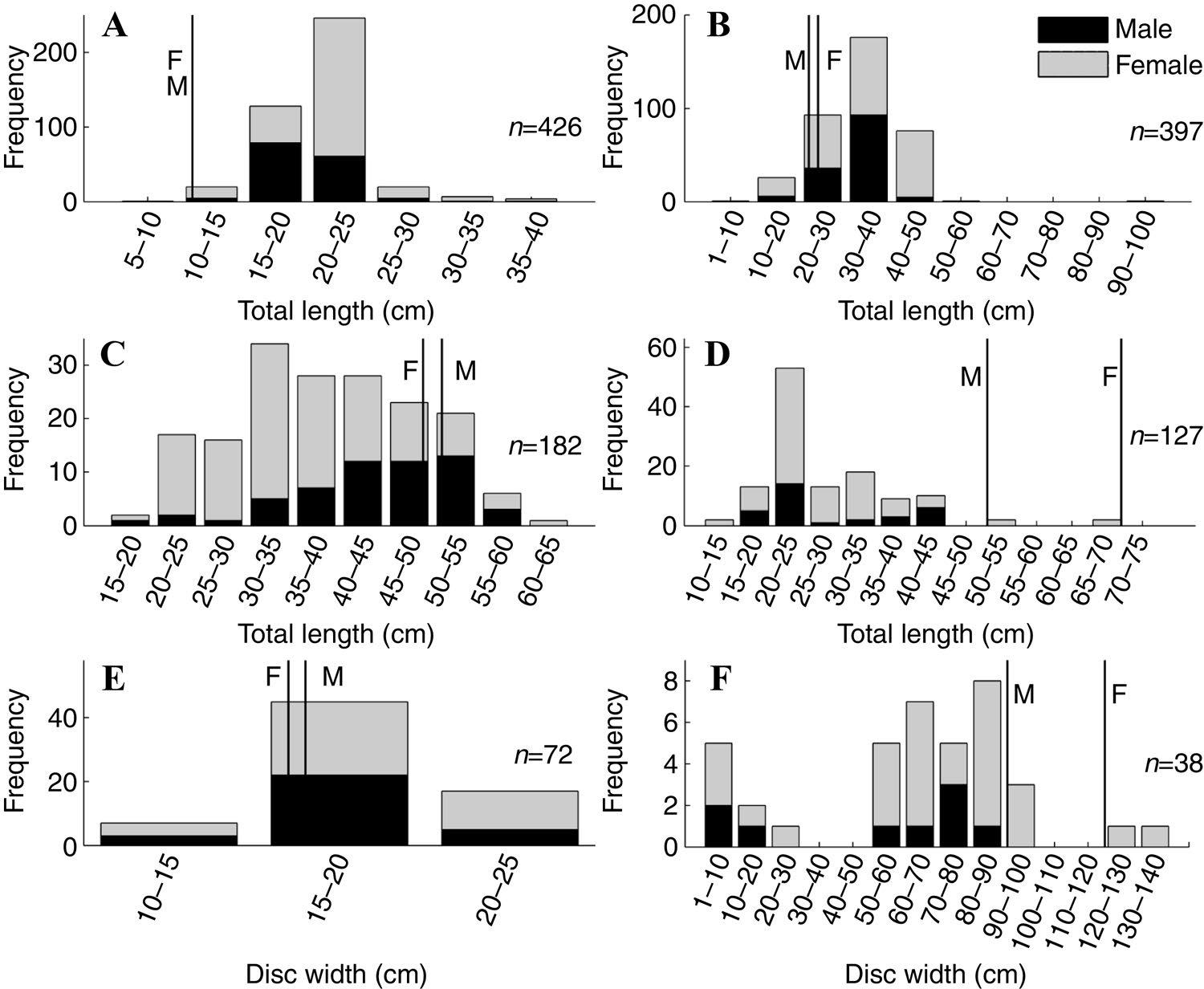
Figure 1. Size–frequency distributions of elasmobranch species landed by shrimp trawlers as bycatch from 2017 through 2022 in Las Lisas, Guatemala: (A) vermiculate electric ray (Narcine vermiculata), (B) Panamic stingray (Urotrygon aspidura), (C) whitesnout guitarfish (Pseudobatos leucorhynchus), (D) giant electric ray (N. entemedor), (E) blotched stingray (U. chilensis), and (F) longtail stingray (Hypanus longus). Histograms are based on the number of organisms sampled (n), not on the total number of individuals captured. The vertical lines indicate lengths at first maturity for males (M) and females (F).
Conservation and management
In the General Law of Fisheries and Aquaculture of Guatemala, rays are not included as target species in coastal fisheries (MAGA, 2002). In 2021, the Ministry of Agriculture, Livestock, and Food, which oversees DIPESCA, approved the National Action Plan for the Conservation of Chondrichthyans of Guatemala by ministerial agreement (no. 280-2021) (MAGA, 2021) to investigate, manage, and conserve chondrichthyan species in the exclusive economic zones of Guatemala in the Atlantic and Pacific Oceans. Nonetheless, few studies on elasmobranchs that are not commercially valuable, such as the Panamic stingray (Torres Palacios, 2015), which is listed as near threatened on the IUCN Red List (Kyne et al., 2020a), and the blotched stingray (Pincay-Espinoza and Romero-Calcedo, 2014), which also is listed as near threatened on the IUCN Red List (Kyne et al., 2020b), have been done. Therefore, little information is available to inform management decisions. Indeed, the composition and volume of ray bycatch are often unknown, and no research or monitoring efforts are directed at this group of elasmobranch species. As such, the results of this study provide an important characterization of the species composition of elasmobranchs that are normally discarded as bycatch during shrimp trawling activities off Guatemala.
Acknowledgments
This study was supported by the Shark Conservation Fund (grant no. G-21-2123555). We thank L. Trejo, J. Morales, M. Shoenbeck, T. Pereira, A. Lievana, and J. Rodríguez for their support. We also thank our community monitors in Las Lisas and the trawlers that operate along the Pacific coast of Guatemala for their collaboration during data collection.
Notes
- 1 TNC (The Nature Conservancy). 2018. Planificación espacial marina del Pacífico de Guatemala, 108 p. Proyecto conservación y uso sostenible de la biodiversidad en áreas protegidas marino-costeras. Ministerio de Ambiente y Recursos Naturales, Consejo Nacional de Áreas Protegidas, United Nations Development Programme, and Global Environment Facility. [Available from TNC, 4245 North Fairfax Dr., Ste. 100, Arlington, VA 22203-1606.]
- 2 Ixquiac Cabrera, M., I. Franco, J. Lemus, S. Méndez, and A. López-Roulet. 2010. Identificación, abundancia, distribución espacial de batoideos (rayas) en el Pacífico Guatemalteco, 41 p. Informe final. Proyecto Fodecyt 34-2006. Fondo Nac. Cienc. Tecnol., Cent. Estud. Mar Acuic., and Organ. Conserv. Medio Ambiente, Guatemala City, Guatemala.
- 3 López, J., P. A. Mejía-Falla, and A. F. Navia. 2009. Aspectos biológicos de la raya látigo Dasyatis longa (Pisces: Dasyatidae) de la zona central del Pacífico colombiano. Doc. Téc. Fund. SQUALUS FS0109, 39 p.
- 4 Torres-Huerta, A. M. 2012. Peces batoideos de la plataforma continental del Golfo de Tehuantepec, 68 p. Informe final. SNIB-CONABIO proyecto no. HJ031. Inst. Recur., Univ. Mar., Puerto Ángel, Mexico.
- 5 Jolon-Morales, M. R., R. Sanchez-Castañeda, J. C. Villagrán-Colón, C. Mechel, and H. A. Kinh. 2005. Estudio sobre los recursos pesqueros (de escama) en el Litoral Pacífico y Mar Caribe de Guatemala, 128 p. Agencia Esp. Coop. Int. and Uni. Manejo Pesca Acuic., Guatemala City, Guatemala.
- 6 FUNMZ (Fundación Mundo Azul). 2023. Informe anual 2022, 25 p. FUNMZ, Guatemala City, Guatemala.
Literature cited
- Anislado-Tolentino, V., and C. Robinson-Mendoza. 2001. Age and growth for the scalloped hammerhead shark, Sphyrna lewini (Griffith and Smith, 1834) along the central Pacific coast of Mexico. Cienc. Mar. 27:501–520.
- Barreto, G. C., M. A. Leite Lima, A. R. Carvalho, V. R. Cañete, F. H. Souza Lobato, Q. H. Pantoja Lobo, M. T. Cabrera, F. Escobar-Toledo, M. Rueda, Á. Hernández-Flores, et al. 2022. Cadenas de valor en las pesquerías de arrastre de América Latina y el Caribe—integración y análisis de estudios nacionales. FAO Doc. Téc. Pesca Acuic. 679, 70 p. FAO, Rome.
- Carrera-Fernández, M., C. M. Tenelema-Delgado, and A. B. Zúñiga Reinoso. 2019. Aspectos reproductivos de la raya mariposa, Gymnura crebripunctata, en el Pacífico ecuatoriano. In Libro de resúmenes. Primer congreso Latinoamericano de tiburones, rayas y quimeras: VIII Simposium Nacional de Tiburones y Rayas; Playa del Carmen, 27–29 March, p. 46. Soc. Mex. Peces Cartil., Mexico City, Mexico.
- Castellanos Betancourt, J. C., C. E. Ramírez Santiago, and J. L. Castillo Géniz. 2013. Catálogo de aletas, tronchos y cabezas de tiburones en el Pacífico Mexicano, 60 p. Inst. Nac. Pesca, Juarez, Mexico.
- Compagno, L. 2001. Sharks of the world. An annotated and illustrated catalogue of shark species known to date. Volume 2: Bullhead, mackerel and carpet sharks (Heterodontiformes, Lamniformes and Orectolobiformes). FAO Species Cat. Fish. Purp. 1, 269 p. FAO, Rome.
- Ebert, D., and S. Fowler. 2015. A pocket guide to sharks of the world, 256 p. Princeton Univ. Press, Princeton, NJ.
- Ebert, D. A., M. Dando, and S. Fowler. 2021. Sharks of the world: a complete guide, 608 p. Princeton Univ. Press, Princeton, NJ.
- FAO (Food and Agriculture Organization of the United Nations). 2018. Diagnóstico del sector de la pesca y la acuacultura en Guatemala, 64 p. FAO, Guatemala City, Guatemala.
- Gillett, R. 2010. Estudio mundial sobre las pesquerías del camarón. FAO Doc. Téc. Pesca Acuic. 475, 386 p. FAO, Rome.
- IUCN (International Union for Conservation of Nature and Natural Resources). 2022. The IUCN Red List of Threatened Species, vers. 2022-3. [Accessed November 2022.]
- Ixquiac Cabrera, M. 1998. Análisis de la composición y distribución de la fauna de acompañamiento del camarón (FAC) en el Océano Pacífico guatemalteco dentro de las isóbatas de 10 al 100 m durante los cruceros de investigación enero 1996 a febrero 1998. B.S. thesis, 104 p. Cent. Estud. Mar Acuic., Univ. San Carlos Guatem., Guatemala City, Guatemala.
- Jiménez García, Y. A. 2020. Demografía de Rhinoptera steindachneri (Evermann & Jenkins, 1891) y Narcine entemedor (Jordan & Starks, 1985); en Bahía de la Paz, BCS, México. M.S. thesis, 52 p. Cent. Interdiscip. Cienc. Mar, Inst. Politéc. Nac., La Paz, Mexico.
- Kelleher, K. 2005. Discards in the world’s marine fisheries: an update. FAO Fish. Tech. Pap. 470, 152 p. FAO, Rome.
- Kyne, P. M., P. Charvet, E. M. Areano, A. Cevallos, M. Espinoza, A. González, K. Herman, P. A. Mejía-Falla, J. M. Morales-Saldaña, A. F. Navia, et al. 2020a. Urotrygon aspidura. The IUCN Red List of Threatened Species 2020: e.T161689A124528276.
- Kyne, P. M., P. Charvet, E. M. Areano, A. Cevallos, M. Espinoza, A. González, K. Herman, P. A. Mejía-Falla, J. M. Morales-Saldaña, A. F. Navia, et al. 2020b. Urotrygon chilensis. The IUCN Red List of Threatened Species 2020: e.T44647A124436667.
- MAGA (Ministerio de Agricultura, Ganadería y Alimentación). 2002. Ley general de pesca y acuicultura. Decreto no. 80-2002. Congreso de la República de Guatemala, Guatemala City, Guatemala.
- MAGA (Ministerio de Agricultura, Ganadería y Alimentación). 2021. Plan de acción nacional para la ordenación y conservación de tiburones, rayas y quimeras de Guatemala. Acuerdo Ministerial no. 280-2021, 2 p. Minist. Agric. Ganad. Aliment., Guatemala City, Guatemala.
- Payán, L. F., A. F. Navia, E. A. Rubio, and P. A. Mejía-Falla. 2011. Biología de la raya guitarra Rhinobatos leucorhynchus (Günther, 1867) (Rajiformes: Rhinobatidae) en el Pacífico colombiano. Lat. Am. J. Aquat. Res. 39:286–296.
- Pincay-Espinoza, J., and A. Romero-Calcedo. 2014. Reproducción de la raya chilena Urotrygon chilensis en dos localidades del Pacífico ecuatoriano. In Primer Congreso Latinoamericano de Rayas y Quimeras; Manta, 10–12 March, p. 71–76. Secr. Tec. Mar., Manta, Ecuador.
- Ponce Hernández, J. A. 2015. Relación entre la abundancia relativa del pez vela Istiophorus platypterus (Shaw, 1792) y la temperatura superficial del agua en el Pacífico de Guatemala. B.S. thesis, 29 p. Univ. San Carlos Guatem., Guatemala City, Guatemala.
- Ronquillo Moreira, I. L. 2019. Distribución, abundancia, estructura de tallas y fidelidad del sitio de Aetobatus laticeps, mediante monitoreo participativo y foto-identificación I3S en la Reserva Marina El Pelado, Santa Elena. B.S. thesis, 57 p. Univ. Estatal Peníns. Santa Elena, Santa Elena, Ecuador.
- Torres Palacios, K. 2015. Edad y crecimiento de la raya espinosa Utrotrygon aspidura de la zona Centro-Sur del Pacífico colombiano. M.S. thesis, 59 p. Cent. Interdiscip. Cienc. Mar., Inst. Politéc. Nac., La Paz, Mexico.
- Vélez Tacuri, J. 2015. Aspectos reproductivos de la raya ocelada Zapteryx xyster (Jordan & Everman, 1896) en Santa Rosa, Salinas, Ecuador. B.S. thesis, 99 p. Univ. Laica Eloy Alfaro Manabí, Manta, Ecuador.
- Villavicencio Garayzar, C. J. 2000. Taxonomía abundancia estacional, edad y crecimiento y biología reproductiva de Narcine entemedor Jordan y Starks (Chondrichthyes; Narcinidae), en Bahía Almejas, B.C.S., México. Ph.D. diss., 136 p. Univ. Autónoma Nuevo León, San Nicolás de los Garza, Mexico.
- Walker, T. I. 1992. Fishery simulation model for sharks applied to the gummy shark, Mustelus antarticus Günther, from southern Australian waters. Mar. Freshw. Res. 43:195–212.