Combining monitoring approaches to reveal deep‑water chondrichthyans diversity in the Caribbean waters of Guatemala
https://doi.org/10.1007/s12526-026-01657-x
Combining monitoring approaches to reveal deep‑water chondrichthyans diversity in the Caribbean waters of Guatemala
Ana Cristina Hérnandez‑Solis1 · Julio Sánchez‑Jiménez1 · Elisa M. Areano‑Barillas1 · Juan Carlos Pérez‑Jiménez1,2
Received: 26 July 2025 / Revised: 28 January 2026 / Accepted: 13 April 2026
© The Author(s), under exclusive licence to Senckenberg Gesellschaft für Naturforschung 2026
Communicated by F. A. Martinez
Juan Carlos Pérez‑Jiménez jcperez@ecosur.mx
1 Fundación Mundo Azul, Km 21.5 Carretera a Villa Canales, Guatemala, Guatemala
2 El Colegio de La Frontera Sur, Av. Rancho Polígono 2‑A, Ciudad Industrial, 24500, Lerma, Campeche, México
Abstract
Between 2015 and 2025, a total of 124 deep-water chondrichthyan individuals were recorded in El Quetzalito, Guatemala, through fishery-dependent monitoring (n=86) and fishery-independent longline surveys (n=38), representing seven shark species, one skate, and one chimaera. The gulper shark (Centrophorus granulosus) was the most recorded species across both surveys, with females and immature individuals present among the captures. Catch per unit effort (CPUE) for C. granulosus showed a decreasing trend in both monitoring approaches, underscoring the importance of continued monitoring to better understand these patterns. Other species recorded included Hexanchus vitulus, Squalus cubensis, Neoharriotta carri, and several rare or single-occurrence taxa. Fishery-independent data revealed species not seen in recent commercial landings, such as S. cubensis, emphasizing the value of complementary survey methods to detect underreported taxa in artisanal fish- eries. The predominance of mature females in commercial landings and immature individuals in research surveys suggests differential spatial or behavioral patterns that may influence catchability. This study provides a baseline for understanding deep-water elasmobranch diversity in the region and highlights the importance of combining fishery-dependent and fishery- independent approaches to generate data on these little-known and vulnerable species.
Introduction
Deep-water ecosystems are among the least studied environments worldwide (Ramirez-Llodra et al. 2010; Costello et al., 2017; Finucci et al. 2022, 2024). Despite increased deep-water exploration and resource exploitation in recent decades, scientific surveys remain limited, particularly in remote regions, resulting in an incomplete understanding of deep-water biodiversity (Danovaro et al. 2014; Miller et al. 2018; Finucci et al. 2022).
Deep-water species represent the most diverse yet understudied group among chondrichthyans (cartilaginous fishes, including sharks, rays, and chimaeras) (Finucci et al. 2022).
These species primarily inhabit depths exceeding 200 m throughout their life cycle (Kyne and Simpfendorfer 2007). Nearly half of all known chondrichthyan species are classi- fied as deep-water species (Cotton and Grubbs 2015) and given the vast unexplored regions of the deep sea, many more are likely to remain undiscovered (Finucci et al. 2022).
Deep-water chondrichthyans play crucial ecological roles by linking pelagic, mesopelagic, and benthic ecosystems through trophic interactions. They prey on mesopelagic, benthopelagic, and demersal fishes and invertebrates, while some species also scavenge on marine mammals and dis- carded fisheries catch, contributing to nutrient cycling in deep-sea ecosystems (Cotton and Grubbs 2015; Kyne and Simpfendorfer 2010; Pethybridge et al. 2012). Nevertheless, despite their important role in maintaining ecosystem balance, deep-water chondrichthyans can be particularly vulnerable to overfishing due to a combination of biological traits and increasing fishing pressure in deep-sea habitats (Kyne and Simpfendorfer 2010). Their life-history characteristics, such as slow growth, late sexual maturity, low fecundity, long gestation periods, and extended lifespans, are evolutionary adaptations to the extreme conditions of the deep sea, including low temperatures, high hydrostatic pressure, limited food availability, and the absence of sunlight, which restricts primary production (Tyler et al. 2016; Finucci et al. 2022). For instance, species such as Centrophorus granulosus, Dalatias licha, and Deania calceus exhibit very low intrinsic rates of population increase and are currently listed as Vulnerable to Critically Endangered on the IUCN Red List.
Additionally, they experience relatively low predation pressure, with larger sharks as their primary natural predators. Their reproductive strategy, producing only a few offspring capable of reaching maturity, has been successful in stable, predator-limited environments; however, it leaves them highly susceptible to population decline under human exploitation (Cortés, 2000; Rigby and Simpfendorfer 2015). Deep-water chondrichthyans exhibit even lower productivity than their coastal and pelagic relatives, making their populations less resilient to fishing pressure and more prone to depletion (García et al. 2008; Simpfendorfer and Kyne 2009).
In recent decades, the expansion of deep-water fisheries has significantly increased pressure on deep-water chondrichthyans, particularly in regions where bottom trawling and bottom longlining are prevalent (Baremore et al. 2021; Talwar et al. 2022). Many deep-water sharks are caught as bycatch or targeted for their meat, liver oil, and fins, yet their slow life cycles mean that even low levels of fishing can cause severe population declines. Given their limited capacity for recovery, continued exploitation without effective management could push many deep-water chondrichthyans toward extinction (García et al. 2008; Simpfendorfer and Kyne 2009).
In the review by Finucci et al. (2024), it was found that most deep-water chondrichthyans (87.7%) are caught incidentally in trawl, longline, and gillnet fisheries targeting species such as grenadiers and hakes. Meanwhile, 11.6% of deep-water chondrichthyans are directly targeted in fisheries.
However, targeted fishing is a major concern among threatened species, affecting 35% of species, particularly those from three families: gulper sharks, dogfishes, and hardnose skates (Finucci et al.2024). Bycatch in deep-water trawling and longline fisheries remains a significant conservation issue, often leading to population declines (Kyne and Simpfendorfer 2010). Additionally, habitat degradation and the expanding footprint of industrial fisheries further threaten these species, highlighting the urgent need for improved management and conservation strategies.
Although no published data are available describing a direct expansion of Guatemalan Caribbean fisheries into deep-sea habitats, regional studies indicate that similar fisheries in the western Atlantic have increasingly shifted to deeper waters following declines in coastal resources (Baremore et al. 2021; Talwar et al. 2022). Based on these documented patterns, a comparable expansion may occur in the Guatemalan Caribbean, particularly along the Cayman Trench. However, the extent to which local fisheries may transition into deeper habitats remains largely unknown. Artisanal fishers from El Quetzalito reported that deeper fishing grounds yield higher catches of groupers and occasional pelagic sharks, making these areas attractive; nevertheless, these observations should be interpreted as local perceptions rather than evidence of a systematic expansion.
Since 2015, efforts led by the Blue World Foundation, in collaboration with artisanal fishers, have resulted in the documentation of at least eight deep-water chondrichthyan species in Guatemalan waters. Notable among these are Centrophorus granulosus (Endangered) and Dalatias licha (Vulnerable), both species of conservation concern due to their limited reproductive potential and susceptibility to overexploitation. Other recorded species include Hexanchus griseus, Heptranchias perlo, Squalus cubensis, Scyliorhinus hesperius, Hexanchus vitulus, Cirrhigaleus asper, and the chimaera Neoharriotta carri. Several of these represent recent and significant findings for the country’s marine fauna. For example, the first national records of S. hesperius, H. perlo, N. carri, and H. vitulus were reported by Hacohen-Domené et al. (2016a, 2016b), Polanco-Vásquez et al. (2017), and Avalos-Castillo et al. (2020), respectively, while D. licha and H. griseus were added to the list more recently by Sanchez-Jiménez et al. (2024a, 2024b).
Although every year the Ministry of Agriculture, Live- stock, and Food (MAGA), through the Directorate of Fisheries and Aquaculture Regulation (DIPESCA), establishes a 4-month closed season for sharks and rays, the current impact of fishing on deep-water chondrichthyans in the region remains unknown due to the lack of species-specific monitoring and reporting. The main objective of this paper is to describe the diversity and catch composition of deep-water chondrichthyans in both fishery-dependent and fishery-independent surveys conducted in the Caribbean of Guatemala. This study aims to provide essential baseline information to inform future conservation strategies and enhance the management of these vulnerable and understudied species.
Material and methods
Study area
The study was conducted in the coastal community of El Quetzalito (Fig. 1), located in the municipality of Puerto Barrios, Izabal, Guatemala. Since 2015, Fundación Mundo Azul (Blue World Foundation) has been conducting chondrichthyan landing monitoring in this community. Recently, in 2022, the organization initiated scientific longline surveys in the deep waters of Guatemala’s Caribbean territorial sea, within the marine area of the Punta de Manabique Wildlife Refuge (RVSPM), which borders El Quetzalito.
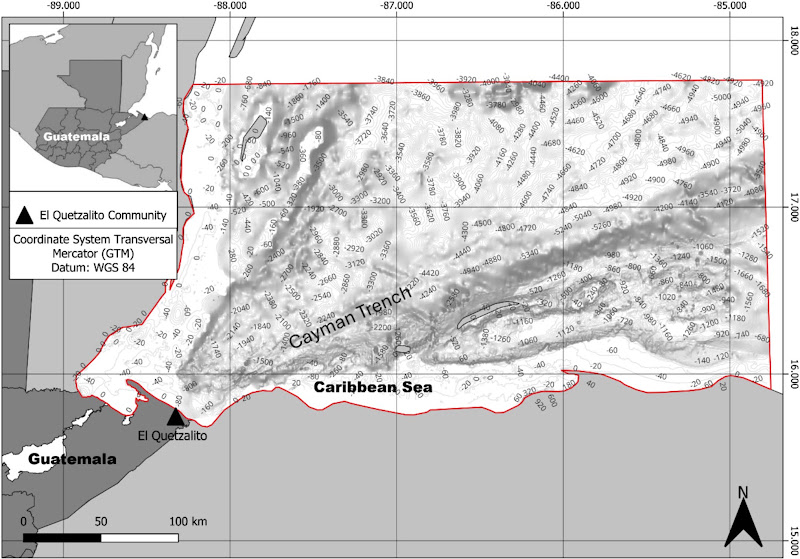
Fig. 1 Study area in the Guatemalan Caribbean showing bathymetry(m) and the location of the coastal community of El Quetzalito. The inset map (upper left) indicates the location of Guatemala within Central America, while the main panel depicts the Caribbean Sea, highlighting the deep-sea geomorphological features of the Cayman Trench
Fishery‐dependent monitoring surveys
Local fishers and youth from El Quetzalito were trained to conduct landing monitoring of chondrichthyans caught during artisanal fishing operations. These monitors formed part of a Citizen Science Program. Monitors recorded data on species composition, specimen count, total length (± 1cm), fishing gear used, and the number of boats returning from fishing trips each day. A total of 65artisanal fishing trips were recorded between February 2015 and April 2025, in compliance with the closed season for sharks and rays. The ban on shark fishing occurred from May to August, and the ban on ray fishing occurred from June to September.
Catch per unit effort (CPUE) was calculated for each species as the total number of individuals reported in a given year divided by the total number of fishing trips conducted that same year. Additionally, a global CPUE was calculated by dividing the total number of individuals reported across all years by the total number of fishing trips during the study period. The monitoring program documented a total of 658 fishing trips during the study period; however, only the 350 bottom longline sets were included in the analysis, as longlines operate in deeper waters than gillnets and therefore provide a more reliable measure of encounterability with deep-water chondrichthyan species. Each longline set is deployed once per day and retrieved the following day, enabling artisanal fishers to access deeper habitats where these species may occur. The monitoring program operates daily and provides coverage of three artisanal vessels.
Artisanal longlines consist of four polypropylene sections (8 mm × 425 m each), for a total length of 1500–1700 m, and carry approximately 220 non-offset circle hooks (size 9/0). Lines are anchored at both ends and baited with shad (Opisthonema spp.) or bonito (Sarda spp.). The operational depth of the gear varies according to the target species: when targeting pelagic sharks, fishers typically set the longline between 30 and 100 m, whereas when targeting deep-associated groupers, the gear is deployed at depths exceeding 200 m. These deeper deployments increase the likelihood of occasional interactions with deep-water chondrichthyans. Although precise depth measurements are not available for all commercial fishing trips, this operational range provides an informative approximation of the depths at which individuals recorded in commercial landings were captured.
Fishery‐independent monitoring surveys
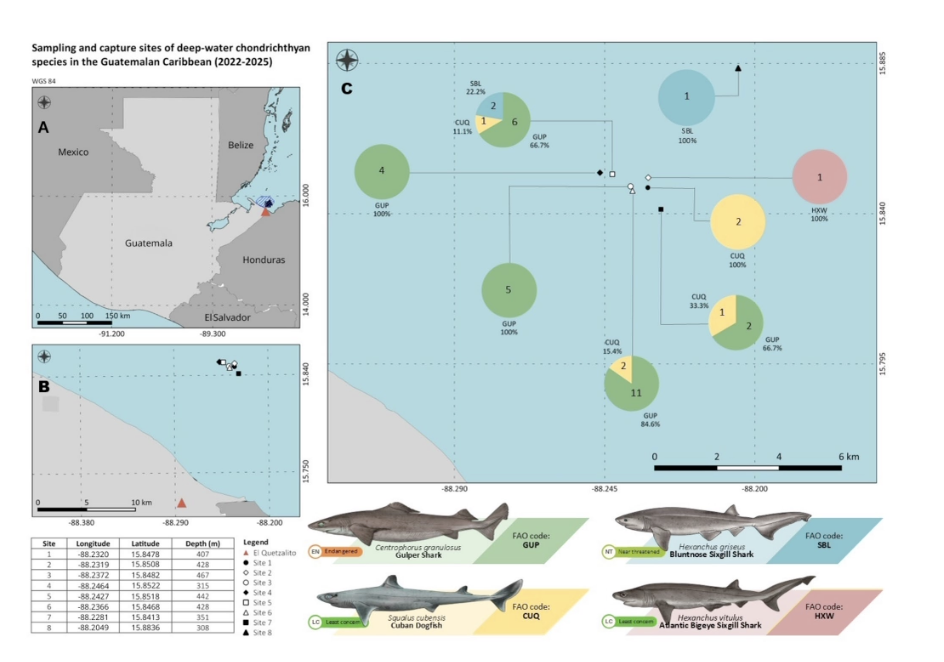
Scientific longlines were deployed in collaboration with local fishers at eight fishing sites within an area known by El Quetzalito fishers as El Hoyo (The Hole) (Fig. 2). El Hoyo is located within the Cayman Trench, which has the deepest areas in the Caribbean. These surveys took place from September 2022 to April 2025, in accordance with the seasonal fishing bans. A total of 75 scientific bottom longline setswere deployed at depths ranging from 315 to 467 m across 22 scientific campaigns, with two to three sets deployed per campaign depending on weather conditions. Captured individuals were handled following strict protocols to minimize harm, as recommended by Protocol 16022 of the Institutional Animal Care and Use Committee (IACUC, 2022).
Each shark was restrained in the water alongside the vessel by three team members while its taxonomic identification, sex, and total length were recorded, with total length measured using a measuring tape. For very large individuals (e.g., the ~ 4 m bluntnose sixgill shark, Hexanchus griseus), the measurement may involve some approximation. The physical condition of each shark was also recorded at the time of capture or release to document signs of stress or barotrauma, which is particularly relevant for deep-water species.
Additionally, sharks were tagged with Floy tags to obtain crucial data in the event of recapture by fisheries, such as movement patterns, survival times, and growth rates. The CPUE was calculated for each species as the total number of individuals recorded in a given year divided by the total number of longlines deployed during that year. A global CPUE was also calculated by dividing the total number of individuals recorded across all years by the number of longlines deployed throughout the study period.
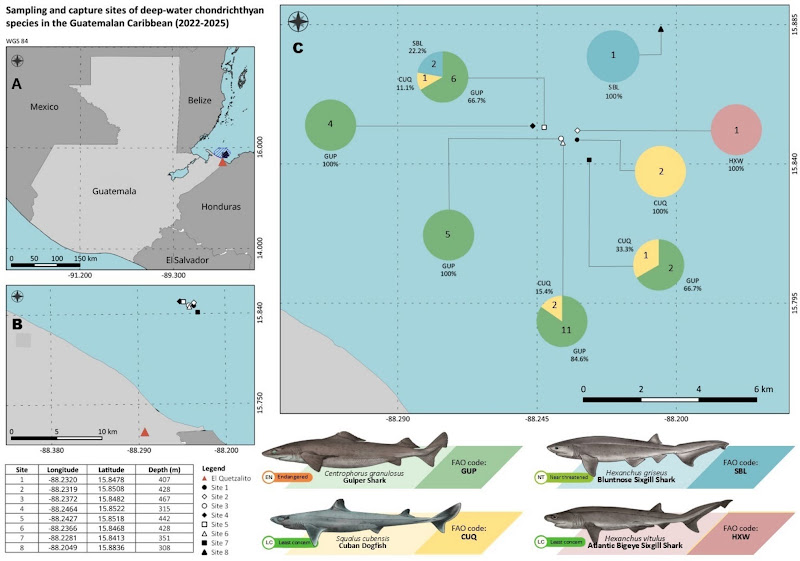
Fig. 2 Fishing areas for deep-water chondrichthyan species in the Guatemala Caribbean. A Location of El Quetzalito (red triangle) and approximate polygons representing the artisanal fishing grounds (blue hatched area) and the fishery-independent survey area (black circle); B closer view of El Quetzalito and the specific sites sampled during the scientific surveys. At the bottom of the panel, a table summarizes the geographic coordinates and corresponding sampling depths for each site; C locations where deep-water shark species were captured during fishery-independent surveys, with different colors indicating individual species. The symbols (legend) identifying each sampling site correspond to those reported in the table shown in panel B We used different units of fishing effort for fishery-dependent and fishery-independent surveys because effort could be quantified at different levels of resolution. For fishery-independent surveys, effort was precisely quantified as the number of longlines deployed per year. In contrast, during fishery-dependent monitoring, fishers used variable numbers of longlines and sets per trip, and this information was not consistently recorded. Consequently, the most reliable measure of effort available for fishery-dependent data was the number of fishing trips. This methodological difference limits direct quantitative comparison of CPUE values between monitoring approaches but reflects the highest-quality effort data available for each dataset.
Taxonomic identification and biological features
All chondrichthyan specimens were identified to the species level using standard taxonomic references, including Ebert et al. (2021) and Castro (2011), which offer comprehensive diagnostic keys, morphological descriptions, and distributional information for sharks, rays, and chimaeras. These guides ensured consistent and accurate identification across both fishery-dependent and fishery-independent records.
Size-frequency distributions were constructed for the most frequently captured species, the gulper shark Centrophorus granulosus, using data from both monitoring approaches. Maturity status was assessed using established morphological and size-based criteria. For males, individu- als were classified as mature when claspers were fully calcified and rigid, whereas uncalcified or partially calcified claspers indicated immaturity, following the diagnostic criteria described by Clark and von Schmidt (1965). For females, maturity was determined using published size-at-maturity values reported for each species, primarily based on Ebert et al. (2021) and Castro (2011). To evaluate differences in body size of C. granulosus between fishery-dependent and fishery-independent surveys, a Student’s t-test was conducted to compare mean total length between both groups.
Results and discussion
Between 2015 and 2025, a total of 124 deep-water chondrichthyan individuals were recorded in El Quetzalito through both fishery-dependent landing monitoring (n=86;69.4%) and fishery-independent longline surveys (n=38;30.6%) (Table 1). The dataset comprises seven shark species, one skate, and one chimaera, reflecting the area’s remarkable deep-water elasmobranch diversity and offering valu- able baseline data for future conservation and management efforts.
In the fishery-dependent surveys, the most landed species was the gulper shark (C. granulosus), with 36 individuals, representing 41.9% of the landing records. Of these, 58.33% were classified as mature, and the average total length was 131.1 ± 29.2 cm. Females represented 97.22% of the individuals recorded, which may indicate sex-based spatial segregation, habitat preferences, or behavioral patterns that increase female catchability. This species is listed as Endangered (EN) by the IUCN, and although its capture rate is low, the fact that most individuals recorded were females raises concerns about the potential vulnerability of its reproductive population in the region. The Atlantic sixgill shark (Hexanchus vitulus) followed with 17 individuals (19.8% of landings), of which 64.71% were mature; however, only 35.29% were females. The Cuban dogfish (Squalus cubensis) comprised 14 individuals (16.3%), with 85.71% classified as mature and 42.86% identified as female. The dwarf sick- lefin chimaera (Neoharriotta carri) was recorded 12 times (14.0%), with 75% of the individuals mature and 83.3% of the individuals being female.
| No. | Species | # Records | Mean size ± SD (cm TL) | Size range (cm) | % Maturity | % Females | IUCN status |
|---|---|---|---|---|---|---|---|
| Fishery-dependent monitoring surveys | |||||||
| 1 | Centrophorus granulosus | 36 | 131.1 ± 29.2 | 48.0–198.00 | 58.33 | 97.22 | EN |
| 2 | Hexanchus vitulus | 17 | 135.5 ± 29.0 | 61.0–165.00 | 64.71 | 35.29 | LC |
| 3 | Squalus cubensis | 14 | 47.6 ± 19.5 | 26.6–110.00 | 85.71 | 42.86 | LC |
| 4 | Neoharriotta carri | 12 | 78.5 ± 18.1 | 46.4–109.00 | 83.33 | 75.00 | NT |
| 5 | Cirrhigaleus asper | 3 | 117.0 ± 9.6 | 110.0–128.00 | 100.00 | 100.00 | DD |
| 6 | Scyliorhinus hesperius | 2 | 46.0 ± 2.8 | 44.0–48.00 | 100.00 | 0.00 | LC |
| 7 | Dalatias licha | 1 | 142.00 | N.A. | 100.00 | 100.00 | VU |
| 8 | Dipturus garricki | 1 | 79.20 | N.A. | 0.00 | 100.00 | LC |
| Fishery-independent monitoring surveys | |||||||
| 1 | Centrophorus granulosus | 28 | 98.4 ± 30.8 | 45.0–145.00 | 14.29 | 96.43 | EN |
| 2 | Squalus cubensis | 6 | 51.2 ± 11.5 | 40.0–68.00 | 66.67 | 83.33 | LC |
| 3 | Hexanchus griseus | 3 | 343.3 ± 66.6 | 300.0–420.00 | 33.33 | 100.00 | NT |
| 4 | Hexanchus vitulus | 1 | 155.0 | N.A. | 100.00 | 0.00 | LC |
TL, total length; N.A., not available. Size range is listed as N.A. when only a single individual was recorded. IUCN status: EN, Endangered;
LC, Least concern; NT, Near threatened; VU, Vulnerable; DD, Data deficient Other species recorded in lower numbers include the roughskin spurdog (Cirrhigaleus asper), with three mature females; the whitesaddled catshark (Scyliorhinus hesperius), with two mature males; the kitefin shark (Dalatias licha), with one mature female; and the San Blas skate (Dipturus garricki), represented by a single female. Despite their low representation, the biological importance of these species should not be underestimated. Deep-water elasmobranchs exhibit traits such as slow growth, late maturity, low fecundity, and long lifespans (Tyler et al. 2016; Finucci et al. 2022), making them particularly vulnerable to overexploitation (Kyne and Simpfendorfer 2010). Consequently, even infrequent captures can have a significant impact on their population stability (Finucci et al. 2024).
In the fishery-independent scientific surveys, C. granulosus was also the most caught species, representing 73.7% of the total captures (28 individuals) (Fig. 2). However, in contrast to the fishery-dependent results, the majority (85.71%) of these individuals were immature (Fig. 3), with a lower average size (98.4 ± 30.8 cm TL) and similar female-biased sex ratio (96.43%). Additionally, the mean total length of C. granulosus differed significantly between monitoring approaches (t=4.33, df=62, P < 0.0001), with individuals recorded in the fishery-dependent surveys being larger on average (131.1 ± 29.2 cm TL) than those captured during the fishery-independent surveys (98.4 ± 30.8 cm TL).
In the fishery-independent surveys, depth-related catch data indicate that Site 6, at 428 m depth, yielded the highest number of individuals (N=13), followed by Site 5 at 442 m depth (N=9). The remaining sites recorded catches of five individuals or fewer, and no consistent pattern in catch abundance with depth was evident. For example, some sites deeper than 400 m yielded only one or two specimens, while two sites shallower than 400 m recorded catches of three and four individuals (Fig. 2).
In terms of species composition, most C. granulosus were captured at depths greater than 400 m, with the exception of Site 4 (315 m), where four individuals were recorded. Most S. cubensis were also captured at depths exceeding 400 m. Specimens of Hexanchus spp. were recorded across a depth range of 308–442 m (Fig. 2).
The observed pattern, with more immature individuals recorded in the fishery-independent surveys, may reflect spatial segregation by age or sex. However, this possibility cannot be evaluated without clearer information on the extent of overlap between the surveyed areas and the fishing grounds. Current evidence suggests that the commercial fleet operates across a wider and more variable area than that covered by the scientific surveys, using fishing grounds that only partially coincide with those sampled through fishery-independent efforts, which underscores the need to better quantify this spatial overlap.
Records of C. granulosus showed a gradual decrease in the number of individuals recorded over the years in both monitoring methods (see Supplementary Materials S1 and S2). In particular, fishery-independent data show a decrease in C. granulosus CPUE across the years (Table 2), with catch rates dropping from 2.00 individuals per set in 2022 to zero in 2025.
Similarly, fishery-dependent CPUE data (Table 3) show a decrease in catch rates for C. granulosus. The global CPUE for this species over the 11-year period was 0.103 individuals per fishing trip, with the most recent years showing near-zero catch rates. While this pattern in the fishery-dependent data may be influenced by a reduction in fishing effort, likely driven by the declining profitability of deep-sea fisheries and the limited market demand for deep-water shark products in the region, it may also reflect differences in the spatial extent of fishing activities. The commercial fleet often operates across a broader and more diverse area than that covered by scientific surveys, exploiting shallower fishing grounds not included in the fishery-independent sampling. For instance, the fishing grounds used by the commercial fleet may encompass, and even exceed, the areas surveyed during scientific surveys.
Some studies have shown that the global decline in chondrichthyan landings over the past few decades is more strongly associated with sustained fishing pressure and ecosystem-related factors than with improvements in fisheries management (Davidson et al. 2015). This highlights the need to interpret local landing trends cautiously, as declining catches do not necessarily indicate a deterioration in population status. In some cases, reduced catches may result from effective management actions that limit fishing effort, such as gear restrictions, seasonal closures, or reduced time at sea, rather than from changes in the abundance of the species. Distinguishing between these scenarios is essential for accurately understanding catch trends in the region.
Squalus cubensis was the second most commonly recorded species in the scientific surveys (Table 1), with six individuals (15.8% of total captures), most of which were mature, and 83.3% were females. Notably, this species had not been recorded in fishery-dependent landings since 2019, but its consistent presence in longline sets from 2022 to 2025 (Fig. 1; Supplementary Materials S1 and S2) highlights the value of using complementary survey methods to better understand species persistence and community composition. Several factors may explain its apparent absence in recent landing data. Although fishing activity in the western Atlantic has expanded into deep-sea habitats in recent years (Baremore et al. 2021; Talwar et al. 2022), this expansion is not necessarily uniform across all regions or fisheries. In the Guatemalan Caribbean, direct evidence of such expansion is currently lacking. A recent decline in effort specifically directed at certain deep-water species, combined with the low or absent commercial value of some taxa, has led fishers to release incidental catches alive, which may contribute to their non-appearance in landings. Additionally, spatial segregation may play a role, whereby individuals inhabit deeper areas that are effectively sampled during scientific surveys but are not regularly accessed by artisanal fishers. This calls for further exploration through both scientific studies and collaboration with local fishers to refine our understanding of species distribution. These findings also emphasize that fishery-independent surveys play a crucial role in identifying species that may be underreported or entirely overlooked by traditional landing monitoring in multi-gear and small-scale fisheries.
Table 2 Annual and overall catch per unit effort (CPUE; individuals per longline set) of deep-water sharks recorded during fishery-independent longline surveys in El Quetzalito (2022–2025). Numbers in parentheses below each year denote the number of longline sets deployed (total = 75)
| Species | 2022 (5) | 2023 (34) | 2024 (6) | 2025 (30) | Overall (75) |
|---|---|---|---|---|---|
| Centrophorus granulosus | 2.00 | 0.41 | 0.67 | 0.00 | 0.373 |
| Squalus cubensis | 0.00 | 0.15 | 0.17 | 0.00 | 0.08 |
| Hexanchus griseus | 0.20 | 0.03 | 0.00 | 0.03 | 0.04 |
| Hexanchus vitulus | 0.00 | 0.03 | 0.00 | 0.00 | 0.013 |
Hexanchus griseus was represented by three individuals, the largest recorded in the entire dataset, ranging from 300 to 420 cm total length, although only one was mature. Finally, a single mature male H. vitulus was recorded in the scientific surveys. Although their presence was limited, these findings complement the broader pattern observed in the commercial landings and confirm the area’s role in sustaining multiple little-known deep-water shark species across life stages.
While only a minority of species are currently listed as Endangered, Vulnerable, or Near Threatened on the IUCN Red List, deep-water chondrichthyans remain particularly susceptible to population impacts due to their low reproductive rates, slow growth, and limited resilience. Even mini- mal capture levels can have a disproportionate impact on these species, and their localized declines often go unnoticed due to data deficiencies and limited management attention (IUCN Ssc Shark Specialist Group 2025). These features underscore the need to reassess the risks faced by all deepwater elasmobranchs, including those currently classified as Least Concern.
In particular, the deep-water chondrichthyan species recorded in this study exhibit highly variable depth preferences, which strongly influence their likelihood of interacting with the artisanal longline fleet operating in the Guatemalan Caribbean. Although several species include shallow waters (< 100m) within their overall distributional ranges, many of the taxa reported here, such as S. hesperius, D. garricki, N. carri, C. granulosus, and D. licha, are predominantly associated with deeper habitats. In particular, C. granulosus and D. licha are known to occur at depths exceeding 600 m and 200 m, respectively, and may extend into bathyal zones reaching 1500–1800 m. These depth preferences substantially reduce their encounterability with most artisanal fishing operations in the region.
Commercial longlines in El Quetzalito are generally deployed in shallow waters (< 100 m), primarily targeting elasmobranchs and finfish species associated with the continental shelf. Longline sets deployed for pelagic sharks typically operate between 30 and 100 m, resulting in minimal overlap with deep-water species. Only when fishers target deep-associated groupers do they deploy longlines beyond 200 m, creating opportunities for interactions with deep-water chondrichthyans. Indeed, the specimens of D. licha and D. garricki recorded during this study were captured at approximately 280–334 m, confirming that interactions occur only when fishing gear is placed in deeper habitats. This mismatch between species’ depth distribution and fishing operations explains the overall low frequency of deep-water species in artisanal landings and Table highlights the limited catch susceptibility of many taxa to current fishing practices in the region.
Table 3 Annual and overall catch per unit effort (CPUE; individuals per fishing trip) for the four most recorded deep-water shark species in artisanal landings monitored in El Quetzalito (2015–2025). Numbers in parentheses below each year denote the number of fishing trips monitored (total = 350)
| Species | 2015 (30) | 2016 (41) | 2017 (36) | 2018 (34) | 2019 (57) | 2020 (25) | 2021 (18) | 2022 (33) | 2023 (23) | 2024 (40) | 2025 (13) | Overall (350) |
|---|---|---|---|---|---|---|---|---|---|---|---|---|
| Centrophorus granulosus | 0.47 | 0.07 | 0.19 | 0.03 | 0.11 | 0.00 | 0.06 | 0.09 | 0.00 | 0.03 | 0.00 | 0.103 |
| Hexanchus vitulus | 0.03 | 0.02 | 0.08 | 0.06 | 0.05 | 0.04 | 0.06 | 0.00 | 0.09 | 0.03 | 0.15 | 0.049 |
| Squalus cubensis | 0.03 | 0.27 | 0.03 | 0.03 | 0.00 | 0.00 | 0.00 | 0.00 | 0.00 | 0.00 | 0.00 | 0.040 |
| Neoharriotta carri | 0.03 | 0.05 | 0.00 | 0.09 | 0.00 | 0.00 | 0.00 | 0.03 | 0.17 | 0.00 | 0.08 | 0.034 |
Environmental features of the study area also help explain species occurrence patterns. El Quetzalito, located within the Wildlife Refuge of Punta Manabique (Hacohen et al., 2020), lies near the Cayman Trench. This deep-sea system is the deepest feature of the Caribbean Sea, with depths exceeding 6000m and steep escarpments that bring deep habitats relatively close to the continental margin (Donnelly 1994). The presence of Hexanchidae and other deep-sea species along the Guatemalan Caribbean is likely facilitated by this geomorphology. While oceanographic processes such as thermocline shifts or seasonal currents may influence vertical movements of deep-water species, no environmental datasets are currently available to evaluate these potential drivers for this region. The lack of oceanographic information highlights a significant knowledge gap that warrants further investigation.
Overall, the combination of depth-related ecological constraints, the limited overlap between species’ depth distributions, and fishing gear deployment explains the low catch rate of deep-water chondrichthyans in artisanal landings. Future research expanding fishery-dependent and fishery-independent surveys will be essential to improve our understanding of the catch susceptibility of deep-water chondrichthyan species in the Caribbean waters of Guatemala.
From a management perspective, the results of this study support the consideration of spatially based conservation approaches as precautionary tools for deep-water chondrichthyans in the Guatemalan Caribbean. Although current catch levels of deep-water species are low, it is known that even limited fishing pressure could have disproportionate effects on populations characterized by slow growth, late maturity, and low fecundity. In this context, management actions should prioritize prevention rather than reaction, particularly in regions where deep habitats are accessible to artisanal fisheries. One feasible option is the promotion of a Fish Replenishment Zone (FRZ) encompassing deep-water habitats adjacent to El Quetzalito, particularly those associated with the continental slope near the Cayman Trench. FRZs have been applied in the Mesoamerican Reef region as locally man- aged, no-take or low-impact areas that enhance ecosystem resilience and protect vulnerable life stages without imposing broad-scale fishing bans (https:// marfu nd. org/ en/ fish-reple nishm ent- zones/).
In parallel, the study area meets several criteria for consideration as an Important Shark and Ray Area (ISRA), including the presence of threatened species, the capture of immature individuals, and proximity to deep-sea geomorphological features that facilitate species occurrence. ISRA recognition would not impose regulatory measures per se, but would provide a science-based designation to support conservation planning, prioritize future research, and inform national and regional decision-making processes.
Conclusion
This study contributes valuable insights into the catch composition of deep-water chondrichthyan species in the Guatemalan Caribbean. Centrophorus granulosus, S. cubensis, and H. vitulus emerged as the most commonly recorded species, with differences in size and maturity stages between fishery-dependent and fishery-independent data, highlighting the varying population segments affected by different monitoring strategies. Although deep-water chondrichthyans are globally recognized as highly vulnerable to fishing pressure, the low catch rates observed in this study should not be interpreted as evidence of low population risk. Instead, they likely reflect a combination of depth-related ecological constraints, limited overlap between species distributions and artisanal fishing operations, and low commercial demand for deep-water taxa. Consequently, current data do not allow direct inference of fishing-driven population declines in the Guatemalan Caribbean, underscoring the need for expanded monitoring and environmental data to better assess long-term impacts.
Supplementary Information
The online version contains supplementary material available at https://doi.org/10.1007/ s12526-026- 01657-x.
Acknowledgements
The authors extend their gratitude to the fishers and community monitors from the Citizen Science Program in El Quetzalito for their invaluable support during both fishery-dependent and fishery-independent surveys. Special thanks to Leonardo Zaldívar Baires, José Eliberto Pineda, Ever Ayala-Donado, Edgar Enrique López, Reneé Ortega, Samuel Ortega, Jose Luis Saldívar, César Saldívar, Darwin Rivera, and Eduin José Romero Esquivel for their assistance and participation during the scientific longline surveys. We also thank the National Council for Protected Areas (CONAP) and the Directorate of Fisheries and Aquaculture. Regulations (DIPESCA) for authorizing and supporting the execution of this research.
Funding
This work was made possible through the financial support of the Save Our Seas Foundation, Luis von Ahn Foundation, and the Rufford Foundation. Their contributions enabled the implementation of deep-sea chondrichthyan monitoring efforts through both fishery-dependent and fishery-independent surveys.Author statement The authors confirm that the content of this manuscript is original and has not been previously published, nor is it under review by another journal. All authors have reviewed and approved the manuscript for submission. Additionally, the submission has received the necessary institutional approvals. If accepted, this work will not be published in any other form, language, or platform without the express written consent of the copyright holder.
Declarations
Competing interests
The authors declare no competing interests. Ethical approval Research activities were authorized and conducted under the approval of the Consejo Nacional de Áreas Protegidas (CONAP), the national authority responsible for the conservation, management, and sustainable use of protected areas and biodiversity in Guatemala. The study was carried out under Research Permit No. 00766-B and Collection Licenses No. 01684 (Series B) and No. 01700.
Data availability
The data that support the findings of this study are available from the corresponding authors upon request.
Author contribution
Ana Cristina Hernández-Solís: writing—original draft, data curation, formal analysis, project administration, methodology, conceptualization. Julio Sánchez-Jiménez: writing—review and editing, project administration, methodology, funding acquisition. Elisa M. Areano-Barillas: writing—review and editing, supervision, funding acquisition. Juan Carlos Pérez-Jiménez: conceptualization, writing— review and editing, formal analysis, methodology.
References
- Avalos-Castillo CG, Santana-Morales O, Becerril-García EE, Areano E (2020) New records and morphometry of the Atlantic sixgill shark Hexanchus vitulus in the Caribbean coast of Guatemala. Lat Am J Aquat Res 48(3):488–491.https://doi.org/10.1186/s41200- 016- 0104-8
- Baremore IE, Graham RT, Matthew JW (2021) Fishing down the reef slope: characteristics of the nearshore deepwater fisheries of MesoAmerica. Ocean Coast Manage 211:105773.https://doi.org/10.1016/j.oceco aman. 2021.105773
- Castro JI (2011) The sharks of North America. Oxford University Press, Oxford
- Clark E, von Schmidt K (1965) Sharks of the central gulf coast of Florida. Bull Mar Sci 15:13–83
- Cortés E (2000) Life history patterns and correlations in sharks. Rev Fish Sci 8(4):299–344.https://doi.org/10.1080/10408 34030 8951115
- Costello MJ, Chaudhary C (2017) Marine biodiversity, biogeography, deep-sea gradients, and conservation. Curr Biol 27(11):R511–R527. https://doi.org/10.1016/j.cub.2017.04.060
- Cotton CF, Grubbs RD (2015) Biology of deep-water chondrichthyans: introduction. Deep Sea Res Part II Top Stud Oceanogr 115:1–10. https:// doi. org/ 10. 1016/j. dsr2. 2015. 02. 030
- Danovaro R, Snelgrove PV, Tyler P (2014) Challenging the paradigms of deep-sea ecology. Trends Ecol Evol 29:465–475.https://doi.org/10.1016/j.tree.2014.06.002
- Davidson LNK, Krawchuk MA, Dulvy NK (2015) Why have global shark and ray landings declined: improved management or over-fishing? Fish Fish 17(2):438–458. https://doi.org/10.1111/faf.12119
- Donnelly TW (1994) The Caribbean Sea Floor. In: Donovan K, Jackson TA (eds) Caribbean Geology: An Introduction. Univ. of the West Indies Publ. Assoc., Kingston, pp 41–64
- Ebert DA, Dando M, Fowler S (2021) Sharks of the world. A complete guide. Princeton University Press, New Jersey
- Finucci, B., Cotton, C.F., Grubbs, D.R., Bineesh, K.K., & Moura, T. (2022). Deepwater chondrichthyans. In: J.C. Carrier, C.A. Simpfendorfer, M.R. Heithaus & K.E. Yopak (Eds.), Biology of sharks and their relatives (3rd. ed., pp. 603–634). CRC Press. https://doi.org/10.1201/9781003262190
- Finucci, B., Pacoureau, N., Rigby, C.L., Matsushiba, J.H., Faure-Beaulieu, N., Sherman, S., VanderWright, W.J., Jabado, R.W., Charvet, P., Mejía-Falla, P.A., Navia, A.F., Derrick, D.H., Kyne, P.M., Pollom, R.A., Walls, R.H.L., Herman, K.B., Kinattumkara, B., Cotton, C.F., Cuevas, J.M.,… Dulvy, N.K. (2024). Fishing for oil and meat drives irreversible defaunation of deep-water sharks and rays. Science, 383, 1135–1141. https://doi.org/10.1126/science.ade9121
- García, V.B., Lucifora, L.O., & Myers, R.A. (2008). The importance of hábitat and life history to extinction risk in sharks, skates, rays and chimaeras. Proceedings of the royal society B, 275(1630). https://doi.org/10.1098/rspb.2007.1295
- Hacohen-Domené A, Polanco-Vásquez F, Estupiñan-Montaño C, Graham RT (2020) Description and characterization of the artisanal elasmobranch fishery on Guatemala’s Caribbean coast. PLoS One 15:e0227797. https://doi.org/10.1371/journal.pone.0227797
- Hacohen-Domené A, Polanco-Vásquez F, Graham RT (2016a) First report of the white saddled catshark Scyliorhinus hesperius (Springer, 1966) in Guatemala’s Caribbean Sea. Mar Biodiv Rec 9:101. https://doi.org/10.1186/s41200-016-0103-9 Institutional Animal Care and Use Committee (IACUC) (2022) Policy and Procedure Manual Sections Relating to IACUC. UCDavis, Office of research, California, United States IUCN SSC Shark Specialist Group. (2025). Deepwater Chondrichthyans Working Group. https://www.iucnssg.org/deepwater-wg.html
- Hacohen-Domené, A., Polanco-Vásquez, F., & Graham, R.T. (2016b). First record of Heptranchias perlo (Bonnaterr 1966) in Guatema- la’s Caribbean Sea. Marine Biodiversity Records, 10(12). https://doi.org/10.1186/s41200-017-0118-x
- Kyne PM, Simpfendorfer CA, IUCN SSC Shark Specialist Group (2007) A collation and summarization of available data on deep-water chondrichthyans: biodiversity, life history and fisheries. Marine Conservation Institute, United States
- Kyne, P.M., & Simpfendorfer, C.A. (2010). Deepwater chondrichthyans. In: J.C. Carrier, J.A. Musick, & M.R. Heithaus (Eds.), Sharks and their relatives II: biodiversity, adaptive physiology, and conservation (pp. 37–113). CRC Press. https://doi.org/10.1201/9781420080483
- Miller KA, Thompson KF, Johnston P, Santillo D (2018) An overview of seabed mining including the current state of development, environmental impacts, and knowledge gaps. Front Mar Sci 4:418. https://doi.org/10.3389/fmars.2017.00418
- Pethybridge H, Butler ECV, Cossa D, Daley R, Boudou A (2012) Trophic structure and biomagnifcation of mercury in an assemblage of deepwater chondrichthyans from southeastern Australia. Mar Ecol Prog Ser 451:163–174. https://doi.org/10.3354/meps09593
- Polanco-Vásquez F, Hacohen-Domené A, Méndez T, Pacay A, Graham RT (2017) First record of the chimaera Neoharriota carri (Bullis and Carpenter 1966) in the Caribbean of Guatemala. Mar Biodiv Rec. https://doi.org/10.1186/s41200- 016-0104-8
- Ramirez-Llodra E, Brandt A, Danovaro R, De Mol B, Escobar E, German CR, Levin LA, Martinez Arbizu P, Menot L, Buhl-Mortensen P, Narayanaswamy BE, Smith CR, Tittensor DP, Tyler PA, Vanreusel A, Vecchione M (2010) Deep, diverse and definitely different: unique attributes of the world’s largest ecosystem. Biogeosciences 7:2851–2899. https://doi.org/10.5194/bg-7-2851-2010
- Rigby C, Simpfendorfer CA (2015) Patterns in life history traits of deep-water chondrichthyans. Deep Sea Res Part II Top Stud Oceanogr 115:30–40. https://doi.org/10.1016/j.dsr2.2013.09.004
- Sánchez-Jiménez J, Ayala-Donado J, Rosales-Melgar MA, Areano-Barillas EM, Kasana D, González-Jaramillo M, Pérez-Jiménez JC (2024a) First record of the kitefin shark, Dalatias licha (Bonnaterre, 1788) from the Guatemalan Caribbean Sea. Lat Am J Aquat Res 52(2):318–322. https://doi.org/10.3856/vol52-issue2-fulltext-3132
- Sánchez-Jiménez J, Santana-Morales O, Ayala-Donado J, Rosales-Melgar MA, Areano-Barillas EM, González-Jaramillo M, Pérez-Jiménez JC (2024b) First record of the bluntnose sixgill shark Hexanchus griseus (Bonnaterre, 1788) in the Guatemalan Caribbean Sea. Lat Am J Aquat Res 52(2):307–311. https://doi.org/10.3856/vol52-issue2-fullt ext-3098
- Simpfendorfer CA, Kyne PM (2009) Limited potential to recover from overfishing raises concerns for deep-sea sharks, rays and chimaeras. Environ Conserv 36(2):97–103. https://doi.org/10.1017/S0376892909990191
- Talwar BS, Anderson B, Avalos-Castillo CG, Blanco-Parra M, Briones A, Cardeñosa D et al (2022) Extinction risk, reconstructed catches and management of chondrichthyan fishes in the Western Central Atlantic Ocean. Fish Fish 23:1150–1179. https://doi.org/10.1111/faf.12675
- Tyler, P. A., Baker, M., & Ramirez-Llodra, E. (2016). Deep-sea benthic habitats. In: M. R. Clark, M. Consalvey & A. A. Rowden (Eds.), Biological sampling in the deep sea (pp. 1–15). John Wiley & Sons, Ltd. https://doi.org/10.1002/9781118332535
Publisher's Note
Springer Nature remains neutral with regard to jurisdictional claims in published maps and institutional affiliations. Springer Nature or its licensor (e.g. a society or other partner) holds exclusive rights to this article under a publishing agreement with the author(s) or other rightsholder(s); author self-archiving of the accepted manuscript version of this article is solely governed by the terms of such publishing agreement and applicable law.